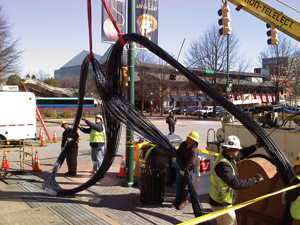

Municipal broadband networks have been gaining traction across the country. It's easy to see why: In many rural and low-income communities, privately offered broadband services are nonexistent. In its 2012 Broadband Progress Report the Federal Communications Commission counted nearly 20 million Americans (the vast majority living in rural areas) beyond the reach of broadband.
The Free Press' Timothy Karr's words are supported by the growing number of pins on our Community Network Map. We connect with places nearly every day where municipal networks fill the cavernous gaps left by the massive corporations. Large cable and telecom providers do not hide their aversion to servicing rural areas, yet year after year their lobbying dollars persuade state politicians to introduce bills to stop the development of municipal networks. Karr reviewed recent efforts to use state laws to stifle community owned networks in a Huffington Post article.
As readers will recall, this year's front lines were in Atlanta, where HB 282 failed. We hope that loss may indicate a turning point in advancing municipal network barriers because the bill lost on a 94-70 vote with bipartisan opposition. If it had succeeded, Georgia would have been number 20 on a list of states that, thanks to ALEC and big corporate sponsors like AT&T, Comcast, Verizon, and Time Warner Cable, have decided to leave their citizenry begging for the private market to come their way.
Time and again, the supporting argument goes like this:
"A vote 'yes' for this bill means that you support free markets and free enterprise," [Rep Hamilton, the Chief Author of HB 282] said [on the House Floor].
A 'no' vote means that you want more federal dollars to prop up cities, Hamilton said.
But Karr points out that some policy makers are starting to question that argument, with good reason. From his article:

"They talk about [the companies] as if they are totally free market and free enterprise, but doesn't AT&T get some tax breaks?" [Rep. Debbie Buckner] asked. "Didn't Windstream get some stimulus money? Isn't that government money?"
Indeed, phone and cable companies have been on federal welfare since their inception. A 2011 Institute on Taxation and Economic Policy study shows AT&T and Verizon receiving more than $26 billion in tax subsidies from 2008 through 2010. The FCC's 2012 report on Universal Service Fund subsidies shows nearly $3 billion in federal payments to AT&T, Verizon and Windstream.
In 2010, Windstream, Corp. -- a telecommunications company with services across the South -- applied for $238 million in federal stimulus grants to improve its service in 16 states. More than 16 million taxpayer dollars went to upgrade the company's services in Georgia.
So, while AT&T, Verizon, and Windstream continue to work with legislators and lobbyists who advance bills that maintain an environment rife with corporate welfare, rural Americans get nothing for their contributions. As the word spreads and more people learn about the benefits of community networks, we anticipate more people will recognize their value. In addition to saving public dollars, increasing connectivity, and spurring economic development, local networks are accountable to the communities they serve, unlike the big corporate ISPs, who are accountable to shareholders.
"The private companies have not been there for us," said Rep. Buckner, who represents rural parts of Talbot and Meriwether Counties. "And if they say they're going to come and be there for us, we don't know how long it will take them to find us."
Many complain about gridlock in Washington, DC, but I sometimes subscribe to the cynical counter-reaction that gridlock is great. It is when the Democrats and Republicans agree that Americans should beware.
Though this may or may not be true about politics, it is certainly true when applied to two of the most hated industries in America: cable television companies and DSL companies like AT&T. When they come to agreement, you can bet that prices are going up for the rest of us.
Unsurprisingly, the cable companies are thrilled at the prospect of limiting competition in communities by cutting off the ability of a community to build a network when the private sector is failing to meet their needs. From the 1st Quarter newsletter [pdf]:
The SCCTA has been actively following the AT&T-backed legislation that would amend the Government-Owned Telecommunications Service Providers Act. House Bill 3508 would impose the same requirements on government-owned broadband operations that are currently imposed on telecommunications operations.
Of course, H.3508 goes far beyond applying the "same requirements." It enacts a host of requirements that only apply to public providers, which are already disadvantaged by being much smaller than companies like Time Warner Cable and AT&T. We have long ago debunked the myth of public sector advantages over the private sector.
H3508, the AT&T backed legislation, has been our dominate piece of legislation in 2011.

Even after the bill was shelved for the year, it remained a high priority for the cable lobbyists (who, of course, need something to do while shmoozing at the capitol day in and day out) according to the 3rd quarter newsletter [pdf]:
The SC Cable Television Association will continue to work to move H3508...
And finally, in the 4th quarter [pdf], we get a sense that all that lobbying has been successful:
When session ended last year, the bill was in Senate Judiciary subcommittee (Sen. Luke Rankin – Chair, Sen. Brad Hutto & Sen. Paul Campbell). Our team of lobbyists have been working very hard meeting with members of the full Senate Judiciary Committee to move this important industry bill forward. As of writing this column, we expect new amendments dealing with Clemson’s Light Rail initiative and Orangeburg County. Our team has been assured the two counties who received the broadband stimulus funds, administered through the U.S. Department of Agriculture’s Rural Utilities Service, will NOT provide service in areas that is capable of receiving other broadband services. This bill is to be heard before full Senate Judiciary and will then head to the Senate floor.
Democracy in action! We know that the private sector will not create competition by itself. In fact, the future will be less competitive as cable systems generally provide faster connections than DSL and wireless, which will compete for those who don't mind slowly surfing.
South Carolina's businesses that want to thrive in the digital economy might consider looking at the nearby job-creator-friendly broadband networks in Brisol, Virginia; Danville, Virginia; Chattanooga, Tennessee; Salisbury, North Carolina; and Wilson, North Carolina. Those communities have the fastest connections in the US at the most affordable prices.
The Georgia Senate is considering SB 313, a bill that would overrule local decision-making authority in matters of broadband. Even as connections to the Internet have become essential for communities, the Georgia Legislature is poised to make it harder for communities to get the networks they need.
Community networks spur competition -- it is why Chattanooga got Comcast's xfinity service before Atlanta, despite Atlanta having long been prioritized over Chattanooga previously. It is why Cox Cable, which is headquartered in Atlanta, launched its upgrades in Lafayette, Louisiana -- they felt the competition pressure from a community fiber network.
"The private sector is handling this exceptionally well," Rogers said. "What they don't need is for a governmental entity to come in and compete with them where these types of services already exist. We're not outlawing a local government entity from doing this, but if they're going to compete, they can play by the same rules and ask the voters if it's okay before they go out and spend all these dollars."

As for whether the private sector is providing enough competition or high enough capacity networks, I leave that to individual communities to decide.
SB 313 effectively removes such decisions from local communities. It purports to just set additional terms that the public sector must meet, but many of these terms are sufficiently onerous (especially when taken all together) that communities will not be able to build the network they need.
The bill first requires communities to ask the private sector to build the necessary network. This ignores the basic fact that community networks are operated with different incentives that privately owned networks. Due to the scarcity in the market, private providers tend to keep prices higher than necessary to maximize their short term profits. Publicly owned networks lower prices (while still paying their costs) in order to spur job creation and increase digital inclusion.
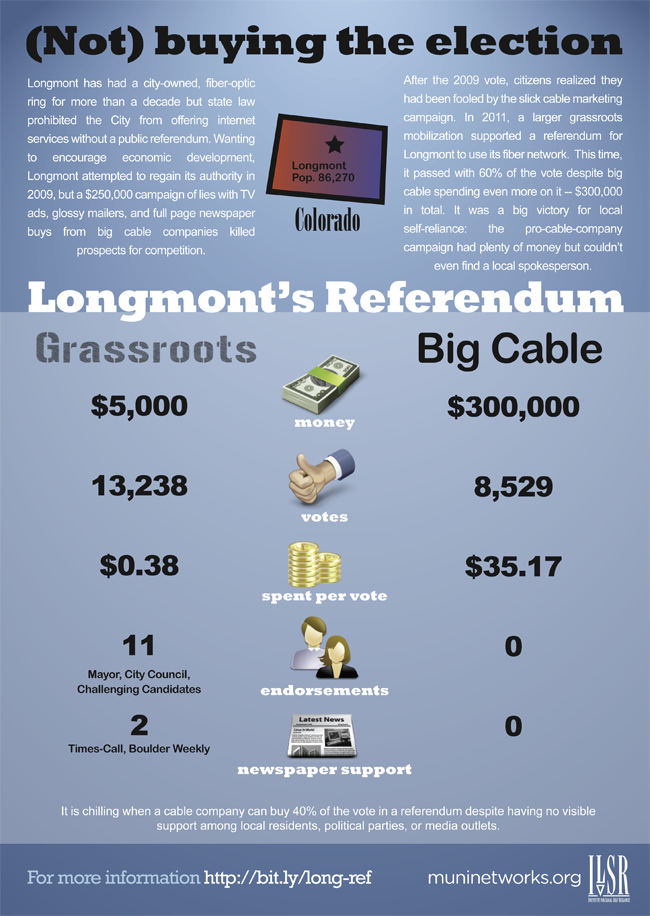
The bill requires communities to pass a referendum before building a network and requires inaccurate, damning language be included on the ballot. Broadband referendums tend to invite deep-pocketed incumbent providers to spend heavily to buy the votes necessary to stop competition - see the Longmont saga for an excellent example of how hard it is for a community to stand up to these big cable corporations.
Communities that somehow get this far are then subject to all the regulations as are private providers in addition to numerous additional regulations imposed on them by this legislation and their inherent duty to operate in an open and transparent manner. Despite being nonprofit, they are required to pay taxes and still face additional barriers that private operators do not.
They will be restricted in how they price their services and where they offer services in ways the private sector is not.
In short, this bill will make it all but impossible for communities to build networks -- even in areas that are presently unserved. The bill purports to exempt some unserved areas, but does so in a cynically evasive way. The only way a community could meet the unserved exemption is if it vowed to only build in the least economical areas -- meaning it would have to be significantly subsidized. Serving unserved areas and breaking even financially almost always requires building a network that will also cover some areas already served (because that is where you can find the margins that will cover the losses in higher expense areas).
The bill is presently in the Senate Regulated Industries and Utilities committee. We will continue covering it and attempt to learn which interests are pushing to revoke local authority and replace it with what distant legislators think best.
Whenever the discussion of public v. private arises, the focus is inevitably on the advantages that the public sector supposedly has over the private providers. We have documented these "level playing field" claims and refuted them.
When I recently visited Lafayette, the head of the public utility told me that in fighting the Local Government "Fair" Competition Act in 2005 (meant to prohibit competition against incumbent cable and phone companies) Lafayette hired one lobbyists and the incumbents hired all the rest. In Tennessee, Chattanooga hires one lobbyist to defend itself from many lobbyists -- in October I learned that AT&T has already registered 26 lobbyists for the 2012 session in Tennessee.
Not only do major national companies like AT&T already have most of the advantages in the marketplace, they spend mightily on lobbyists and campaign contributions to make sure it stays that way. One of the reasons I am an enthusiastic supporters of Larry Lessig's Rootstrikers campaign is because the power of big telephone and cable companies likes in their ability to influence policy and elections, not in the quality of their services in the marketplace.
Back to Public Knowledge -- they researched AT&T's push for th T-Mobile merger and found AT&T hired three former US Senators, four former House members, dozens of staffers from both parties, and spent over $40 million in advertising to push its bid to reduce competition in the wireless market.
“This information gives us a more complete picture of the vast lobbying and advertising resources AT&T has dedicated to trying to ram through this takeover,” said Harold Feld, legal director of Public Knowledge. “It is even more impressive that while many members of Congress have ignored the facts and are backing this takeover, the Justice Department and the Federal Communications Commission have not. It is clear that the data the DoJ and FCC have compiled on this deal will negate all of the money AT&T has spent to mislead policymakers and the public.”
How can it be that the big companies who deliver some of the most important services in our modern lives (access to the Internet, television) rank at the top of the most hated? Probably because when they screw up or increase prices year after year, we have no choice but sticking with them. Most of us have no better options.
But why do we have so few choices? Government-sanctioned monopolies have been outlawed since the 1996 Telecommunications Act. Unfortunately, the natural tendency of the telecommunications industry is toward consolidation and monopoly (or duopoly). In the face of this reality, the federal government has done little to protect citizens and small businesses from telecom market failings.
But local governments have stepped up and built incredible next-generation networks that are accountable to the community. These communities have faster speeds (at lower prices) than the vast majority of us.
Most of these communities would absolutely prefer for the private sector to build the necessary networks and offer real competition, but the economics of telecom makes that as likely as donuts becoming part of a healthy breakfast. In most cases, the incumbent cable and telephone companies are too entrenched for any other company to overbuild them. But communities do not have the same pressures to make a short-term profit. They can take many years to break even on an investment that creates many indirect benefits along the way.
One might expect successful companies like AT&T and Time Warner Cable to step up to the challenge posed by community networks, and they have. Not by simply investing more and competing for customers, but by using their comparative advantage – lobbying state legislatures to outlaw the competition. As we noted in our commentary and video last week, massive cable and telephone companies have tried to remove local authority to build networks.
These companies frequently claim they are at an unfair disadvantage when they have to compete against a broadband network owned by the local government. This claim resonates strongly with some politicians, particularly those who happen to receive a lot of campaign contributions from big telco and cable companies -- as recently demonstrated in Wisconsin. They say they just want a "level playing field."
We decided to take a deeper look. We compared Time Warner Cable to Salisbury, North Carolina -- which built one of the newest community fiber networks – to see who is at a disadvantage.
Big companies like Time Warner Cable have some big advantages over any community that decides to build a network. Of course, communities do not build their own networks on a lark, they do it because they need fast, affordable, and reliable networks for economic development and maintaining a high quality of life.
But a better comparison goes beyond simply the scale of the competitors in order to complete a more meaningful comparison. For that, we created our “Level Playing Field” video, attached below.
There should be no doubt that massive incumbent cable and phone companies have a monopoly on the “unfair” advantages in telecommunications. Fortunately, community networks have a host of local advantages and often superior technology with which to invest in the networks they need. The question is whether Congress and the states will protect the right of communities to choose for themselves if a local community network is necessary.
Access Wisconsin, a group of telephone providers working with AT&T to kill a network essential for schools and libraries across the state, claims that using taxpayer money is unfair competition. It is a fascinating argument from a collection of companies that rakes in various state and federal subsidies.
"This is by far the greatest assault we've ever felt from the University of Wisconsin Extension," said Mark Weller, president and CEO of Access Wisconsin, which represents 30 mostly small, rural telecommunications providers. "It's totally inappropriate.
"When services are available through the private sector at a competitive rate and we have to compete against yet another entity that is being funded by the taxpayers, that's just not fair."
“The Recovery Act grant will bring fiber optic broadband to areas where it would otherwise be too expensive to build. There aren’t enough customers to justify the cost of the investment without the help of these funds," Weller said. “The federal grant, along with a 20% state match, is providing the kind of infrastructure for rural schools and libraries that will meet their needs for decades.”
The new fiber optic broadband connections will provide new education and economic opportunities in 380 largely rural communities across Wisconsin. Schools and libraries in those communities will gain dramatically expanded telecommunications access, while the installation of new infrastructure will help make broadband access available for businesses and residents.
But that award fell through because AT&T and Access Wisconsin didn't read the rules. When they found that they had to share network assets built with all that free money, they balked and returned the money. Which means, hundreds of communities across Wisconsin don't have 'dramatically expanded telecommunications access.' In fact, hundreds of communities need better services -- services that Access Wisconsin readily admitted they cannot provide absent taxpayer subsidies.
So, when Access Wisconsin claims this week that:
"When services are available through the private sector at a competitive rate and we have to compete against yet another entity that is being funded by the taxpayers, that's just not fair."
They know very well that those services are not available through the private sector at a competitive rate.
But what about the argument that they should not have to compete against a network funded by taxpayers? Don't forget, that these same providers are always telling us about how much competition there is -- that is why they needed to be deregulated in Wisconsin a few months ago.
Professor Andy Lewis of UW Extension Service reminded me that at least 15 members of Access Wisconsin have received federal money through the Rural Utility Service for their networks. Isn't it then unfair for WISPs and other private providers to have to compete against Access Wisconsin members living off the public dole?
Make no mistake, Access Wisconsin doesn't want fair, doesn't care about fair, and wouldn't even know fair if it competed Access Wisconsin upside the head. Access Wisconsin wants to protect broadband scarcity because it allows them to charge rates above the cost of providing services. Under stimulus rules, the networks being built have to be available to all parties under fair terms -- so these are actually an opportunity for Access Wisconsin members to use better networks to expand their services!
Taking profits from de facto monopoly territories and dumping it into campaign contributions and lobbying to protect those profits is a no-brainer for profit-maximizing companies. What is curious is why Wisconsin would put up with a Legislature that envisions local schools and libraries as chum for telco sharks. What happened to fiscal responsibility? Schools and libraries need WiscNet and the broadband stimulus to operate efficiently and provide the best opportunities to their communities.
On June 1, the Information Technology and Innovation Foundation held an oxford-style debate over the proposition: "Governments should neither subsidize nor operate broadband networks to compete with commercial ones."
Jim Baller and I spoke against the proposition while Rob Atkinson and Jeff Eisenach defended it during the 2 hour, 15 minute session. I was unable to be in DC and thus participated by the magic of modern telecommunications.
This is a long but valuable and unique discussion. We left talking points behind, actually responded to the points raised by the other side, and presented both sides of this debate in a reasonable manner. In short, this is exactly the kind of discussion we would elected officials to consider before legislating on the matter. But it very rarely happens -- nothing even remotely close to it occured in North Carolina when Time Warner Cable pushed its bill through the Legislature to enact a de facto ban on muni networks in the state.
Sign up for a live webcast (or if you are in DC, please attend) of Jim Baller and Christopher Mitchell engaging in an Oxford-style debate on the subject of community broadband with Rob D. Atkinson and Jeff Eisenach on June 1 at 9:00 EDT.
The statement to be debated is: "Governments Should Neither Subsidize nor Operate Broadband Networks to Compete with Commercial Ones." Guess which side Jim and I will take?
At least once a week in my 48 months of public service, I was told by someone that the purpose of the Commission was to create a "level playing field." No one meant it. The proponents of this view wanted someone else to be burred under their "level" field. And I never believed our job was "leveling." Should a jury declare a defendant neither guilty nor innocent, but only express a neutral view?
Considering local ISP MStar is offering symmetrical 15Mbps service for $39.95 and symmetrical 50Mbps connections for $59.95 through Utopia, surely locals are happy that Qwest has spent so much time in the state protecting consumer interests. Qwest has done a particularly good job protecting consumers from the dangers of upstream speed.