Johnson City, Tennessee, is considering the pros and cons of expanding the fiber network its public electrical utility is installing to connect substations in order to improve grid reliability. They may follow the example of many other Tennessee public utilities that have offered broadband services to residents, creating competition in a sector sorely needing it.
They will need to speed the process along if they are going to get any stimulus money - many communities have been considering these options for longer and are ready with plans.
When Johnson City first considered connecting the substations, providers opposed it, afraid they would ultimately offer broadband services to residents. These providers said they already had fiber and would be happy to connect the substations at a "fraction of what JCPB [Johnson City Power Board] is about to spend."
Undoubtedly, they were comparing the costs of building a public network against the costs of leasing services for one year. Johnson City was smart to rebuff them and pursue owning the fiber - companies like Charter and Comcast don't make a profit by offering fair prices on connectivity (in fact, Charter is still bankrupt despite overcharging for its slow broadband speeds). Communities that own their fiber (regardless of whether they offer retail services to businesses and residents) find that they get better services at lower costs than when leasing connectivity.
These cable companies in Tennessee are brutal - they abuse the courts with frivolous lawsuits (that are frequently thrown out at the first opportunity) and invent data to suggest public ownership is a poor choice. Ultimately, Johnson City Power Board will have to choose what makes sense based on the numbers, not on fearmongering from companies that are just trying to protect high profits protected by a lack of competition.
Construction on a new city-owned fiber network in Cabot, Arkansas will soon bring affordable broadband access to every city resident and business in the state’s “Strawberry Capital.” The network comes courtesy of a partnership with Connect2First, the broadband subsidiary of local power company First Electric Cooperative Corporation, which continues to build on its significant presence across Arkansas.
Joplin, Missouri has announced a new broadband public-private partnership (PPP) with ALLO Fiber that should help boost competition and lower rates across the city of 52,000. The partnership poses a particular challenge to regional cable giant CableOne, which currently enjoys a monopoly over broadband access across a whopping 83 percent of the city.
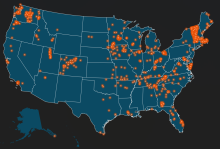
As the municipal broadband movement continues to gain momentum, here is a new fact sheet that highlights the dramatic surge in the building of publicly-owned, locally controlled high-speed Internet infrastructure. We also unveil a new map of municipal broadband networks across U.S.
Photo-filled look at the many days of prep and three days of immersive programming that went into creating Tribal Broadband Bootcamp 11 at RantanenTown Ranch.
The city-owned utility in Chicopee, Massachusetts has adopted the “fiberhood” approach to broadband deployment as it expands affordable access to city residents under the Crossroads Fiber brand. Chicopee Electric Light launched Crossroads Fiber in the summer of 2019 and since then the utility has been expanding access steadily to the rest of the city.
Westfield City Council votes to approve $11.1 million bond for a new athletic track and field at the local high school, thanks to the success of Westfield Gas & Electric’s broadband subsidiary Whip City Fiber. And though the return on investment may not be as eye-popping as the $2.7 billion Chattanooga's municipal network, EPB Fiber, has reaped in Tennessee, Westfield officials hailed the community investment as a “huge moment” for local residents.