
The following stories have been tagged muni ← Back to All Tags

Longmont City Council Approves Fiber Network

Longmont, Colorado, will move ahead with plans to offer fiber connectivity to the entire community. After presenting this business plan to the City Council, members voted unanimously on May 14th to support the measure. Scott Rochat from the Times-Call attended the meeting.

Residents stepped forward to express their opinions and all but one urged the council to "get it done."

From the Rochat article:

The plan projects a four-tier price structure. For residential rates, that's proposed to range from $39.95 a month for 10 megabit-per-second upload and download, to $99.95 for 100 mbps.

The study estimates that 35 percent of homes would choose to get their Internet service from the city, still leaving plenty of the field for the existing providers.

"Competition is good," Councilman Alex Sammoury said. "Just because we're a government entity doesn't mean the free market doesn't apply to us. If someone can do it better, more power to them."

The plan proposes to have the city provide Internet directly and work with a private partner for phone service.

Video service would not be provided, Roiniotis and the Uptown consultants said, because Internet video has eroded the market for traditional television.

Vince Jordan, LPC Manager, began the presentation and stressed economic development, education, and lifestyle.

Representatives from Uptown Services reviewed recommendations and the business plan. They answered about 3 hours of questions from council members, including skeptical members who want to avoid becoming the next Provo, Utah. Neil Shaw and Dave Stockton from Uptown Services provided some perspective between the two communities. They pointed out the large number of successful networks in states across the country.

Longmont had been prepared to incrementally expand the network using the cash on hand from the many years of dark fiber leasing. Such an expansion could be done without borrowing but would take a long time (more than ten years, likely) to get to everyone. This is the approach Danville, Virginia, has been using.

Instead, Longmont is now developing a plan to finance the rollout of the network to everyone over a few years, estimated to cost $41 million. A future discussion will examine whatever financing strategy is recommended and approve it before it can move forward.

To view the discussion, zoom ahead to about 14 minutes in to the video below.

Video: 
See video

Upcoming Broadband Communities Mag Issue Dedicated to Community Networks

We look forward to the next issue of Broadband Communities magazine, due on June 15th. This upcoming edition is titled "Fiber Nation: Are We At The Tipping Point?" and focuses completely on local communities that created their own networks.

Broadband Communities puts on the annual Broadband Communities Summit, which we just attended in Dallas in April. The magazine is free and features a lot of information useful to those thinking about building networks.

According to the announcement, you can subscribe now and have the issue delivered to your door and/or your inbox. The issue will include:

  • Annual Census and Analysis of Muni Networks
  • FTTH Deployments with Case Studies
  • Best Practices for Broadband Adoption
  • Deployment of Advanced Broadband on University Campus
  • Financial Modeling for Rural FTTH Builds
  • Economic Development and Broadband
  • Gigabit Communities - The Fast Few

Joanne Hovis on Business Plans for Municipal Fiber

Joanne Hovis, President of CTC Technology and Energy, recently published a must-read article in Broadband Properties Magazine. Whether you are a community leader investigating the possibility of a publicly owned network or an engaged citizen looking for pros and cons, this piece explains practical benefits succinctly. In her article, The Business Case For Government Fiber Networks [PDF], Hovis looks at life beyond stimulus funding. She points out how we should evaluate municipal networks in an environment where shareholder profit is not the first consideration.

Hovis gives a brief history of how local communities reached this point of need. As many of our readers know, local communities used to be able to negotiate with cable providers for franchise opportunities and rights-of-way. Often cable providers would construct broadband infrastructure in exchange for a franchise to operate in a given community, creating I-Nets for local government, schools and libraries. Once states inserted themselves into the process with state-wide franchising, local negotiating power evaporated. Many of those franchise agreements are ending and local leaders are considering municipal fiber optic networks.

Hovis stresses that municipalities do not function in the same environment as the private sector. While they still have a fiscal responsibility to their shareholders (the taxpayers) the main function is providing public safety, encouraging economic development, offering education, and using tax dollars to better the quality of life. Hovis describes how redefining return on investment (ROI) needs to go beyond the balance sheet bottom line. 

These benefits have nothing to do 
with traditional financial measures. Rather, they represent the return 
to the community in terms of such largely intangible societal benefits 
as enhancing health care quality, narrowing the digital divide, providing enhanced educational opportunities to school children, delivering job search and placement opportunities at public computer centers and helping isolated senior citizens make virtual social connections.

joanne-hovis.jpg

Even without the intangible benefits, Hovis argues the financial benefits to local communities cannot be ignored:

First, a government network can help avoid existing and future costs by replacing services for which the government previously paid third parties. Second, a network can bring revenues to a community, especially given new E-Rate regulations that make government networks eligible for subsidy if they serve schools and libraries. Together, these cost savings and revenue streams can add up to significant dollars – potentially to amounts that justify financing the necessary construction.

Hovis explains the economics of government need to lease circuits, an extremely lucrative practice for phone companies or providers. In addition to being expensive, Hovis notes they are often low-bandwidth. Hovis takes it one step further:

Build the network and you will shave this amount from your accounts payable.

In fact, because a government network can deliver far higher-capacity connectivity than the jurisdiction
 had previously leased, its value is even greater than simple cost avoidance. 
A government that owns a network 
can use inexpensive, off-the-shelf equipment to connect its facilities to one another at no cost for bandwidth (because the traffic is “on network”
 and not going out to the Internet). It can also deliver Internet connections to these facilities at a per-unit cost much lower than that of leased connections because it can aggregate the needs of all departments and purchase commodity bandwidth. This is particularly true for a jurisdiction that can develop a mutually beneficial partnership with a provider of wholesale bandwidth.

Considering the fact that capacity needs continue to grow, savings with a publicly owned next-generation network increase exponentially. Eliminating the need to lease now eliminates the need to lease more later.

Hovis also examines in detail the different ways municipal networks can provide revenue. She examines:

  • Dark or lit fiber to community anchor institutes (CAIs): We have documented hundreds of communities that lease dark fiber to CAIs and also to commercial customers. That list continues to grow.
  • Middle Mile Capacity: Providing infrastructure to private ISPs is more speculative, but encourages economic growth and provides connectivity to businesses and individuals who would not otherwise have it.
  • E-Rate Subsidies: As of September 2010, nonprofit and public networks are eligible for E-rate subsidies for providing broadband to schools and libraries. This potential source can contribute toward network self-sustainability.

The article also stresses one of the factors we find most compelling when considering investment in publicly owned networks - keeping local money in the local economy:

Circuits leased from a large national provider require the delivery of a big monthly check to a potentially far- away corporate entity, but monthly fees paid to a government-owned network stay in the community to be spent on other government services and to be multiplied when network employees go out to eat or spend money at other local businesses.

The concept of planning, financing, and building a municipal network is daunting to many communities; it should be a unique local decision. Few people have experience like Hovis, who does an excellent job of laying out critical considerations.

Businesses Lining Up for Service in Longmont, FTTH Build-Out Studied

In January, Longmont Power and Communications (LPC) announced they would begin connecting businesses located within 500 feet of the existing network. As we reported, local businesses were chomping at the bit to get hooked up and enjoy the high-speed next generation network. Even without efforts at marketing or advertising, more businesses have added themselves to the queue. LPC will present the formal business plan for expanding the network to the City Council on May 14th. Tony Kindelspire recently reported on the race to get on LPC's network in the Longmont Times-Call:

"We are bringing to council a business plan to build out all of Longmont," [Vince] Jordan, [Broadband Services Manager], said. "It's the whole enchilada."

The fact that there has so far been only limited rollout is due to economics. Currently, the installations are being paid for from a reserve fund that Longmont Power has built up over the years leasing portions of its fiber-optic loop to entities such as Longmont United Hospital and a third-party provider that services the school district. Those leases bring in about $250,000 annually, Jordan said.

For 2013, the Longmont City Council authorized LPC to use $375,000 of that reserve fund to begin connecting businesses and residents to the loop.

This model works, but does not connect everyone fast enough for their liking:

To expedite the build-out, extra up-front dollars will have to be allocated, but where those dollars will come from is yet to be determined, Jordan said, adding that ultimately, the decision will lie with City Council.

Map of Longmont Fiber Rings

Right now, Longmont will cover the initial cost of connecting subscribers except in cases of extraordinarily high cost cases. If it would cost $10,000 to install but the payback to the utility in 2.5 years is only $6,000, a customer would have to cover the $4,000 difference presently. While there are over 1,300 businesses with in 500 feet of the network, connection costs vary depending on proximity to roads, structures, and geography.

Jordan notes LPC's first priority is to boost economic development:

"We're really focused on economic development, so the ones that will put the most dollars (they save on broadband costs) back into their business, those are the ones we're working with first."

Businesses and organizations that are on the network appreciate fast symmetrical service, affordability, and the fact that they get service from the city rather than a commercial provider:

"I emailed Vince asking when I could get on," said Michael Jurey, network/telecommunication specialist for Longmont Clinic. "Luckily, the loop ran right by Longmont Clinic. On our side of the street no less."

Jurey said the city's network is three times faster than the speeds the clinic got before at a cost savings of $1,600 a month.

"We use it for two reasons," said one of the other three owners [of the Pumphouse, a restaurant and brewpub in Longmont], Dave D'Epagnier. "No. 1 is our business functions -- we process credit cards with it ... just normal day-to-day business activities. Plus, it's a big place, and we could have 50 customers that are using the broadband all at once."

The other thing that attracted him and the other owners was that the business was finally able to tap into the city-owned network after so many years of having to buy high-speed service from a commercial provider. And that is all thanks to the voters, D'Epagnier said.

According to a Scott Rochat article in the Times-Call, the business plan for a FTTH network to anyone in town is possible within three years with a $41 million investment. That plan eliminates the usual $500 - $15,000 hook-up fee:

 "We have to be competitive," said Tom Roiniotis, director of LPC. "None of the incumbents charge an install fee, so we won't as well."

Uptown Services prepared the business plan and included residential fees from $39.95 for 10 Mbps to $99.95 for 100 Mbps for Internet. Residential Internet would be symmetrical. Business rates would range from $49.95 for 20 Mbps/5 Mbps to $499.95 for 250 Mbps symmetrical.

100 Years of Longmont Power

If LPC wants to pursue a triple play offering, Uptown estimates it would cost another $6 million. At this point, LPC does not consider triple play a good investment:

"The young generation that's active now, they don't watch TV in the conventional way," Jordan said. At a recent presentation, he said, when he asked a college student how often he watched traditional scheduled TV programming, the response was "Never."

According to a survey conducted for the business plan, about 68 percent of respondents said they would either definitely or probably switch to the city for Internet service if it were cheaper than existing services. Only about 20 percent said they had a "triple play" or wanted it.

Uptown's estimates were based on a take rate of 35% and the business plan estimates a broadband utility to be in the black within four years and to pay for itself in ten years.

Possible funding mechanisms include:

  • Certificates of participation, using city property as collateral
  • A bond issue backed by sales tax
  • A bond issue backed by electrical revenue 
If the city council considers the plan favorable, it will go to the city finance department for more detailed review.

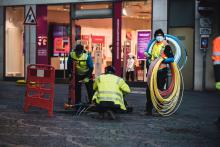
Here is a quick video from LPC, as technicians install connections at the Pumphouse:

New York Times on Internet in America, Genachowski Legacy

Eduardo Porter has an important column today in the business section of the New York Times, "Yanking Broadband From the Slow Lane." He correctly identifies some of the culprits slowing the investment in Internet networks in our communities.

The last two paragraphs read:

Yet the challenge remains: monopolies have a high instinct for self-preservation. And more than half a dozen states have passed legislation limiting municipalities from building public broadband networks in competition with private businesses. South Carolina passed its version last year. A similar bill narrowly failed in Georgia.

Supporting these bills, of course, are the nation’s cable and telephone companies.

Not really "supporting" so much as creating. They create the bills and move them with millions of dollars spent on lobbyists and campaign finance contributions, usually without any real public debate on the matter.

Eduardo focuses on Google Fiber rather than the hundreds of towns that have built networks - as have most of the elite media outlets. Google deserves praise for taking on powerful cable and DSL companies, but it is lazy journalism broadly that has ignored the networks built by hundreds of towns - my criticism of the press generally, not Eduardo specifically.

FCC Logo

The person who deserves plenty of criticism is former FCC Chairman Genachowski. From the article:

According to the F.C.C.’s latest calculation, under one-third of American homes are in areas where at least two wireline companies offer broadband speeds of 10 Mbps or higher.

We have 20 million Americans with no access to broadband. The rest are lucky to have a choice between two providers and even then, most still only have access to fast connections from a single provider.

When the National Broadband Plan was unveiled, we were critical of it and believed it would do little to improve our standing. Even its architect, Blair Levin, is annoyed at how Genachowski failed to implement even the modest proposals put forth.

Back in the NYT piece, we find this:

Mr. Genachowski contends that broadband deployment is on the right track. He points to the growing number of high-speed broadband deployments like Google Fiber and municipal projects around the country, as well as to AT&T’s announcement that it will expand the footprint of its U-verse network — the number of homes to which service is available — to 33 million. This uses fiber part of the way and, AT&T claims, can attain up to 75 Mbps.

Absurd. First of all, the supposed AT&T expansion is playing with numbers. If anyone actually gets U-Verse from this new deployment, it will be fewer than 1.5 million people but we really have no way of knowing because neither the states or the FCC really keeps track of these deployments. They just take AT&T's word for it.

As for 75 Mbps, talk about cherry picking data. Most people live far enough away from the DSLAM or have old enough copper wires that they will not even come close to that number. And this is only for downstream - the upstream capacity remains a fraction of that. This is a fantasy in a fantasy but these numbers are repeated by media sources because they come from AT&T.

I'm rather surprised Genachowski did not also take credit for AT&T's pretend fiber press release in Austin or the overblown CenturyLink pilot in Omaha. Communities engaged in the hard work of building a network received scant attention until they had a ribbon cutting where Chairman Genachowski would appear suddenly supportive and trying to take some measure of credit.

FCC Revolving Door

Genachowski likely felt more comfortable with AT&T, CenturyLink, and a few other big corporations because they share his preference for press releases rather than doing the hard work that needs to be done. We look forward to seeing which of these firms he joins as a lobbyist of some sort ... after a stint at a nonprofit to make it less obvious, of course. Wouldn't want to be as obvious as former FCC Commissioner Baker.

Lest I go too far in attacking our former FCC Chairman, we do remain thankful that once in awhile he did stand up the big corporations and meekly request a reasonable concession.. Most recently, he spoke out against legislation in Georgia to revoke local authority to build networks. For years, FCC Commission and acting Chair Mignon Clyburn has fought to preserve local authority and we were pleased to see her get some backup from the then-Chairman. He didn't actually use his power to actually do anything, but it was nice of him to think of us.

As we move forward with the new FCC under Chairman-nomineer Wheeler, we hope to see real progress on expanding fast, affordable, and reliable Internet access to everyone. Given his industry background, we cannot help but be nervous. And the utter disaster Obama has been for a public interest media and telecom agenda does not help either.

As this NYT article confirms, communities are smart to pursue their own strategies in solving this problem, not waiting for DC to sort anything out. And if DC can be bothered to take any action on telecom, it would be smart to start by removing barriers for communities that want to invest in themselves.

Community Owned Network in New Mexico Helps Save Lost Pets

We recently learned about Aztec, New Mexico's, free downtown Wi-Fi  so we decided to contact Wallace Begay, the IT Director, to find out more. This desert community of about 6,600 people not only offers the free service, but uses its fiber to serve government, schools, and even four-legged residents.

Begay tells us that in 1998 the city and school system coordinated to install the original fiber and the entities share ownership. The school wanted better, affordable connectivity for students while the city wanted economic development opportunities. Community leaders used E-rate funding and a Gates Foundation grant to construct the original fiber aerial route.

The town provides water, wastewater, and electric services through municipal utilities with its SCADA system. The public library and all ten Aztec Municipal School facilities connect to the fiber network. Municipal government facilities also use the network.

Even though the city is a co-owner, it took several years for municipal offices to get on the fiber network. Aztec City Council originally decided to install the fiber network as a way to bring in revenue by leasing dark fiber, not as a way to connect offices. When Begay started at the city in 2001, administrative offices still used dial-up connections. Twenty dial-up accounts (and the crawling speeds associated with them) added up to $500 each month.

At the time, Qwest (not CenturyLink) was the provider in Aztec and could only offer microwave or copper connections. Connecting 13 facilities at 1.4 Mbps would have cost the city $1,200 each month. Begay used $500 from the electrical enterprise fund to purchase equipment and pay for tech labor to move municipal offices on to the existing network. The city electrical enterprise fund pays for expansions and updates. The network is now about 12 miles.

Begay is especially pleased about the 2004 expansion to the Aztec Animal Control facility, serving all of San Juan County. Before the expansion, Animal Control also used dial-up and spent a significant amount of time fielding calls from worried pet owners. Now, when a new animal arrives it is photographed and vitals are posted online. Staff spends more time working with animals rather than answering calls and more pets find their way home. Begay says Aztec Animal Control also teams up with local animal shelters to share video of potential adoptees to expand adoption possibilities.

Map of Aztec, NM near Four Corners

In 2010, new City Manager Joshua Ray, embraced the idea of providing free Wi-Fi. From a 2011 Farmington Daily Times article:

"Aztec has possibly the best fiber infrastructure for Internet in the entire southwestern United States, so we decided to capitalize on it and build a citywide Internet connection," he said. "I'm hoping we can eventually light up the whole city with free Internet."

"In other cities, you have to go hunt down the Starbucks or McDonald's to get free Internet," he said. "We'll have it throughout the city, and I think that will be incredibly attractive to businesses and tourists. It will really improve the quality of life for our citizens and visitors, and I think it will be an economic driving factor for Aztec."

With a New Mexico Certified Community Initiative grant and additional funds from the city, Begay purchased the equipment for the Wi-Fi network for around $75,000.

There are 19 hotspots, mostly along the business corridor. Begay says the community is considering expanding the range to reach residential areas. 

Begay told us Wi-Fi users sign on for two hour time blocks to discourage "squatters." The Wi-Fi offers up to 11 Mbps and many businesses downtown use it for Internet access and simple applications. They also appreciate the ability to offer access to patrons. Entrepeneurs in Aztec often contact the city to find out details about the Wi-Fi signal when choosing a location for a new business. Aztec sponsors several large outdoor festivals in Minium Park and the city provides free day-long access so vendors can serve customers and increase sales.

The city still intends to offer commercial dark fiber leasing and is vetting technical and legal requirements. Begay estimates Aztec will have pieces in place within three months and will be ready to sign up its first customer.

Tullahoma, Tennessee, Latest Inductee to the 1 Gig Club

In 2008, the Tullahoma Utilities Board in Tennessee, created LighTUBe. In addition to attracting employers, the FTTH network connects residents and provides smart meter capability. The network now offers 1 gig service to business and residential customers.

Andrea Agardy, from the Tullahoma News, covered the story. Residential customers who now purchase the highest tier, 300 Mbps, will be automatically upgraded at the same $300 monthly rate. LighTUBe will provide 1 gig business connectivity on a case-by-case basis.

Brian Skelton, General Manager, said:

“It shows that we can provide anything they want,” he said. “The TUB board made the decision to build a fiber to the premise system for economic development reasons, and it is paying off for our community. We want to make Tullahoma a much more desirable location for technology companies to locate, due to our ultra-high speed Internet and our highly skilled workforce. Tullahoma is light years ahead of most cities in the United States with the ability to offer these incredibly fast Internet speeds, and we look forward to the benefits this will bring to our city.”

Kudos to LighTUBe and the community of Tullahoma!

Palo Alto Dark Fiber Brings $2.1 Million Per Year, Expansion Plans Developing

The city owned dark fiber network in Palo Alto is bringing in a steady stream of revenue that may lead to better connectivity for the entire community. According to a Gennady Sheyner Palo Alto Online article, the Utilities Department recently reported to the City Finance Committee that the city Fiber Fund yields $2.1 million per year. The revenue comes from dark fiber leases to approximately 80 commercial customers. From the article: 

Viewed as a risky investment two decades ago, the fund has in recent years become a plump cash cow. According to a new report from the Utilities Department, its reserves stand at $14.6 million in the current fiscal year and are expected to nearly double by 2018. [emphasis ours]

Commissioners want to get back to the idea of a city-wide FTTP network to serve residents and spur economic development. The city is now working with the school district on a possible expansion to all local schools. 

In his February March State of the City address, Mayor Greg Scharff declared 2013 as the "year of the future," describing fiber as "the key to assuring Palo Alto's long-term position as the Leading Digital City of the Future."  This year the City Council made "technology and the connected city" a priority.  Also from the article:

Commissioner Jonathan Foster noted that the idea of a citywide fiber network has been floating around Palo Alto for many years and said his views on the project have changed since last year, partly because of the council's new attitude about fiber. Before, when economics were the main driver of the conversation, he was more or less neutral, Foster said.

"Now, my approach is -- let's find a way to make this happen," Foster said. "I'm not sure we'll get there but let's come back with the best proposal we can," Foster said.

Commission Chair James Cook voiced a similar sentiment.

"I think this is probably a good idea whose time has finally come," Cook said. "Maybe now it's just gotten the right kind of momentum."

We spoke with Josh Wallace from Palo Alto Utilities in Episode 26 of the Comunity Broadband Bits Podcast. He shared details about the city's commercial dark fiber network. Durango, Colorado and Staunton, Virginia have also turned fiber assets into revenue and provide reasonably priced access to local businesses. As more communities see the benefit, more offer dark fiber leasing.

Dark fiber tends to be useful only to a minority of tech-savvy businesses but it can form the backbone of a future network and rarely encounters regulatory restrictions.

Opelika, Alabama, Testing New Fiber Network

We spoke with Opelika Mayor Gary Fuller in episode 40 of the Community Broadband Bits podcast and learned all about the community's FTTH project. Local residents and businesses decided to go beyond the substandard services they received from Charter Cable and build their own municipal network. At the time of the interview, Opelika Power Services (OPS) was well into construction and is now testing the network, according to an article in the article in the Opelika-Auburn News.

Steve Harmon, director of OPS, said there are between seven to eight test sites in the city that are basic residences receiving these services. Throughout the trial run, OPS will monitor what services are working efficiently and which ones have problems that need to be fixed.

“We’re getting feedback from those people and we are working on fine-tuning the system’s channel configurations,” Harmon said.

As this stage, test sites do not have telephone capability, which will be part of triple-play service from OPS. Harmon noted that service will not be offered until all issues are resolved. That being said, OPS expects launch to be in late spring or early summer.

The community faced one of Charter's misinformation campaigns, but citizens still approved a referendum to bond $41 million for the network and smart grid project. Since then, Opelika has moved forward steadily with network construction and construction of a network hub facility

From the OPS News website:

“This is a most exciting time in the life of our community.  Opelika is about to become the first city in Alabama to have fiber to the user.  Very soon we’ll fully deploy smart grid along with telecommunications that include video (cable TV), ultra-high speed internet and telephone service.  The future is bright for Opelika.” 

In Kansas, Ottawa Launches Own Fiber Optic Network

Ottawa, located in east central Kansas, recently launched its own municipal fiber network. The community of 13,000 in Franklin County watched nearby Chanute build and establish its own broadband utility. Ottawa plans a similar incremental strategy. Both communities boast strong farming traditions and host industrial employers that could not get what they needed from the existing providers.

I spoke with Chuck Bigham, IT Director for the City of Ottawa, who gave me some nuts and bolts on the network. I also touched base with City Manager Richard U. Nienstedt, both are heavily involved in the establishment of the network.

Like in Chanute, local leaders have long nourished a vision for better connectivity. In recent years, they realized the vision was not only attainable, but necessary for the community to thrive.

Approximately seventeen miles of fiber, installed by USD 290 and Franklin County in the 1990s, was already in the ground when the project began. Students and staff connected to the Internet and linked the 8-10 school district facilities via its fiber network. These pre-existing resources became the backbone of Ottawa's new utility. Cooperation between the City Municipal Utility, USD 290, and Franklin County facilitated the configuration of the new network. Ottawa now provides business Internet access, expanded educational opportunities, and a higher level of service than was previously available.

Two years ago, the City and its Chamber of Commerce reached out to major businesses to determine the need for broadband. They found businesses in Ottawa were connected through existing providers, but were unhappy with price and level of service. The community's industrial park seemed especially disadvantaged. Businesses needed better upload speeds than the existing T1s, which ran up to $600 per month. While DS3 connections were available, they were unaffordable and there was no level of service between the two options. Businesses could not convince AT&T to offer something they could afford and, as Bigham noted, the telecom giant appeared to be "milking the cow."

Map of Ottawa, Kansas

This is a common complaint among communities - the big national telephone and cable companies often refuse to upgrade their level of service because the lack of alternatives for local business connectivity means the firms cannot switch away from the existing provider.

The City approach USD 290 and Franklin County and proposed a partnership. The City would use several available fibers on the existing infrastructure to serve as the community network backbone. The School District and the County would still own the fiber asset already in place, while the City would own any added segments and the routers and switches to make it work. The City and its utility would support and manage the network 24/7. The school board and county commission approved the proposal in the fall of 2012.

The School District now pays the City $3,000 per month with monitoring and network support from the City all day, every day. USD 290 gets double the bandwidth it used to get from AT&T, when it paid nearly $6,000 per month for a DS3 connection. Paying less, but getting double, seems like a very smart investment.

Ottawa followed Chanute's example by providing a floor instead of a ceiling as the foundation for service. In other words, customers contract for minimum capacity but are allowed to burst to whatever capacity is available at any given time. For example, the School District will soon connect with a minimum 250 Mbps with the ability to burst to 500 Mbps.

Over the course of ten years, Ottawa has spent less than $500,000 on its next-generation community owned network. All the revenue from the network goes back into maintenance and upgrades. City government facilities and two electric substations, which used to connect only to each other, now link to the main power plant via fiber.

Neosho Community College's Ottawa Campus connects to the network. Ottawa Cooperative Association recently joined the network to take advantage of the fast upload speeds needed to send data rich reports and get timely information on grain prices. The Coop previously had a slower DSL connection. Bigham and Nienstedt both expect to see more business customers when the network expands to the Northeast Ottawa Industrial Park, the next expansion project.

Nienstadt tells us via email:

Our main emphasis has been to use it [the network utility]  as a recruiting and retention tool and be able to say that, "We have your broadband needs solved and you do not have to worry about that issue when locating in Ottawa, Kansas."  Most assuredly, some of the businesses have been able to benefit from lower broadband costs since we  started surveying and talking about a fiber optic utility.  That, quite frankly, was one of our goals.