Image


Fast, affordable Internet access for all.
Back in January, Colorado Springs Utilities (CSU) announced it was going to begin building a city-wide, open access fiber network owned, and that Ting would be its first anchor tenant. Construction of the network is expected to begin in the third quarter of this year, with a target completion date of 2028 (originally planned for fifteen years). The network will provide multi-gigabit service to roughly 200,000 homes as well as city businesses and anchor institutions. It’s still early in the process, but projections at the moment have the utility spending $45 million to $100 million a year for the next six years to complete the project. The first phase will see 225 new fiber route miles laid.
CSU Has Long Used Fiber
For thirty years CSU has built fiber across Colorado’s second-largest city. CSU’s dramatic expansion of this existing network directly benefits the utility by reducing overall costs, improving infrastructure monitoring, and boosting overall utility network resiliency. And it all will come with no rate increases to CSU electric customers.
But the company’s decision to lease access to this fiber expansion also directly aids the local community by lowering consumer utility costs, and delivering universal, affordable, high-speed Internet access. It’s a significant boon to Colorado’s second largest city that’s now an attractive, high-tech growth market.
Since 1972, the Fort Pierce Utilities Authority (FPUA) has provided gas, electric, water, and natural gas services to Fort Pierce, Florida and surrounding areas. Now, inspired by efforts in cities like Chattanooga, the utility hopes to leverage that expertise to deliver affordable fiber Internet access to the city’s 45,000 residents as part of a significant expansion of its internal fiber network.
Building on Its I-Net
Since the early 2000s, FPUA has deployed 110 miles of optical fiber via its FPUAnet Communications division. Initially, the project focused on bringing ultra-fast fiber broadband to large businesses, schools, hospitals, and other community anchor institutions.
In 2018, the city decided to expand its footprint to boost the local economy and cement Fort Pierce’s future reputation as a smart city of the future. First by upgrading the company’s existing utility systems (connected to 30,000 existing customer energy meters), then by utilizing that access to drive expanded fiber connectivity to smaller business and residential customers alike.
“We wanted to look at what we can do, and what are the needs in the community,” Jason Mittler, FPUAnet manager told me. “We have other local competition…Comcast, AT&T are competitors in the area. But in the realm of symmetrical speeds, no one really offers it.”
Fort Pierce certainly isn’t alone in that regard. Even the notoriously inflated FCC data indicates that most U.S. communities rarely have access to symmetrical speeds of 100 Megabits per second (Mbps) downstream and faster, and competition at those speeds is largely nonexistent. Addressing this market failure created an obvious business expansion opportunity for FPUANet that would not only bring additional value to its existing utility customers in the form of improved reliability and cost savings, but improve regional connectivity while keeping those dollars local

With the pandemic-induced rise in remote work, distance learning, e-commerce, and telehealth, a new report published by the Urban Land Institute (ULI), sheds light on how the demand for high-speed Internet connectivity has “helped shift the real estate industry itself from thinking just in terms of physical space to also considering how to engage within a virtual environment.”
The ULI report, Broadband and Real Estate: Understanding the Opportunity, identifies the challenges and opportunities in addressing the digital divide and how real estate professionals and land-use planners can play a central role in designing and deploying broadband networks to meet the growing connectivity needs of communities everywhere.
The report explores four instances when community planners placed technology at the forefront of their development projects and details the positive impact it had on the projects -- from a neighborhood in Washington that designed its fiber-to-the-home network with an emphasis on sustainable development and energy efficiency, to a business and tech hub in Northern Virginia, whose owner purchased seven blocks of CBRS spectrum in 2020 to accelerate the deployment of 5G in the area, establishing it as a center for innovation.
Broadband and Real Estate [pdf] also provides guidance on how real estate planners and professionals can be pivotal in creating more equitable and competitive Internet access ecosystems. For example, the report recommends owners of multifamily properties, or MDUs, install carrier neutral wiring sets to each unit, so MDU residents always have a choice among broadband service providers. The report states owners of MDUs should own all of the Internet infrastructure in their building themselves, so it is independent and the property can not be monopolized by a single Internet Service Provider (ISP).
Some key takeaways from ULI’s Broadband and Real Estate report are:
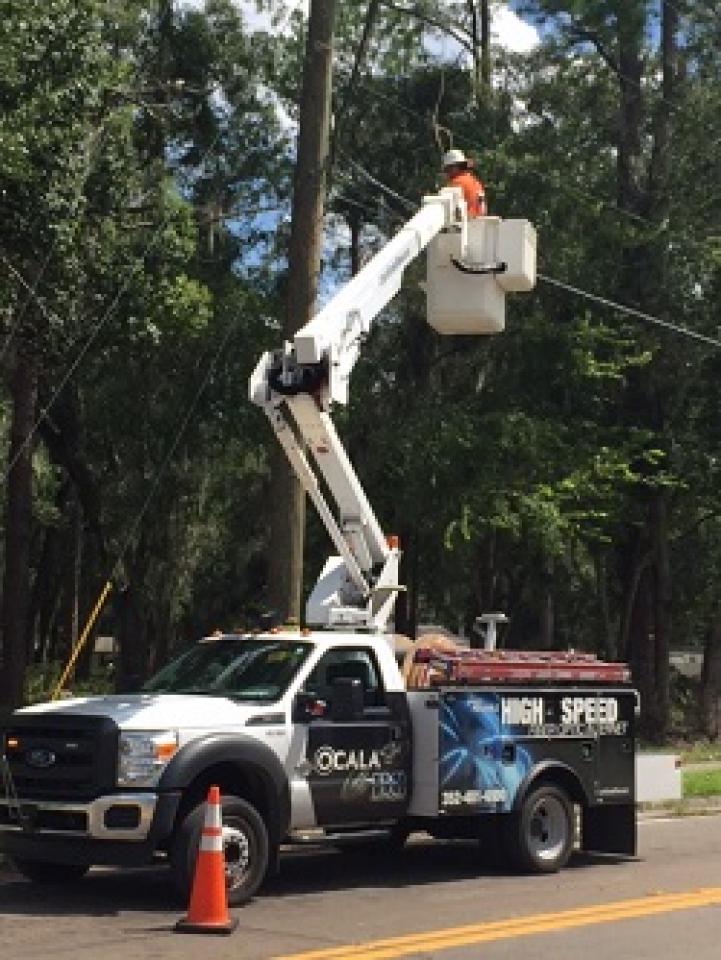
Even before the central Florida city of Ocala in Marion County became officially known as “The Horse Capital of the World,” the city – home to 61,810 Floridians and over 1,200 county-wide horse farms – was already galloping toward high-speed Internet connectivity. In recent years, the Ocala Fiber Network (OFN) has expanded into offering residential service, trotting carefully towards a citywide fiber-to-the-home (FTTH) finish.
It began in 1995 with the Ocala municipal electric department upgrading its substation monitoring (SCADA) system, which has been estimated to have saved the city $25 million in networking costs since. Over the past two years, OFN has extended the network to bring affordable, reliable, high-speed Internet service to city residents, neighborhood by neighborhood.
While the municipal network has been providing high-speed Internet service for the past decade to area businesses, healthcare facilities, community anchor institutions, and schools throughout the county, OFN launched residential service in 2019 and is now serving 2,500 residential subscribers in four city neighborhoods.
“We did four pilot neighborhoods. Our target goal was to have a 30 percent take rate in each neighborhood. In the largest neighborhood (the Highlands neighborhood) with a thousand homes, we have a 42 percent take rate. We still have a challenge in one neighborhood (Happiness Homes) with about a 10 percent take rate that we think is mostly an educational challenge,” Ocala Fiber Network Director Mel Poole told us in a recent interview.
Image

For the past several years the Knoxville Utilities Board (KUB) has been considering whether to add high-speed Internet service to its portfolio of offerings after nearly a decade of the region’s residents and businesses being plagued with the poor connectivity served up by incumbent providers.
Now, with the Tennessee Valley Authority (TVA) and the state Comptroller’s office having earlier this spring approved the Knoxville Utilities Board (KUB) business plan [pdf] to build a fiber network, the city-owned utility recently cleared the final hurdle needed to move forward with the massive project.
Unanimous Approval from Knoxville City Council
Two weeks ago, the Knoxville City Council unanimously approved the KUB Board of Commissioners proposal to build a fiber-to-the-home (FTTH) network in one of the Volunteer State’s largest metro areas. Network construction is expected to cost $702 million and take seven to 10 years to build out, reaching 210,000 households across KUB’s 688-square-mile service area spanning Knox, Grainger, Union, and Sevier counties.
Once the network is complete, it will not only be the largest community-owned network in Tennessee – surpassing the size of EPB Fiber in Chattanooga, which served as inspiration for KUB officials – it will also be the largest municipal network in the nation.
“Now that the approval process is complete, our focus has shifted to deploying the infrastructure and implementing the processes and systems that allow us to deliver quality services to our customers. We will be providing regular updates to our customers as we make progress,” KUB officials wrote in a prepared statement to Knox News.
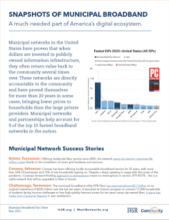
Municipal networks in the United States have proven that when dollars are invested in publicly owned information infrastructure, they often return value back to the community several times over. This new fact sheet [pdf] highlights municipal broadband success stories from across the country and some of the many benefits the networks have brought to the communities they serve.
These networks are directly accountable to the community and have proved themselves for more than 20 years in some cases, bringing lower prices to households than the large private providers. Municipal networks and partnerships account for 9 of the top 10 fastest broadband networks in the nation.
Download Snapshots of Municipal Broadband: A Much-Needed Part of America's Digital Ecosystem [pdf] here.
For timely updates, follow Christopher Mitchell or MuniNetworks on Twitter and sign up to get the Community Broadband weekly update.

Baratunde Thurston hosted Bruce Patterson on the most recent episode of his podcast How To Citizen. The episode is a deep dive into the consequences of a lack of competition in Internet access, and how the city of Ammon on stepped up to meet the challenge. Baratunde talks with Technology Director Bruce Patterson about how he got into this space, how the project got started, and the wealth of positive outcomes it has help drive for the community.
Listen here, then watch the video below on how the network is saving money, creating competition for broadband services, and creating powerful new public safety applications.
For timely updates, follow Christopher Mitchell or MuniNetworks on Twitter and sign up to get the Community Broadband weekly update.
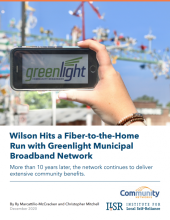
Built in 2008 with an eye toward the future and operated with local priorities in mind, Greenlight has a long track record of putting people first. In a new case study, the Institute for Local Self-Reliance explores the wide-ranging community benefits of Greenlight, the city-owned Fiber-to-the-Home network in Wilson, North Carolina.
Download Wilson Hits a Fiber-to-the-Home Run with Greenlight Municipal Broadband Network.
The case study details how it has been able to quickly adapt and expand service during the pandemic, as well as the host of advantages and overall value brought to the city over the last decade in education, equity, and economic development. For example:
Access for All
Economic Development
Education
In a new case study, the Institute for Local Self-Reliance explores the wide-ranging community benefits of Greenlight, the city-owned Fiber-to-the-Home network in Wilson, North Carolina. The case study details how it has been able to quickly adapt and expand service during the pandemic.
Built in 2008 with an eye toward the future and operated with local priorities in mind, Greenlight has a long track record of putting people first. A few examples are:
Access for All
Economic Development
Education
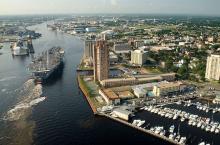
Portsmouth, Virginia, recently announced that they intend to invest in fiber optic infrastructure to reduce telecommunications costs, encourage economic development, and keep the city competitive in the region. The project is also part of a regional effort to foster economic development in the Hampton Roads metropolitan area.
In the April press release, the city announced that the project will include a 55-mile fiber optic ring around the city that will connect municipal facilities and anchor institutions. The plan will use a five-year multiphase approach for the estimated $9 million capital project and construction is likely to begin this summer.
According to city CIO Daniel Jones, costs for the first year will come in at around $2.7 million. Portsmouth is currently reviewing bids for the project.
Significant Savings
Portsmouth CIO Dan Jones noted, “Right now, Portsmouth is internet carrier dependent. The broadband network will improve municipal operations at a substantial cost savings.”
Last year, the city adopted a Fiber Master Plan, which analyzed potential cost savings, should Portsmouth choose to invest in its own Internet network infrastructure. Consultants estimated that the city and public schools spend more than $1 million on connectivity costs per year for municipal facilities, schools, and public libraries. The community’s schools’ telecom expenditures are almost $638,000 per year; libraries spend around $29,000 per year. Portsmouth schools receive an 80 percent reimbursement from the federal E-rate program, which allows the school system to receive a subsidy of more than $510,000 annually. Portsmouth plans to use E-rate dollars to help fund network construction in areas where it serves school facilities.