Image


Fast, affordable Internet access for all.

Last November the LA County Board of Supervisors quietly and unanimously approved a project that could dramatically reshape affordable Internet access in the largest county in the United States. While success will require coordination at an unprecedented scale to avoid the mistakes of the past, this new effort has momentum and funding options on its side.
The newly approved plan first aims to deliver wireless broadband to the 365,000 low-income households in Los Angeles county that currently don’t subscribe to broadband service, starting with a 12,500 home pilot project. But the vote also approved a new feasibility study into a Los Angeles county-wide municipal fiber network.
The motion tasked the LA County Internal Services Department, directed by Director Selwyn Hollins, with coordinating the effort. Hollins in turn is working with the City of Los Angeles’ Bureau of Street lighting (which had already received a CBDG grant to help fund local Wi-Fi networks) and other regional city agencies already engaged in digital divide efforts.
Sources familiar with project planning say it’s too early to specify pricing and speeds, but one goal is to be able to provide symmetrical 100 Mbps service for $30/month. As with other communities (like Fort Pierce, Florida), the county then hopes to layer on the $30 discount from the FCC’s Affordable Connectivity Program to ensure costs are negligible for low income residents.
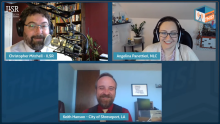
On Episode 19 of the Connect This! Show, co-hosts Christopher and (a partly there) Travis Carter (USI Fiber) are joined by Keith Hanson (Shreveport, Louisiana Chief Technology Officer) and Angelina Panettieri (National League of Cities) to talk about how some cities place themselves at the vanguard of innovation by undertaking projects designed to improve local conditions using existing infrastructure and know-how. Keith shares Shreveport's efforts to map the digital divide by connecting low-power computing devices to GPS sensors and cell phone batteries on garbage trucks to map broadband access across the city. He also talks about other edge computing initiatives, like video for public safety.
The group also discusses the newly released Treasury rules on the $10 billion in infrastructure funding coming down the pipeline, and how cities can position themselves to take advantage.
Subscribe to the show using this feed, or visit ConnectThisShow.com
Email us broadband@muninetworks.org with feedback, ideas for the show, or your pictures of weird wireless infrastructure to stump Travis.
Watch here, or below.

On Episode 19 of the Connect This! Show, co-hosts Christopher and Travis Carter (USI Fiber) are joined by Keith Hanson (Shreveport, Louisiana Chief Technology Officer) and Angelina Panettieri (National League of Cities) to talk about how some cities place themselves at the vanguard of innovation by undertaking projects designed to improve local conditions using existing infrastructure and know-how. For instance, in this episode of the show, Keith will share Shreveport's efforts to bridge the digital divide: an initiative driven in part by connecting low-power computing devices to GPS sensors and cell phone batteries on garbage trucks to map broadband access across the city.
The group will also discuss the newly released Treasury rules on the $10 billion in infrastructure funding coming down the pipeline.
Join us for the live show Thursday, September 23rd, at 5pm ET.
Subscribe to the show using this feed, or visit ConnectThisShow.com
Email us broadband@muninetworks.org with feedback, ideas for the show, or your pictures of weird wireless infrastructure to stump Travis.
Watch here, or below.
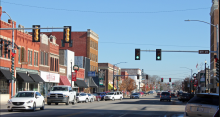
Ponca City, Oklahoma (pop. 24,100) sits in the north-central part of the Sooner State 100 miles north of Oklahoma City. Its history as a community built and shaped by the oil town looms large, from the E.W. Marland Mansion which still stands as a testament to the efforts of the oil baron who helped build the city in the first decades of the 1900s, to the Conoco Museum which offers residents and tourists a look at the history of the corporate giant which emerged in the latter half of the twentieth century.
But today, instead of pumping petroleum in the name of keeping the local economy strong, officials are broadcasting bytes to residents, business, government facilities, and community anchor institutions via their new municipal fiber utility: Ponca City Broadband. The project, which left its pilot phase two years ago in July, has passed the halfway point of a full greenfield overbuild which will see more than 400 miles of new fiber pulled to build the citywide network as it aims for completion in late 2022.
A Wired Upgrade
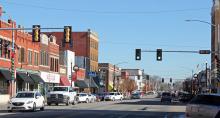
Ponca City, Oklahoma, is a small community of about 24,000 just 30 miles off of I-35. Although known for its history museums, Ponca City also has a rich history in its publicly owned network. The city was one of the pioneers of citywide Wi-Fi in the 2000s, and now they are embarking on a Fiber-to-the-Home (FTTH) project. Construction on the first phase of the network will be complete with customers online by mid-July. We spoke with David Williams, the Director of Technology Services, to learn more about Ponca City’s project.
The First Phase
The first phase of the new FTTH network is a small section of the city, a 1 mile by 1.5 mile rectangle bounded by Bradley Avenue, Highland Avenue, 14th Street, and Union Street where the city is primarily deploying aerially on poles. The entire city is only about 20 square miles and the entire network for the city will eventually be a mix of underground and overhead deployment, matching the municipal electric network infrastructure.
The engineering estimate for the first phase puts the cost at approximately $3.5 million. The city estimated how many people will sign up for service (the take rate) very conservatively and is on track to meet its target number.
 Williams said they chose to focus exclusively on Internet service and will have no data caps or subscriber contracts. There will be an activation fee with two payment options: a one-time payment of $200 or $10 per month for 24 months.
Residents can choose from three speed tiers — all are symmetrical:
Service for businesses will also be available; rates are available on a case-by-case basis.

If you're looking for a resource that focuses on wireless connectivity, check out the MuniNetworks.org Wireless Page. Rather than an exhaustive list of every municipal wireless (muni-wireless) project, we've created an introduction to the potential of wireless technologies. Explore commonly held misconceptions about wireless, gain a better understanding of spectrum, and learn how cities have built wireless projects.
Why Wireless
We invite you to use this resource when considering whether a wireless project is right for your community. Some communities have used wireless service as a temporary solution before building fiber networks while others have used it to improve connectivity in their downtowns or during special events. Wireless service has potential to provide needed Internet access, but it is still not a substitute for high-quality wireline service.
These technologies improve and change rapidly over the past decade, and we will update the page periodically as they continue to evolve. To that end, we have included boxes with links to more information for in-depth reading. In particular, we invite you to read the Moving Forward section, which highlights possibilities for the future of wireless in both rural communities and urban areas.
If you have additions, corrections, or comments, please let us know at broadband@MuniNetworks.org.

Seattle has received a lot of attention as it's struggled with the concept of a community network, but people in the small community of Brinnon are moving past the talking phase. A group of residents are tired of waiting for high quality Internet access and don't expect a national provider to bring it to them any time soon. People in Brinnon are considering a fixed wireless approach pioneered in the San Juan Islands, which is a few hours north.
Community members have formed a nonprofit, West Canal Community Broadband Project, to bring wireless Internet service to the town and neighboring communities. Two hundred people have already signed up on the nonprofit’s website.
The community is located about 25 miles due west (62 miles by car to get through the Sound) and home to about 800 people. People in Brinnon with the best connections have DSL, but many use satellite or mobile Internet access. Data caps associated with satellite and mobile plans drive up the costs and neither source is reliable. With such a small population, the locals don't expect any incumbent investment soon; they're exercising their self-reliant muscles and hashing out the details of better local connectivity on their own.
If all goes as planned, Brinnon could see better Internet access options by next summer.
Very Little Connectivity
The community center and the school have high-speed Internet service thanks to a federal grant project in Jefferson County, but residents and businesses struggle to connect.
The goal of this wireless project is fast, reliable Internet service without data limits for both business and residents. The residential download speed will be 25 Megabits per second (Mbps), and business connections will have speeds of 50 Mbps. Customized plans with speeds of up to 250 Mbps will also be offered. No word yet on expected upload speeds. The cost for each tier of service has not yet been decided.
The DIY Wireless Project

Residents and businesses in the rural Massachusetts Town of Greenfield are in the process of gaining faster and more affordable Internet service thanks a new municipally-owned hybrid fiber-wireless network. In November, more than 80% of voters passed a ballot referendum to authorize the city to create a nonprofit entity to construct and operate the network.
While scheduled completion is not until spring 2017, some customers will be able to start service during the network’s construction period starting in July. Thanks to the Greenlight pilot program, customers and network operators are already experiencing the new service. Upon completion of an engineering study to iron out the precise plans for the network, the city will start construction of the 80- to 100- mile fiber network. There will be as many as 1,000 wireless access points.
How Does it All Work?
Residents and businesses seeking the fastest available connection to the network will install an antenna on their property. Although prices for the antenna-based service have not yet been determined, the likely base charge for a symmetrical 25 Megabits per second (Mbps) connection will be $29.99 per month. The city expects to offer speeds as fast as 1 Gigabit per second (Gbps). The network will provide Internet, telephone service, and possibly video.
Customers seeking basic Internet access will be able to connect directly to the access points from their personal wireless devices for as little as $9.95 per month. A consultant for the project said that low income residents in the city may be able to get almost free access to this lowest tier plan after reimbursement through Lifeline, an FCC program that provides a subsidy to all low income Internet users.
The town is providing an upfront loan from the general fund of $5 million to pay for the network. Prices for access to the network may decrease as new customers sign up and revenues grow. Eventual profits from the network could also go back into the town’s general fund to spend down the initial loan.

The early 2000s created a boom of both public and private wireless projects throughout the U.S., but many struggled with unrealistic expectations and flopped. Successful muni wireless networks transformed themselves, adapting to the changing needs of the communities. Some, such as Sandy, Oregon, have transitioned to Fiber-To-The-Home (FTTH) networks where the high-speed fiber-optic cable is hooked up directly to the home. Others repurposed their networks to provide other needed services -- like in Lompoc, California.
Lompoc transformed its $4 million muniwireless network, LompocNet, into a full-fledged Broadband Utility. Originally, the city council hatched the idea of a subscriber-based Wi-Fi network, but times changed quickly. Now, the Broadband Utility primarily provides much-needed internal connectivity for city services.
New Role: City Services
In this small city of about 42,000 people, the Broadband Utility operates a Wide Area Network (WAN) for municipal services. The electric and water utilities use the network for their smart-meters, which automatically provide usage information to the city utilities. Police video cameras transmit their feeds across the service, improving public safety. The Broadband Utility also provides the city’s phone and data services, and and has begun to connect some municipal buildings with fiber-optic cable. The Broadband Utility’s role has increased in importance; Lompoc’s franchise agreement with Comcast expired at the end of 2014, so now the Broadband Utility is beginning to function as an Institutional Network, connecting public buildings.
Lompoc’s approach to broadband may seem inverted to those used to the concept of incremental build-outs, but it worked for the city. In an incremental build-out, a small section of the network is built for a specific purpose and the revenues from that section pay for the next expansion. Lompoc decided to do the opposite: blanket the city completely and immediately with low-cost Internet access via Wi-Fi.
From Being a Flop to Being On Top

The rumors have been swirling for months now that the city of Chaska was considering putting an end to its municipal Wi-Fi service, Chaska.net. A recent Chaska Herald article confirms that city staff recommends the Council choose to end its residential service. If the Council follows the recommendation, the remaining business Wi-Fi customer, KleinBank data center, and School District 112 will still receive Wi-Fi service.
According to the article, the city explored the possibility of selling the system to the private sector, but the idea did not garner a favorable deal:
[City Administrator Matt] Podhradsky said that it appeared that the proposals were more of an attempt to gain access to the city’s water towers. “We started asking ourselves, ‘Should we be in the business of picking winners and losers?’” said Podhradsky. “We decided that’s just not the right direction for us.”
City staff is recommending that the service end when the contract for support for the existing equipment ends in July. They also recommend that the last four months of service be offered free of charge. Customers will be notified by letter in early 2015.
The end of Chaska.net is bittersweet. When it was new, it was much celebrated as one of the first municipal Wi-Fi networks in the U.S. The past few years, however, have proved difficult. Waning subscriptions, competition from private providers, and old equipment have taken a toll. In order to replace the aging equipment, the city needs to spend $3 million.
Podhrasky said the city is proud of what it accomplished with Chaska.net. “When you think back, there were a lot of cities that tried things and spent a lot of dollars to get something like this off the ground.”
He noted that the goal of the Internet utility was to provide high-speed service at an affordable cost until the market caught up. “We were a gap,” he said.
Today, that market has caught up. “It sort of feels like we completed our goal,” said Podhradsky.
Read more about Chaska's fiber network and Wi-Fi investment in our recent report, All Hands On Deck: Minnesota Local Government Models for Expanding Fiber Internet Access.