Image


Fast, affordable Internet access for all.

Join us live this Thursday, October 14th at 5pm ET for Episode 22 of the Connect This! Show, where co-hosts Christopher and Travis Carter (USI Fiber) will be joined by Dennis Pappas (Longmont, Colorado) and Christy Batts (Clarksville, Tennessee) to talk about large municipalities successfully deploying broadband infrastructure for an array of community benefits.
Longmont, Colorado's Nextlight has been wildly successful during its first five years of life in uncommon ways. Clarksville, Tennessee's CDE Lightband has overcome early challenges to bring significant savings to the public, especially to members of the municipal electric utility. Christopher, Travis, Dennis, and Christy come together to unpack how they got there and what it means for the future.
Subscribe to the show using this feed, or visit ConnectThisShow.com
Email us broadband@muninetworks.org with feedback, ideas for the show, or your pictures of weird wireless infrastructure to stump Travis.
Watch here or below on YouTube Live, or via Facebook Live here.

Just a year after city leaders of Superior, Wisconsin (pop. 26,000) passed a resolution declaring fiber optic cabling critical infrastructure, officials are beginning to put the city’s money behind an action plan. In August, a majority of City Council members voted to adopt a plan to develop a city-owned fiber network and Superior Mayor Jim Paine proposed to reserve the bulk of the city’s American Rescue Plan federal relief funds to back the project.
The recent 8-2 City Council vote gave the green light to move forward with Connect Superior – a plan to construct open access, fiber optic broadband infrastructure reaching every resident, community anchor institution and business in the city.
As Mayor Paine plans to budget no less than $10 million of the city’s $17 million in Rescue Plan funds to finance the project, Superior’s legislative and executive officials are largely united

behind the decision to pursue the path laid out in a Broadband Master Plan [pdf] developed for the city by EntryPoint Networks.
City Councilors’ adoption of the Master Plan is a significant step forward, even as there are still numerous motions the City Council will need to approve in order for municipal fiber to become a reality.
The next phase of the project involves designing and planning the network and hiring the contractors who will build it. City Council members will have to approve every contract with every consultant, design, and engineer firm along the way; as well as the Mayor’s American Rescue Plan budget in order to award the funds necessary to get the project rolling.
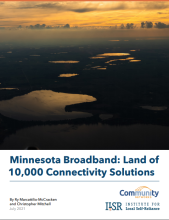
In a new report, the Institute for Local Self-Reliance showcases the diverse range of approaches communities and local Internet Service Providers (ISPs) have taken to expand affordable, high-quality Internet access in Minnesota. It includes a series of case studies that detail how communities are meeting the connectivity challenges of a broken marketplace shaped by large monopoly service providers.
Download Minnesota Broadband: Land of 10,000 Connectivity Solutions [pdf] here.
The profiled projects include municipal networks, public-private partnerships, cooperatives, and private investment. They run from the most rural areas of the state to Minneapolis. Some examples include:
Ry Marcattilio-McCracken, co-author of the report and Senior Researcher with ILSR’s Community Broadband Networks initiative, said of the report’s findings:

Our new report, Minnesota Broadband: Land of 10,000 Connectivity Solutions [pdf], showcases the diverse range of approaches communities and local Internet Service Providers (ISPs) have taken to expand affordable, high-quality Internet access in Minnesota. It includes a series of case studies that detail how communities are meeting the connectivity challenges of a broken marketplace shaped by large monopoly service providers.
The profiled projects include municipal networks, public-private partnerships, cooperatives, and private investment. They run from the most rural areas of the state to Minneapolis. Some examples include:
Ry Marcattilio-McCracken, co-author of the report and Senior Researcher with ILSR’s Community Broadband Networks initiative, said of the report’s findings:
Minnesota communities and local ISPs have found creative and sustainable ways to build future-proof networks across the state, despite a broken marketplace and state barriers that favor slow-moving, out-of-state monopoly providers clinging to outdated technology. Lawmakers must stand up for the cities and towns that sent them to the legislature, and remove the obstacles that prevent a more competitive market and local broadband solutions.

For the past several years the Knoxville Utilities Board (KUB) has been considering whether to add high-speed Internet service to its portfolio of offerings after nearly a decade of the region’s residents and businesses being plagued with the poor connectivity served up by incumbent providers.
Now, with the Tennessee Valley Authority (TVA) and the state Comptroller’s office having earlier this spring approved the Knoxville Utilities Board (KUB) business plan [pdf] to build a fiber network, the city-owned utility recently cleared the final hurdle needed to move forward with the massive project.
Unanimous Approval from Knoxville City Council
Two weeks ago, the Knoxville City Council unanimously approved the KUB Board of Commissioners proposal to build a fiber-to-the-home (FTTH) network in one of the Volunteer State’s largest metro areas. Network construction is expected to cost $702 million and take seven to 10 years to build out, reaching 210,000 households across KUB’s 688-square-mile service area spanning Knox, Grainger, Union, and Sevier counties.
Once the network is complete, it will not only be the largest community-owned network in Tennessee – surpassing the size of EPB Fiber in Chattanooga, which served as inspiration for KUB officials – it will also be the largest municipal network in the nation.
“Now that the approval process is complete, our focus has shifted to deploying the infrastructure and implementing the processes and systems that allow us to deliver quality services to our customers. We will be providing regular updates to our customers as we make progress,” KUB officials wrote in a prepared statement to Knox News.

Municipal broadband advocates in Ohio realized a major victory today when a bipartisan House and Senate conference committee released the final version of their state budget plan that added $250 million to expand broadband access in the Buckeye State and removed the anonymous budget amendment that would have effectively banned municipal broadband networks if passed into law.
According to The Columbus Dispatch, the two chambers are expected to approve the final budget tonight before sending it to Gov. Mike DeWine to be signed into law ahead of the July 1 deadline.
The vote comes after local officials, community broadband advocates, and angry residents and businesses from across the state spoke out against the last minute municipal network-killing amendment attached to the state budget proposal. State lawmakers were deluged with a flurry of calls, emails, and letters after the budget amendment was revealed two weeks ago without public discussion or debate.
“We had a real grassroots movement here in Fairlawn. We are thrilled our residents, subscribers and businesses came together and helped us defeat this amendment,” Fairlawn Service Director Ernie Staten told us immediately following the news. “We appreciate that the State of Ohio recognizes that municipal broadband has a place in this state and we hope to continue this great endeavor.”
Staten said when FairlawnGig sent out word to the community about the budget amendment, the response from Fairlawn subscribers was fast and furious. “Over 700 emails were sent by our subscribers saying, ‘Don’t take this (municipal broadband) away!’ I think that’s amazing,” he said.
Will Municipal Networks Be Able To Access New State Grant Money?

News outlets in Ohio have begun to pick up on something we first reported (here and here, thanks to our local allies), sounding the alarm on an Ohio Senate budget amendment that, if passed, would effectively kill municipal broadband networks and other publicly owned and operated broadband projects in the Buckeye State.
In the days following the unveiling of the budget amendment, the law firm IceMiller released an analysis of the overarching consequences if this language makes it into the final budget, outlining the problems not only for cities, but schools, port authorities, and intergovernmental agreements. The analysis suggests that not only would it discourage future investment, but also require many existing operations to cease altogether, to the detriment of Ohio residents and businesses.
‘Set Ohio Back Decades’
This past Sunday, the Akron Beacon Journal published a story on how the proposed amendment has Summit County officials concerned that it could put the region’s celebrated municipal network FairLawnGig out of business with Fairlawn Mayor William Roth saying the proposed legislation “would set Ohio back decades and make the state less attractive for businesses and economic development.”
The Beacon Journal goes on to report that both Mayor Roth and Summit County Executive Ilene Shapiro are reaching out to state lawmakers and the governor's office asking that the anti-municipal network language be removed from the proposed budget and are encouraging residents to register their opposition to the amendment with their legislators as well.
‘Vigorous’ Opposition From Local Community Advocates
This week on the podcast Christopher is joined by Douglas Adams, the CMO of Think Marketing (the firm which handles the marketing operations for the municipal network FairlawnGig in Ohio), Ernie Staten, Director of Public Service for the city of Fairlawn, and Angela Siefer, Executive Director of the National Digital Inclusion Alliance.
The topic of the day is the amendment attached to the upcoming budget for the state of Ohio which, if included in the final version, would make Ohio the first state in a decade to erect barriers to the establishment, expansion, and continuing operation of publicly owned and operation broadband networks.
Douglas, Ernie, and Angela talk about the wide-ranging consequences of this amendment, which was pushed through without any meaningful public debate, and how it would ban the continued operation of existing municipal networks like those run by the cities of Fairlawn, Dublin, Springboro, Wadsworth, and Hudson. At the same time, it would preclude the establishment of new networks, as well as stymie efforts by counties and other public entities to use existing and build new Internet infrastructure to save local governments money or deploy low-cost options to families stuck on the wrong side of the digital divide.
See our previous coverage here and here. Click here to read a new fact sheet on the benefits that municipal broadband has brought to the state of Ohio, and the widespread impact if the amendment is adopted as-is.
Read our earlier coverage of the amendement here.
Read our new fact sheet [pdf] on all the ways Ohio's community networks have brought value to the state.
This show is 30 minutes long and can be played on this page or via Apple Podcasts or the tool of your choice using this feed.
Transcript below.
We want your feedback and suggestions for the show-please e-mail us or leave a comment below.
Listen to other episodes here or view all episodes in our index. See other podcasts from the Institute for Local Self-Reliance here.
Thanks to Arne Huseby for the music. The song is Warm Duck Shuffle and is licensed under a Creative Commons Attribution (3.0) license.

Municipal networks in the United States have proven that when dollars are invested in publicly owned information infrastructure, they often return value back to the community several times over. This new fact sheet [pdf] highlights municipal broadband success stories from across the country and some of the many benefits the networks have brought to the communities they serve.
These networks are directly accountable to the community and have proved themselves for more than 20 years in some cases, bringing lower prices to households than the large private providers. Municipal networks and partnerships account for 9 of the top 10 fastest broadband networks in the nation.
Download Snapshots of Municipal Broadband: A Much-Needed Part of America's Digital Ecosystem [pdf] here.
For timely updates, follow Christopher Mitchell or MuniNetworks on Twitter and sign up to get the Community Broadband weekly update.

Since it was first introduced in Congress in March, the Community Broadband Act of 2021 has gained widespread support from over 45 organizations representing local governments, public utilities, racial equity groups, private industry, and citizen advocates.
The legislation -- introduced by U.S. Representatives Anna Eshoo, Jared Golden, and U.S. Senator Cory Booker -- would authorize local communities to build and maintain their own Internet infrastructure by prohibiting laws in 17 states that ban or limit the ability of state, regional, and local governments to build broadband networks and provide Internet services.
The Act also overturns state laws that restrict electric cooperatives' ability to provide Internet services, as well as laws that restrain public agencies from entering into public-private partnerships.
States have started to remove some long-standing barriers to public broadband on their own. In the last year, state lawmakers in both Arkansas and Washington removed significant barriers to municipal broadband networks, as high-quality Internet with upload speeds sufficient for remote work, distance learning, telehealth, and other online civic and cultural engagement has become essential.
Community broadband networks offer a path to connect the unconnected to next-generation networks. State barriers have contributed to the lack of competition in the broadband market and most communities will not soon gain access without public investments or, at the very least, the plausible threat of community broadband.
The Many Benefits of Publicly-Owned Networks