Image


Fast, affordable Internet access for all.
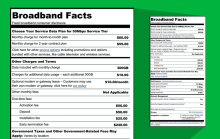
Nearly one year ago on November 15, 2021, Congress passed the Infrastructure Investment and Jobs Act (IIJA), which contained significant legislation around broadband. One piece, which the Institute for Local Self-Reliance (ILSR) has studied closely over the past year and a half, is the implementation of a broadband nutrition label which would require the transparent disclosure of broadband pricing and service information.
While this issue gets very little news coverage, it is an important undertaking as the big providers have a long-established habit of hiding pricing and speed information from subscribers, which prevents them from making informed choices and can leave them vulnerable to exploitation. Our advocacy for the label, and the original research behind our position, can be found here. The FCC is now under deadline to release an order to “promulgate regulations to require the display of” the label by November 15 of this year. We’ve taken a moment here to re-access the issue, offer a few updates, and highlight the ingredients of a strong broadband nutrition label.
Pushing for Clarity, Easy Accessibility, and Enforcement
ILSR, along with 30 other digital equity organizations, recently filed a letter to the FCC supporting the creation of the broadband consumer label and advocating that it be published in a way that makes it clear and easily accessible for customers. While ILSR believes the label is a key decision-making tool and should be published at the point of sale, we reject proposals to limit the label’s display to the point-of-sale only. We emphasize in this letter that the label should also be published on the monthly bill to provide an additional provider accountability mechanism that allows customers to understand what they're paying for.
This past August, the Open Technology Institute (OTI) (a program of New America) released its 2020 Cost of Connectivity Report, which showed that a combination of regulatory and oversight choices combined with market forces results in Internet access that for most Americans is slower, less reliable, and more expensive than elsewhere in the world.
In October, the OTI followed up that report with one focused on the Navajo Nation. It argues that “altogether, the federal government’s failure to connect people on tribal lands deprives entire tribes of opportunities for employment, healthcare, education, and economic growth in both the short and long-term.”
The Navajo Nation is divided into 109 political subdivisions (called chapters) by geography across Arizona, New Mexico, and Utah. The OTI report finds that just four of those chapters have access speeds which meet the FCC’s standard for basic broadband (25/3Mbps (Megabits per second)), and that many in the community remain stuck on the wrong side of the digital divide.
More Findings
Claire Park, author of the study, pulled data from the Navajo Nation Woven Integrated Data Project and combined it with FCC data and state broadband maps from March to July 2020, cross checking a sample of addresses with existing residential Internet Service Providers (ISPs) in those areas. It uses a total of 450 offered plans in its data set.
The report succinctly argues that broadband remains just one among the litany of struggles that those living on tribal lands face:
The ongoing COVID-19 pandemic exposes the deeply unjust policies behind stark inequities in certain communities. In the case of tribal nations, the federal government’s lack of support during the pandemic is another chapter in a brutal history of injustice that leaves tribes particularly vulnerable to this disease. Generations of federal policies undermining Indigenous wealth, power, and sovereignty have left many Native people without access to basic infrastructure, including food, running water, safe and adequate housing, telecommunications service, and healthcare.
The Cost of Connectivity 2020, a recent report from the Open Technology Institute (OTI) at New America, explores how much Americans pay for Internet access compared to those in other parts of the world.
After examining 760 broadband plans in 28 countries in North America, Europe, and Asia, the report's authors conclude that Americans pay higher fees for slower speeds, with communities of color and low-income households most affected. The report points to a lack of Internet service provider transparency and competition as reasons why costs are higher in the United States compared to other places. OTI found that municipal broadband networks, like the one in Ammon, Idaho, provide much better value to subscribers and offer some of the most affordable Internet plans in the country.
Some takeaways from The Cost of Connectivity 2020:
- "[I]nternet service in the United States remains unaffordable for, and therefore inaccessible to, many low-income households . . . In April 2020, 43 percent of lower-income parents reported that their children will likely have to do homework on their cellphones, and 40 percent said that their children would likely have to use public Wi-Fi to finish schoolwork because they lack a reliable internet connection at home. The 'homework gap' also disproportionately affects students who belong to BIPOC communities."
"Just three U.S. cities rank in the top half of cities when sorted by average monthly costs. The most affordable U.S. city—Ammon, Idaho — ranks seventh."
"Data caps further increase the cost of internet service while limiting users’ data consumption . . . Furthermore, data caps can have anticompetitive effects on the wider ecosystem, especially if an Internet Service Provider (ISP) selectively applies data caps to preference its own content while deprioritizing competitors . . . Notably, most of the plans with data caps are in the United States. In Europe, all plans advertised no caps or did not specify. In Asia, only one city specified a cap."
This is the transcript for episode 264 of the Community Broadband Bits podcast. Mason Carroll and Preston Rhea join Christopher Mitchell on the show to talk about their work at Monkeybrains, an urban wireless Internet Service Provider. Listen to the audio here.
Mason Carroll: Every single person needs to have their own Internet connection. This is not just like, "Oh, I can sort of get the building-wide Wi-Fi as I stand near my front door." No. You should have your own Internet connection that you can plug in, and watch TV, or set up a computer, or to do your work. That's really what digital quality is.
Lisa Gonzalez: This is episode 264 of the Community Broadband Bits podcast from the Institute for Local Self-Reliance. I'm Lisa Gonzalez. Episode 264 takes us to San Francisco, home to the Golden Gate Bridge, cable cars, and Monkeybrains. Preston Rhea and Mason Carroll from the Internet service provider are here to tell us about the local company, the services they provide in the Bay Area, and the work they're doing to chip away at the digital divide. Learn more about the company at Monkeybrains.net. As a reminder, this conversation with Preston and Mason is commercial free, but our work at ILSR requires funding. Please take a moment to contribute at ILSR.org. If you have already contributed, thank you. Now, here's Christopher with Preston Rhea and Mason Carroll, from Monkeybrains.
Christopher Mitchell: Welcome to another edition of the Community Broadband Bits podcast. I'm Chris Mitchell with the Institute for Local Self-Reliance. Joining me today is Preston Rhea, Senior Field Engineer for Monkeybrains, an ISP in California. Welcome to the show.
Preston Rhea: Thanks Chris, a pleasure to be here.
Christopher Mitchell: And we also have Mason Carroll, Lead Engineer for Monkeybrains. Welcome to the show as well.
Mason Carroll: Yeah, thanks a lot.
Christopher Mitchell: So, I think the first question is, monkey brains, I remember running into those in a Harrison Ford movie a long time ago. What is Monkeybrains in San Francisco?
After we saw April Glaser's article on a local San Francisco ISP connecting low-income housing to high-quality Internet access, we knew we wanted to learn more. Preston Rhea is the Senior Field Engineer for Monkey Brains and someone we knew from his work with the Open Technology Institute at New America. He joins us with Mason Carroll, Lead Engineer for Monkey Brains, to explain what they are doing in Hunters Point and more broadly across San Francisco.
Monkey Brains delivers Internet access primarily via high-capacity fixed-wireless links to buildings with multiple tenants. Working with the San Francisco Housing Development Corporation, they are delivering gigabit access to low-income housing units at Hunters Point.
Preston and Mason discuss the process, the challenges, the long-term plan, and more. In particular, they discuss why good wiring in each building is important for ensuring high-quality access to each household rather than just relying on common Wi-Fi access points around the buildings.
Silicon Beat also covered this story.
This show is 28 minutes long and can be played on this page or via Apple Podcasts or the tool of your choice using this feed.
Transcript below.
We want your feedback and suggestions for the show-please e-mail us or leave a comment below.
Listen to other episodes here or view all episodes in our index. See other podcasts from the Institute for Local Self-Reliance here.
Thanks to Arne Huseby for the music. The song is Warm Duck Shuffle and is licensed under a Creative Commons Attribution (3.0) license.

The Open Technology Institute (OTI) at the New America Foundation recently released its report on bandwidth caps. "Artificial Scarcity: How Data Caps Harm Consumers and Innovation" is the latest warning about an issue with grave implications. The PDF is now available to download.
Last November, the Government Accounting Office (GAO) released a report [PDF] with serious comments on how ISPs might abuse their power through bandwidth caps. In that report, the GAO strongly suggested the FCC take action.
This report by Danielle Kehl and Patrick Lucey further examines how this profit grabbing technique from the big ISPs impacts consumer decisions and usage.
From the OTI press release:
In this paper, we examine the growth and impact of usage-based pricing and data caps on wired and mobile broadband services in the United States. We analyze the financial incentive that Internet service providers (ISPs) have to implement these usage limits and discuss research that demonstrates how these policies affect consumer behavior. In particular, we explain how data caps can make it harder for consumers to make informed choices; decrease the adoption and use of existing and new online services; and undermine online security.
It is also increasingly clear that data caps have a disproportionate impact on low-income and minority populations as well as groups like telecommuters and students. In the conclusion, we urge the Federal Communications Commission (FCC), particularly as the new Open Internet Order goes into effect, to open up a serious inquiry into whether data caps are an acceptable business practice.
In addition to their own data and conclusions, Kehl and Lucey provide information to many other resources that tackle the implications of bandwidth caps. As consumers' need for bandwidth increases with their changing Internet habits, this topic will only become more pressing.
After reading "Amtrak's Lessons for Access to the Airwaves," I knew we wanted to talk to Michael Calabrese and Patrick Lucey of the Open Technology Institute at the New America Foundation to discuss wireless policy. Unfortunately, scheduling challenges kept Patrick off the this show but we do have a great discussion for this week's Community Broadband Bits podcast with Michael Calabrese, who runs the Wireless Future program at OTI.
We discuss the wireless technology Amtrak has wanted to deploy and alternatives that would have been less costly and more quickly to implement. However, this is really just an opportunity to begin the larger discussion about where wireless is going. We also talk about a recent FCC decision to create much more shared spectrum and how the new system will work, which was also described in a presentation by Milo Medin at the 2015 Freedom to Connect event.
If you enjoy this discussion, you may be interested in our previous discussions with Dewayne Hendricks.
This show is 25 minutes long and can be played on this page or via Apple Podcasts or the tool of your choice using this feed.
Transcript below.
We want your feedback and suggestions for the show-please e-mail us or leave a comment below.
Listen to other episodes here or view all episodes in our index. See other podcasts from the Institute for Local Self-Reliance here.
Thanks to Persson for the music, licensed using Creative Commons. The song is "Blues walk."
On April 17th, FCC Commissioners voted unanimously to expand the use of spectrum previously reserved for U.S. Army and Navy radar systems. The FCC Report and Order creates the Citizens Broadband Radio Service (CBRS) which establishes rules for shared use by licensed and unlicensed users.
This is a step forward to ensuring we are getting the most use out of the spectrum - by allowing different entities to share the spectrum when it is not being used in some geographic areas for the purpose it was originally allocated for. Milo Medin of Google explained this plan at Freedom to Connect - watch his presentation here.
According to the FCC Press Release [PDF], sharing will be managed with a three-tiered approach:
In addition to the protected incumbent tier, the Report and Order authorizes two commercial tiers of use in the Citizens Broadband Radio Service. The General Authorized Access tier, which allows any user with a certified device to operate without seeking any further Commission approval, will permit low-cost entry into the band, similar to unlicensed uses. A Priority Access tier will make geographically targeted, short-term priority rights to a portion of the band available through future spectrum auctions. One or more Spectrum Access Systems, operated by private commercial entities, will facilitate coexistence among the different user tiers.
Public Knowledge applauded the decision. Senior Vice President Harold Feld:
Today’s FCC’s actions lay the groundwork for changes in the very way we use wireless, allowing different levels of interference protection and network architecture that will make the wireless world of the future as radically different as the smartphone and the WiFi hotspot are from touchtone phones and the CB radios.
New America's Michael Calabrese, Director of New America's Wireless Future Project commended the FCC and pushed for more action:
This is the third year the Open Technology Institute (OTI) at New America Foundation studied the cost and quality of connectivity in the U.S. Once again, the results indicate we trail behind peer countries. On November 11th, Chris joined Sarah Morris, one of the report authors, to discuss the report's findings, municipal networks, and how Title II reclassification may change the landscape. They joined Dave Miller for the Think Out Loud program on Oregon Public Broadcasting.
In addition to detailed data analysis on where the best speeds and prices are, The Cost of Connectivity 2014 provides reviews of several other papers from sources such as Akamai, the FCC, and the American Enterprise Institute.
Some notable findings from the report:
OTI made special note of the success of municipal networks in places where traditional providers are not willing to invest:
Although there are many examples of successful locally-owned networks, we focus on Chattanooga, TN; Bristol, VA; and Lafayette, LA, which now offer some of the fastest and most affordable high-speed residential products available in the country despite the fact that they have some of the lowest population densities among the cities we survey.
If you missed Chris in D.C. at the New America Foundation on May 28th, you can still catch the action via the archived presentation.
Chris joined Joanne Hovis, Will Aycock, and Catharine Rice to discuss "Localism Over Consolidation: An Exploration of Public Broadband Options." New America Foundation writes:
Today, more and more communities are thinking of broadband as a local issue. Even large cities like Baltimore, Seattle and New York have recently begun public discussions about ways to improve broadband services and what role the local government could play in that improvement. Current technology policy debates about net neutrality and the potential Comcast-Time Warner Cable merger mean it is more important than ever that local governments play a more active role in ensuring their communities do not get left behind in the digital age.
New America’s Open Technology Institute presented a discussion of various approaches to local investment in broadband. The panel featured a diverse set of experts on public broadband networks and projects, including the manager of a municipal fiber network in Wilson, NC. Panelists discussed different approaches communities have taken so far and share thoughts on what steps other local governments can take going forward to support access to affordable and high-speed broadband.
The discussion runs just under 90 minutes.