Image


Fast, affordable Internet access for all.
This week on the podcast, Christopher is joined by Harold Feld, Senior Vice President at Public Knowledge. Feld is a staple of the field, and has been a consistent voice not only for consumers but broadband advocates of all types for more than two decades.
The show takes on a reflective nature, as they talk about theories of change in the context of doing broadband policy today. Harold shares how he thinks of the progress that gets made in the long term by aligning the corporate incentive with the public interest. He shares coming to terms with having lots of hard days, the power of fighting battles you expect to lose, and learning, getting better, and building powerful coalitions along the way. Harold and Christopher end the show by talking about some examples of the latter, including important wins like the Rural Tribal Priority Window and the expansion of community networks of all shapes and sizes.
This show is 48 minutes long and can be played on this page or via Apple Podcasts or the tool of your choice using this feed.
Transcript below.
We want your feedback and suggestions for the show-please e-mail us or leave a comment below.
Listen to other episodes here or view all episodes in our index. See other podcasts from the Institute for Local Self-Reliance here.
Thanks to Arne Huseby for the music. The song is Warm Duck Shuffle and is licensed under a Creative Commons Attribution (3.0) license.

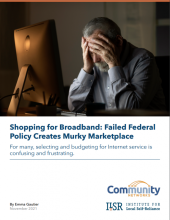
In November, the Institute for Local Self-Reliance published a report examining the transparency practices of Internet Service Providers (ISPs). Shopping for Broadband: Failed Federal Policy Creates Murky Marketplace [pdf] identified locally-controlled broadband networks as the most transparent around key service details.
Large ISPs, however, were found to be more likely to make information like upload speed and pricing difficult or impossible for potential customers to find.
After the report’s original publication, a WISP advocate suggested that our fixed wireless sample may not appropriately represent the industry and requested that we review and re-issue our analysis with an alternative list of ISPs that have been more aggressive in pursuing federal funding and spectrum opportunities. These WISPs greatly outperformed our original sample, which was selected based on those claiming the largest population coverage.
New Set of WISPs Shows Better Transparency
While many of the original WISPs failed to disclose basic pricing and service information, only two of the second set offered less than excellent information in all categories. The second set had less poor quality information and slightly more missing information than our set of cooperatively-run networks. Municipal networks remained the most transparent.
Though many of the fixed wireless providers originally studied do seem to claim the greatest number of potential customers, we agree with some reviewers that they are not actually among the largest fixed wireless ISPs with the most subscribers. The new list of WISPs, which is included alongside the original one on the Broadband Transparency Rule Compliance Scorecard, may be a more accurate representation of providers’ transparency practices in this industry.
Report updated in January, 2022.
A new report from the Institute for Local Self-Reliance (ILSR) examines Internet Service Providers’ (ISPs) transparency — or lack thereof — around the Internet service packages they offer. Shopping for Broadband: Failed Federal Policy Creates Murky Marketplace [pdf] finds that locally-controlled broadband networks are the most transparent around key service details. Large ISPs, on the other hand, are more likely to make information like upload speed and pricing difficult or impossible to find.
Missing or unclear information is frustrating for anyone shopping for a new Internet service. It can make it especially difficult for low-income customers, who need to know pricing details (such as the difference between a service’s promotional price and standard monthly cost) in order to navigate the market and budget for service. Federal standards for transparency exist, but are not currently enforced in any real way by either federal regulation or market pressure.
Recently, Congress passed the Infrastructure Investment and Jobs Act, which includes new information disclosure requirements for ISPs. To underscore the value of these requirements and the need for their proper enforcement, this report offers detailed analysis of 50 of the nation’s largest private wireless, private fiber, cable, municipal, and cooperative ISPs based on how clearly they disclose basic service and pricing information. Key findings include:
Frustrated while shopping for Internet service? Blame federal policy (and monopoly power).
A new report from the Institute for Local Self-Reliance (ILSR) examines Internet Service Providers’ (ISPs) transparency — or lack thereof — around the Internet service packages they offer. Shopping for Broadband: Failed Federal Policy Creates Murky Marketplace [pdf] finds that locally-controlled broadband networks are the most transparent around key service details. Large ISPs, on the other hand, are more likely to make information like upload speed and pricing difficult or impossible to find.
Missing or unclear information is frustrating for anyone shopping for a new Internet service. It can make it especially difficult for low-income customers, who need to know pricing details (such as the difference between a service’s promotional price and standard monthly cost) in order to navigate the market and budget for service. Federal standards for transparency exist, but are not currently enforced in any real way by either federal regulation or market pressure.
Recently, Congress passed the Infrastructure Investment and Jobs Act, which includes new information disclosure requirements for ISPs. To underscore the value of these requirements and the need for their proper enforcement, this report offers detailed analysis of 50 of the nation’s largest private wireless, private fiber, cable, municipal, and cooperative ISPs based on how clearly they disclose basic service and pricing information. Key findings include:

We’ve all been lied to, but when we’re lied to by those we rely on, it’s the worst. Right now, we are all subject to a lie about our Internet access. That lie is rooted in the idea that the best way to move forward is to allow the free market to dictate our access to the Internet, along with the quality of services, privacy protections, and competition.
The big ISPs try to tell us “it’s a competitive market,” then they tell their shareholders competition is scarce. They tell legislators they fear competing against relatively small municipal networks and cooperatives that only serve singular regions but they have subscribers in vast swaths across the country. Federal decision makers tout the benefits of competition, but approve consolidation efforts by a few powerful companies that are already behemoths. This reality is The Big Lie.
What can we do about it? First, understand the cause of the problem. Next, share that understanding. We’ve created this short video to explain The Big Lie; we encourage you to share it and to check out our other resources. Our fact sheets and reports are a great place to start if you’re looking for a way to improve connectivity in your community. Don't forget to check out our other videos, too.
Just what does it take to have a market? It may be more complicated than you think -- and in large part because of the things most of us don't notice that governments do. We discuss this and the role of broadband planners with Alex Marshall on Community Broadband Bits podcast 260.
Alex is the author of The Surprising Design of Market Economies, a columnist for Governing magazine, and Senior Fellow at the Regional Plan Association in New York City. In the course of our conversation, he notes the Portland Speech from President Franklin D. Roosevelt.
One of the highlights of our conversation is comparing roads to broadband in terms of benefits, how they are funded, and the danger from over zealous tolling. We strongly recommend Alex's writing as it has been quite influential in our thinking about municipal infrastructure over the years.
This show is 25 minutes long and can be played on this page or via Apple Podcasts or the tool of your choice using this feed.
Transcript below.
We want your feedback and suggestions for the show-please e-mail us or leave a comment below.
Listen to other episodes here or view all episodes in our index. See other podcasts from the Institute for Local Self-Reliance here.
Thanks to Arne Huseby for the music. The song is Warm Duck Shuffle and is licensed under a Creative Commons Attribution (3.0) license.
This is the transcript for episode 250 of the Community Broadband Bits podcast. Gary Reback, author of Free the Market: Why Only Government Can Keep the Marketplace Competitive, joins the show to discuss antitrust law. Listen to this episode here.
Christopher Mitchell: I think we have some consensus that maybe the lack of antitrust enforcement has been going on too long and we're beginning to have some problems that need to be addressed.
Lisa Gonzalez: This is episode 250 of the Community Broadband Bits Podcast. From the Institute for Local Self-Reliance, I'm Lisa Gonzalez. In this week's episode, Christoper talks with Gary Reback, attorney and author. Gary's been called the protector of the marketplace and the antitrust champion for his work representing some of Silicon Valley's best-known companies. Gary and Christopher talk about antitrust, concentration of power and the different ways shifts in antitrust enforcement negatively impact both consumers and the market as a whole. Let's get to it.
Christopher Mitchell: Welcome to another edition of the Community Broadband Bits Podcast. I'm Chris Mitchell. Today, I'm speaking with Gary Reback, a well-known Silicon Valley lawyer. Welcome to the show, Gary.
Gary Reback: Thank you.
Christopher Mitchell: I'm excited to have you on the show. You're well-known for being very involved in getting the government to sue Microsoft and for writing a book that actually came to me at a really good time about seven years ago called Free
the Market!: Why Only Government Can Keep the Marketplace Competitive. I really enjoyed that book, highly recommend it. For our audience's sake, we're not going to talk much about broadband in this conversation. But I think that many of these principles around competition in markets apply very strongly but it's something that will be sort of in the sideline. Gary, I'm curious if we can just start with a brief description of what you might describe as a working market before we spend the rest of our time talking about the markets that aren't working as well.
The larger focus of our work in the Community Broadband Networks Initiative is to ensure communities have the networks they need. Our guest for Community Broadband Bits episode 250 is an expert in how markets break and the policies that make them work.
Gary Reback is a well known Silicon Valley lawyer and Of Counsel at Carr Ferrell LLP. He also wrote an excellent book, Free the Market: Why Only Government Can Keep the Marketplace Competitive that I fully recommend. Reback has had a front-row seat to the failings of government policy that has allowed a few technology firms to garner so much market power today.
We talk broadly about markets and monopoly rather than focusing on broadband and telecommunications. This is a good introductory conversation for people unfamiliar with the real threat and harms of monopoly.
A related conversation is my interview with Barry Lynn in episode 83.
This show is 25 minutes long and can be played on this page or via Apple Podcasts or the tool of your choice using this feed.
Transcript below.
We want your feedback and suggestions for the show-please e-mail us or leave a comment below.
Listen to other episodes here or view all episodes in our index. See other podcasts from the Institute for Local Self-Reliance here.
Thanks to Arne Huseby for the music. The song is Warm Duck Shuffle and is licensed under a Creative Commons Attribution (3.0) license.

“Monopoly” may be a fun family night activity, but if you live in a place where you have little or no choice for Internet access, it’s not fun and it’s not a game.
According to FCC data, most families don’t have a choice in Internet access providers, especially providers they like. Nevertheless, the biggest companies keep reporting increasing revenues every year. People aren’t happy with the service they’re receiving, but companies like AT&T and Comcast continue to thrive. What’s going on?
In a recent State Scoop piece, Christopher wrote:
[T]he market is not providing a check to AT&T or Comcast power. They are effectively monopolies — and as we just saw — can translate their market power into political power to wipe out regulations they find annoying.
At the Institute for Local Self-Reliance, where we work to support local economies, this broken market is a major problem. Cable monopolies are bad for local businesses, which become less competitive from paying too much for unreliable Internet access. Communities cannot thrive without high quality Internet access today.
We created this infographic to present the evidence showing that the market is broken. This resource also discusses why creating more competition in the current market is such a challenge. An effective way to overcome this broken market, however, is to consider what hundreds of local communities are already doing - investing in publicly owned Internet infrastructure. Our infographic offers a few examples of different models, each chosen to suit the communities they serve.
Get a larger version of the infographic here.
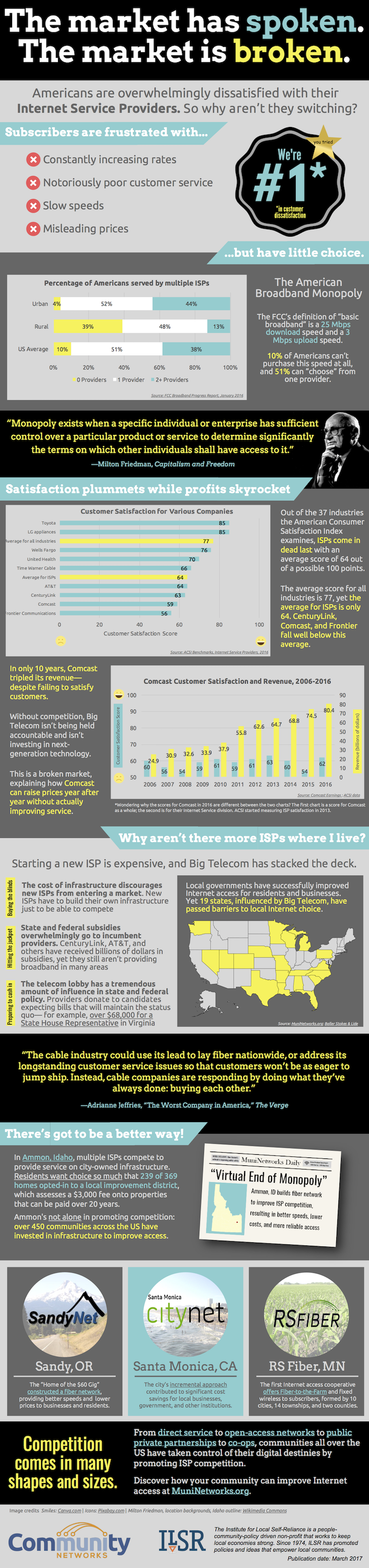
Get a larger version of the infographic here.
Kudos to intern Kate Svitavsky who created the infographic.
Stay up to date on community networks with our newsletter.