Image


Fast, affordable Internet access for all.
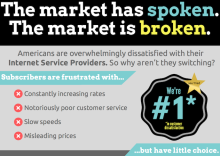
As of June 11th, federal network neutrality protections formally expired, thanks to Chairman Ajit Pai and the other Republican Commissioners at the FCC. In the months leading up to the vote, Pai has continued to press the talking point that the market will protect consumers. Now is a good time to pull out our infographic from last year, "The Market Has Spoken. The Market Is Broken," to remind Chairman Pai that a broken market isn’t much protection.
Is a Broken Market Able to Protect Anyone?
If people Americans aren’t satisfied with their current ISP, they should just switch, right? That’s why we have a competitive market — so subscribers who are unhappy with one Internet service can switch to another, right? Sounds great, but when there is no competition where you live, “you’ll take what you git and you won’t throw a fit.” At least, that’s what monopoly providers expect.
Our infographic addresses national ISPs that deliver services in both urban and rural areas. Time and again, consumers report that they’re dissatisfied with companies such as Comcast, AT&T, and CenturyLink, but with no options in many areas, there is no recourse. Now that we know approximately 177 million Americans live under the shadow of ISPs that willingly offend network neutrality policies, the faulty market is a more important issue than ever.
National ISPs know the monumental task ahead of new entrants, but also know that if subscribers get a taste for something better, big companies will lose their advantage and subscribership. In order to keep their position at the top of the heap, they invest millions of dollars each year into lobbying at the state and federal level. By advancing legislation that effectively blocks smaller players and municipalities from developing new and better services, Comcast, AT&T, and others can maintain their monopolies.
Our infographic looks at some hard numbers and offers examples of solutions. When communities find a way to get past the big telecom and cable industry stranglehold, they can thrive with local control and accountability.
Network neutrality protections are scheduled to disappear on June 11th. In an effort to reverse the FCC’s decision that will put millions at risk by eliminating market protections, 52 Senators voted in favor of a Resolution of Disapproval on May 16th. The vote was enough to pass the Resolution and send it on to the next step under the Congressional Review Act (CRA).
Heading to the House
In addition to the full roster of Democrats, Republican legislators, Republicans Susan Collins of Maine, Lisa Murkowski of Alaska, and John Kennedy of Louisiana, voted in favor of the bill. Last February, citizen groups in Louisiana joined together to show support for network neutrality, staging rallies in four cities and visiting Senator Kennedy with thousands of signatures on a petition urging him to support the Resolution.
Now that the measure has passed in the Senate, it faces a tougher time in the House, however, where passage requires more votes to obtain the necessary majority. Advocates are busy organizing citizens, businesses, and entities to express their support for the policy and demand that Representatives take the same route as the Senate.
“We will continue to fight for net neutrality in every way possible as we try to protect against erosion into a discriminatory internet, with ultimately a far worse experience for any users and businesses who don’t pay more for special treatment,” said Denelle Dixon, chief operating officer at Mozilla.
The Congressional Review Act
Unlike in the Senate, there is no fast-track option from the House Committee to the House Floor. If the House Committee fails to report, however, a majority can force a vote. Like in the Senate, a simple majority in favor of the Joint Resolution is required for passage — 218 votes in the House.

It’s May 16th and today is the day the Senate will vote on whether or not to reverse last December’s repeal of network neutrality rules by FCC Chairman Ajit Pai and other Republican FCC Commissioners. As a reminder, we thought this was a good day to pull out the maps we created that illustrate how that decision to repeal the federal policy put at least 177 million Americans at risk. Without network neutrality protections in place, these folks are limited to obtaining broadband Internet access only from providers that have violated network neutrality or have admitted that they plan to violate network neutrality tenets in the future.
Visualizing the Risks
Back in December 2017 when the current FCC made it’s misguided decision, we decided to take a look at the data and create visualizations to paint a picture of what they had done. We used Form 477 data, which tends to overstate coverage, so the problem in the field is likely more severe than the maps indicate. The results aren’t pretty.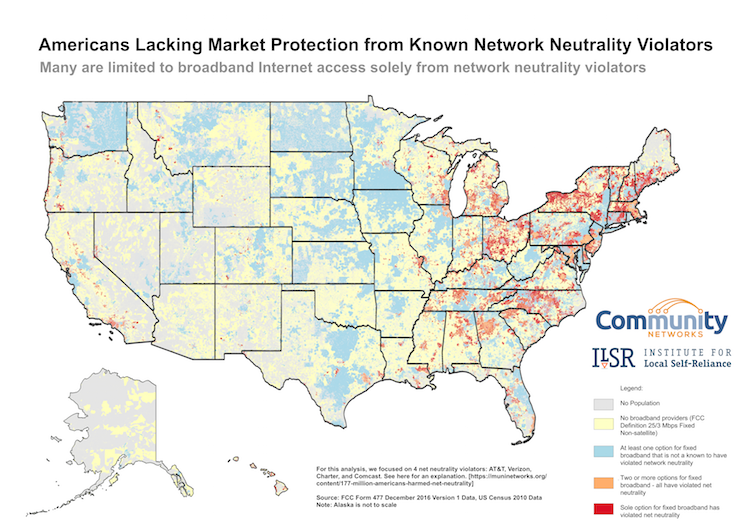
At least 129 million people have only a single provider from which they can subscribe to broadband Internet access. The FCC defines broadband as 25 Mbps download and 3 Mbps upload. Out of those 129 million Americans, about 52 million must turn to a company that has violated network neutrality protections in the past and continues to do so.
In some places, the situation is a little better. There are 146 million Americans with the ability to choose between two providers, but 48 million of those Americans must choose between two companies that have a record of violating network neutrality.
For a larger image, download this version [18 MB png].
Just what does it take to have a market? It may be more complicated than you think -- and in large part because of the things most of us don't notice that governments do. We discuss this and the role of broadband planners with Alex Marshall on Community Broadband Bits podcast 260.
Alex is the author of The Surprising Design of Market Economies, a columnist for Governing magazine, and Senior Fellow at the Regional Plan Association in New York City. In the course of our conversation, he notes the Portland Speech from President Franklin D. Roosevelt.
One of the highlights of our conversation is comparing roads to broadband in terms of benefits, how they are funded, and the danger from over zealous tolling. We strongly recommend Alex's writing as it has been quite influential in our thinking about municipal infrastructure over the years.
This show is 25 minutes long and can be played on this page or via Apple Podcasts or the tool of your choice using this feed.
Transcript below.
We want your feedback and suggestions for the show-please e-mail us or leave a comment below.
Listen to other episodes here or view all episodes in our index. See other podcasts from the Institute for Local Self-Reliance here.
Thanks to Arne Huseby for the music. The song is Warm Duck Shuffle and is licensed under a Creative Commons Attribution (3.0) license.
This is the transcript for episode 250 of the Community Broadband Bits podcast. Gary Reback, author of Free the Market: Why Only Government Can Keep the Marketplace Competitive, joins the show to discuss antitrust law. Listen to this episode here.
Christopher Mitchell: I think we have some consensus that maybe the lack of antitrust enforcement has been going on too long and we're beginning to have some problems that need to be addressed.
Lisa Gonzalez: This is episode 250 of the Community Broadband Bits Podcast. From the Institute for Local Self-Reliance, I'm Lisa Gonzalez. In this week's episode, Christoper talks with Gary Reback, attorney and author. Gary's been called the protector of the marketplace and the antitrust champion for his work representing some of Silicon Valley's best-known companies. Gary and Christopher talk about antitrust, concentration of power and the different ways shifts in antitrust enforcement negatively impact both consumers and the market as a whole. Let's get to it.
Christopher Mitchell: Welcome to another edition of the Community Broadband Bits Podcast. I'm Chris Mitchell. Today, I'm speaking with Gary Reback, a well-known Silicon Valley lawyer. Welcome to the show, Gary.
Gary Reback: Thank you.
Christopher Mitchell: I'm excited to have you on the show. You're well-known for being very involved in getting the government to sue Microsoft and for writing a book that actually came to me at a really good time about seven years ago called Free
the Market!: Why Only Government Can Keep the Marketplace Competitive. I really enjoyed that book, highly recommend it. For our audience's sake, we're not going to talk much about broadband in this conversation. But I think that many of these principles around competition in markets apply very strongly but it's something that will be sort of in the sideline. Gary, I'm curious if we can just start with a brief description of what you might describe as a working market before we spend the rest of our time talking about the markets that aren't working as well.
The larger focus of our work in the Community Broadband Networks Initiative is to ensure communities have the networks they need. Our guest for Community Broadband Bits episode 250 is an expert in how markets break and the policies that make them work.
Gary Reback is a well known Silicon Valley lawyer and Of Counsel at Carr Ferrell LLP. He also wrote an excellent book, Free the Market: Why Only Government Can Keep the Marketplace Competitive that I fully recommend. Reback has had a front-row seat to the failings of government policy that has allowed a few technology firms to garner so much market power today.
We talk broadly about markets and monopoly rather than focusing on broadband and telecommunications. This is a good introductory conversation for people unfamiliar with the real threat and harms of monopoly.
A related conversation is my interview with Barry Lynn in episode 83.
This show is 25 minutes long and can be played on this page or via Apple Podcasts or the tool of your choice using this feed.
Transcript below.
We want your feedback and suggestions for the show-please e-mail us or leave a comment below.
Listen to other episodes here or view all episodes in our index. See other podcasts from the Institute for Local Self-Reliance here.
Thanks to Arne Huseby for the music. The song is Warm Duck Shuffle and is licensed under a Creative Commons Attribution (3.0) license.

In the early 1950s, it was nearly impossible to know the value of an automobile. They had prices, yes, but these would differ radically from dealer to dealer, the customer a pawn in the hands of the seller. This all changed in 1958, when US senator Mike Monroney of Oklahoma shepherded a bill through Congress requiring that official pricing information be glued to the window of every new automobile sold in the US. The “Monroney sticker,” as it came to be known, has been with us ever since. It became an effective means of disclosing the manufacturer’s suggested retail price, or MSRP, and a billboard for other data disclosures to the consumer: the car’s fuel economy, its environmental rating, and so on. The sticker price was one of the triumphs of consumer-rights legislation and has made buying a car an easier—though never altogether easy—experience. What’s more, window stickers made automobile pricing rational and understandable. A customer who knows the base price going in will expect more value coming out. In economic terms, the sticker turned a failed market flummoxed by information asymmetry into something resembling a functioning, price-driven marketplace.There are many smart government policies that could radically improve the telecommunications industry, collectively saving billions of dollars for Americans and businesses. Unfortunately, most of these policies have been ignored by Congress and the FCC, which have focused instead on the solutions put forth by the big cable and DSL companies to further their own narrow interests.

The Lafayette Pro-Fiber Blog alerted us to a piercingly honest analysis from Wall Street. The article on SeekingAlpha.com, titled We-re Big Fans Of Comcast's Cash-Flow Generation captures one of the major policy failures of our time:
Comcast's traditional Cable Communications continues to grow and generate copious cash flow. Video revenue, Xfinity and other cable TV products, grew 2.8% to $5 billion, while High-Speed Internet revenue grew 8.9% to $2.4 billion. We're big fans of the firm's Video and High-Speed Internet businesses because both are either monopolies or duopolies in their respective markets. Further, we believe that both services have become so sticky and important to consumers that Comcast will be able to effectively raise prices year after year without seeing too much volume-related weakness.
Wow.
SeekingAlpha.com, describes itself as "…the premier website for actionable stock market opinion and analysis, and vibrant, intelligent finance discussion."
We want to empower local businesses and communities to control their own destiny. Monopolistic telecommunications companies, with their Goliath market share, Wall Street priorities, and armies of lobbyists continue to attack local control and self-reliance. They are extracting assets from Main Street and shipping it to Wall Street.
Yet we see the FCC, Congress, and many states pretending that the public interest is best served by giving more power to these massive companies. And we will continue to hear industry-funded think tanks claiming that broadband has robust competition and should be subject to less public oversight. Coming soon to an op-ed page near you.Photo courtesy of JSquish via Wikipedia Commons

The great missing debate in contemporary politics is about the role and reach of markets. Do we want a market economy, or a market society? What role should markets play in public life and personal relations?
 The building on the right has a bunch of carriers who are competing. But only Verizon serves the building on the left with dedicated access (a committed information rate as opposed to the standard "up to" connections most residents and many small businesses use).
Thanks to Brough for circulating the slide.
The building on the right has a bunch of carriers who are competing. But only Verizon serves the building on the left with dedicated access (a committed information rate as opposed to the standard "up to" connections most residents and many small businesses use).
Thanks to Brough for circulating the slide.
