
lessig

Tagged Stories

DC Revolving Door, Comcast, and Campaign Finance Reform

One of the reasons community broadband networks face so many unique hurdles (often created deliberately by states in response to cable/dsl lobbying) is because of the many ways in which campaign finance corrupts our national and state governments.

Community broadband networks are focused on meeting community needs, not sending lobbyist armies into Washington, DC, and state capitals (though one of things we do at the Institute for Local Self-Reliance is offer help to those that do push pro-community agendas in these areas).

To understand why DC is so focused on furthering the corporate agendas of AT&T, Comcast, Time Warner Cable, and others, is to understand the revolving door. (Also, understanding capture -- which we have explained previously.)

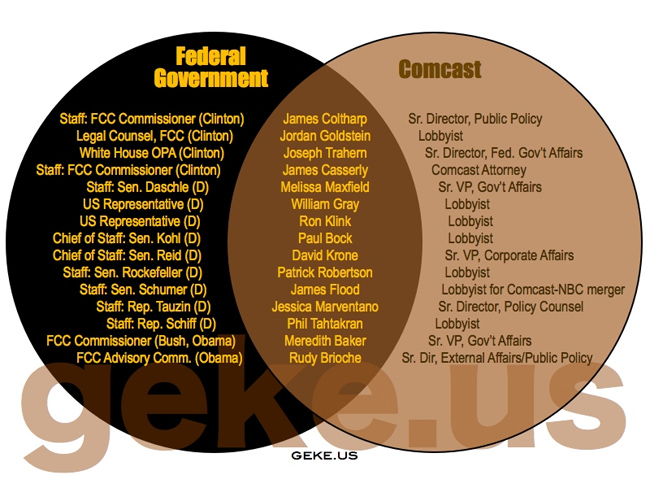
In short, many of the people who make decisions about telecommunications policy in DC have worked, will work, or are presently working for the massive companies that effectively control access to the Internet in most of America's communities.

The good folks at Geke.US have created the following Comcast Venn Diagram illustrating a small piece of the DC revolving door.

Comcast and DC's revolving door Venn Diagram

Reforming this system is a deep, seemingly intractable problem. But for those looking for answers, a good place to start is with the work of Lawrence Lessig. I just finished his Republic, Lost, which offers a grand tour of the problems resulting from the present system of campaign finance.

You can also see a number of his presentations here.

His organization, the Rootstrikers aim to get to the root of problems rather than being distracted by trying to fix symptoms of deeper problems. This is precisely what we do with our focus on community networks.

Many focus solely on resolving digital divide issues, improving rural access to the Internet, lowering the cost of broadband, or the various other problems that result from narrowly-focused private corporations owning and controlling essential communications infrastructure with inadequate regulations.

Solving the problem of ensuring all Americans have fast, affordable, and reliable access to the Internet (a goal remarkably consistant with the FCC's supposed mission enshrined in law by the Communications Act), would be remarkably easier in a world where Congress and state legislators were not corrupted by the influence of the campaign finance system. This is why we emphatically support efforts (like those of Lessig) to reform that system.

Lessig Promotes Publicly Owned Broadband at Personal Democracy Forum

I have long been a fan of Larry Lessig's work, so I was proud to see him use our work as the foundation for his presentation at the 2011 Personal Democracy Forum.  He talks about the fundamental right of communities to build their own networks as well as Time Warner Cable's successful purchase of competition-limiting legislation in North Carolina.
Video: 
See video

Lessig, Doc Searls, and Others Call on Gov Perdue to Veto TWC Bill

As readers know, we have devoted a lot of effort to educating everyone about Time Warner Cable's Bill in North Carolina to kill local authority to build broadband networks. As time runs out for NC Governor Perdue to kill this terrible legislation with her veto pen, we have seen many more calls on the Governor to act on behalf of local businesses and residents rather than on behalf of TWC and CenturyLink.

We've written more on this legislation than almost any other topic (all of it available here), so we want to highlight other recent posts.

Some notable recent calls to action come from Larry Lessig's Rootstrikers:

North Carolina has one of the nation's most impressive community broadband movements. Locally owned, state of the art networks are delivering fast, cheap Internet across the state. Big telecom companies--Time Warner Cable in particular--are not happy with their success. They've spent millions on lobbying state lawmakers. Now, the North Carolina legislature has passed a bill that bans competition from community broadband networks. Under this legislation, local communities would be held hostage to the corporate broadband networks that have given America second-rate networks everywhere.

Josh Levy of Free Press wrote the following in Ars Technica:

Predictably, the big cable companies view these municipal upstarts as major threats. Companies like Time Warner Cable and CenturyLink may be unwilling to extend their networks to communities like Cedar Grove, but they don't want anyone else doing it either—such an incursion would pose a threat to North Carolina’s de facto cable duopoly. Ironically, the weapon these traditionally regulation-shy companies have turned to in order to fight the municipal broadband effort is regulation.

Doc Searls also weighed in:

Here’s a simple fact for Governor Perdue to ponder: In the U.S. today, the leading innovators in Internet build-out are cities, not phone and cable companies. Look at Chatanooga and Lafayette — two red state cities that are doing an outstanding job of building infrastructure that attracts and supports new businesses of all kinds. Both are doing what no phone or cable companies are able or willing to do. And both are succeeding in spite of massive opposition by phone and cable companies.

And finally, Rick Yuzzi from ZCorum

In my opinion, a city should be able to set up a broadband business. It’s not likely to do so unless there is a compelling need in the community. If they do, and they provide a well run and profitable service, the service will survive. If it’s poorly run and a drain on city resources, citizens can vote with their dollars, as well as at the ballot box.

An Open Internet Means Not Having to Ask Permission

Publication Date: 
October 1, 2010
Author(s): 
Larry Lessig
Publication Title: 
New Republic

In a TNR Review, Larry Lessig uses The Social Network to explain why we must maintain an open Internet. This fits exactly into our recurring theme on MuniNetworks.org that rules and structure matter greatly.

The full review is excellent and worth reading, but this is the key for our purposes (it comes toward the middle of the article):

Instead, what’s important here is that [Founder of Facebook] Zuckerberg’s genius could be embraced by half-a-billion people within six years of its first being launched, without (and here is the critical bit) asking permission of anyone. The real story is not the invention. It is the platform that makes the invention sing. Zuckerberg didn’t invent that platform. He was a hacker (a term of praise) who built for it. And as much as Zuckerberg deserves endless respect from every decent soul for his success, the real hero in this story doesn’t even get a credit.

Too few appreciate why the Internet is so revolutionary. One does not have to ask permission to create and distribute content -- ideas. However, there is a lot of money to be made and power to be had by forcing creators to ask permission -- this is what big companies like Comcast and AT&T want to do. They want more control over the Internet to consolidate their power as intermediaries between content and ideas.

The tragedy—small in the scale of things, no doubt—of this film is that practically everyone watching it will miss this point. Practically everyone walking out will think they understand genius on the Internet. But almost none will have seen the real genius here. And that is tragedy because just at the moment when we celebrate the product of these two wonders—Zuckerberg and the Internet—working together, policymakers are conspiring ferociously with old world powers to remove the conditions for this success. As “network neutrality” gets bargained away—to add insult to injury, by an administration that was elected with the promise to defend it—the opportunities for the Zuckerbergs of tomorrow will shrink. And as they do, we will return more to the world where success depends upon permission. And privilege. And insiders. And where fewer turn their souls to inventing the next great idea.

Prior to an important decision in 1968, one had to ask permission of "Ma Bell" to connect anything to the phone network. Then the FCC, at that time buoyed by a DC Circuit Court that did not automatically reject all regulation, forced the telephone company to allow anyone to attach devices to the network so long as they did not damage the network. A world with fax machines, answering machines, computer modems, and more followed because no one had to secure permission to connect to the network.

If you have a great idea for a television channel, can you get it carried in your community? Almost definitely not -- and the bigger the incumbent cable company, the harder it is. The Internet is different -- but it too could change rapidly when big companies like Comcast and AT&T are writing the rules. In the early days of both radio and television, few would have expected these exciting communications mediums to be ultimately controlled by a few powerful corporations and used almost exclusively for lowest-common-denominator, advertisement-driven, content.

This is exactly why broadband networks must put community needs before private demands. Whether owned by the local government, a nonprofit, or coop, broadband networks must be structurally accountable to the public, not a private company with its own interests.

We must resist changes that would require asking permission to publish content, which means we must maintain the power to write the rules.

For the record, I am much less bullish than Lessig on Facebook because its scale and ambition now also present a threat to the open Internet

Lessig Presentation on America's Broadband Policy

Paul Venezia is one of the few who noted a recent Lessig presentation that discusses broadband policy. Larry Lessig's presentation offers an excellent short history of broadband and telecom history - from the beginning of AT&T to the National Broadband Plan. The video runs an hour, but should be essential viewing for anyone who wants to understand why the U.S. continues to fall behind international peers in broadband.

Lessig's answer is that we have lost our independence. Large corporate interests dominate the federal government as well as the state legislatures, resulting in a government that too often bends to their will.

Lessig's presentation covers the essential role of government in forcing AT&T to open the phone network (paving the way for fax machines, Sports Illustrated football phones, and eventually dial-up modems). Key takeaway: the owner of a network makes the rules and determines who is allowed to use it and under what circumstances.

Among other issues, he offers the most accessible explanation of what happened with the FCC/Comcast court ruling that has (temporarily - we hope) rendered the FCC unable to stop carriers from telling users what sites they can visit or adjusting the speeds to some sites based on the carriers' business model.

He notes his disappointment with the National Broadband Plan - where the Obama "reality-based" Administration chose to ignore reality and take the easy road of not challenging powerful incumbent telecom interests.

Toward the end, he raises the chilling prospect of the federal government instituting a form of the PATRIOT ACT on the Internet in the future. Watching this reminded me that we believe government has an essential role in building and owning infrastructure but we strongly support Constitutional checks against the government getting too involved in policing content.

This is an excellent presentation - particularly for those who are not as familiar with the history of the AT&T, the FCC, Carterphone, and the competition we briefly had among service providers in the days of dial-up.

Video: