Image

Fast, affordable Internet access for all.
On Friday, April 26th from 9:30 AM to 4:00 PM, NC Broadband Matters will host its 2nd Annual NC Hearts Gigabit Interactive at the North Carolina Rural Economic Development Center in Raleigh. The event will showcase why broadband access is critically important to urban and rural communities in North Carolina for workforce development and technology innovation.
Register online for the event.
In late 2012, over thirty communities came together in Wilson, North Carolina, over a series of lunches to discuss ways in which to bring more gigabit fiber Internet to the state. By 2016, these talks had turned into formal action and became known as the NC Hearts Gigabit campaign. The following year, the nonprofit NC Broadband Matters was formed to function as the campaign’s coordinating body. Since its inception, NC Broadband Matters has worked to bring together both private and public stakeholders to promote statewide affordable, fast, and reliable Internet.
With a full agenda covering various aspects of broadband policy and finance, the 2nd Annual NC Hearts Gigabit Interactive is one more way that NC Broadband Matters is working to educate stakeholders on why fast Internet is the future. Harvard Law School Professor Susan Crawford, who recently discussed her new book Fiber: The Coming Tech Revolution and Why America Might Miss It on our Community Broadband Bits podcast, will be the keynote speaker of the event.
You can review the full agenda to learn more about specific panel discussions. To help spread the word, feel free to download and share this promotional flyer.
Are you still considering whether or not to attend this spring’s Broadband Communities 2019 Summit in Austin on April 8th, 9th, and 10th? We thought we’d share more information about Christopher’s panels so you can see what you will be missing if you decide to stay home.
Register online for the Summit.
Lessons Learned and Shared
Learning about what communities did that worked and what didn’t work is one of the most valuable aspects of the Summit. On April 10th, at 10 a.m., Christopher heads up a discussion with folks from four different communities across the U.S. to discuss what they learned in deploying their publicly owned fiber networks. Each of these communities faced adversity and found a way to change course to turn difficulty into positive outcome:
One of the challenges of evaluating capital-intensive local broadband projects is that they typically lose money in their early years. Come learn from four communities that have overcome significant challenges – and learned invaluable lessons along the way.
Participating on the panel will be:
More From Christopher
Harvard Professor, author, and broadband champion Susan Crawford has been incredibly busy ever since she released her latest book Fiber: The Coming Tech Revolution — And Why America Might Miss It. Fortunately for us and our listeners, she hasn’t been too busy to take some time for Community Broadband Bits listeners. She’s here this week to talk about the book, her experiences researching it, and discussing policy recommendations aimed at bringing better connectivity to rural and urban areas.
The conversation between Christopher and Susan is one of our best podcasts. They touch on technology, competition, and how we’ve come to the point when local communities are leading the charge to bring high-quality Internet access to their residents and businesses. Susan shares some of the stories she encountered — both favorable and not so favorable — of places where local leaders are either working to hard to put broadband infrastructure in place or barely moving the dial on getting their communities better connected.
She’s travelled all across the world to learn about how other countries approach fiber connectivity and how they’re reaping the benefits. Now, she wants to share some of those policies and ideas to help Americans realize that if we don’t adjust our mindset, we could miss out on fiber’s potential.
Order Susan's book online at Indiebound.org. Learn more about the book by reading Christopher's review.
This show is 33 minutes long and can be played on this page or via Apple Podcasts or the tool of your choice using this feed.
Transcript below.
We want your feedback and suggestions for the show-please e-mail us or leave a comment below.
Listen to other episodes here or view all episodes in our index. See other podcasts from the Institute for Local Self-Reliance here.
Thanks to Arne Huseby for the music. The song is Warm Duck Shuffle and is licensed under a Creative Commons Attribution (3.0) license.

April will be here before you know it, and with the spring comes the 2019 Broadband Communities Summit. This year’s event will be held in Austin, Texas, April 8th - 11th at the Renaissance Hotel. The theme is “Fiber: Putting Your Gigs To Work.”
Register online for the event and check out the agenda.
Special CLIC Program
As in prior years, the Coalition for Local Internet Choice (CLIC) will host a special program during the afternoon of the first day of the summit. “An Action Plan for Local Internet Choice in 2019 and Beyond” will focus on the policies, the politics, and the people that can lead to better connectivity for local communities.
CLIC will host three panel discussions that address federal developments, the FCC’s Broadband Deployment Advisory Committee (BDAC), and nonpartisan approaches to managing the politics of local broadband initiatives. Christopher will speak on this last panel that aims to address lessons learned and recommend strategies that have worked to bring better connectivity to local communities.
Read more about the CLIC program.
Christopher will also appear on panels addressing economic development, including “Broadband at the Crossroads: Our Experts Weigh In.” He’ll also moderate “Lessons Learned From Turn-Around Communities,” a panel that will host Dan Patten from MINET and David Post from Salisbury, North Carolina.
Susan Crawford Keynote
If you haven’t yet read Susan’s latest book, you still have plenty of time before April’s summit. On April 11th, she will deliver the Keynote Address to discuss her findings as she researched for Fiber: The Coming Tech Revolution — And Why America Might Miss It:

Susan Crawford has published the right book at the right time. Fiber: The Coming Tech Revolution -- And Why America Might Miss It, makes a compelling case for local organizing around better Internet networks upon which the future will be written.
The book revolves around several communities that will be familiar to anyone following community networks - cities like Chattanooga and Wilson, many of whom are members of Next Century Cities. Even people with only a casual interest in how to achieve the best Internet access will recognize some of the community names in Susan’s latest book.
As someone who has tracked these networks closer than most, several of the anecdotes were new to me and sufficiently powerful that I - literally - had to restrain myself from cheering while finishing the book on a flight. So it works well both for someone unfamiliar with the technology or movement as well as for those of us who have worked from within it for many years.
Susan dives right into the tech and marries it to the purpose:
Those hair-thin fiber strands, capable of carrying billions of phone calls simultaneously, plus advanced wireless communications that depend on that fiber extending into the last mile, will make possible virtually unlimited, cheap communications capacity wherever you are—which in turn will give rise to new businesses, new transport capabilities, new ways of managing our use of energy, new forms of education and health care, new ways of earning a living, and new forms of human connectedness. For these things to happen, both fiber and advanced wireless technologies need to be widely and competitively available. Without these basic pieces of open infrastructure in place, your country will be missing out on the future being lived and built elsewhere.
Speaking of purpose, this next paragraph is the type of prose that I think sets Susan apart from other writers on these issues.
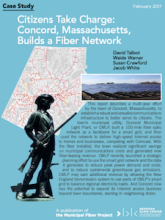
A new case study recently released by the Berkman Klein Center for Internet & Society at Harvard University describes how the community of Concord, Massachusetts deployed its extensive municipal fiber-optic network and smart grid. In Citizens Take Charge: Concord, Massachusetts, Builds a Fiber Network, the authors offer history, and describe the benefits to the community from better connectivity and enhanced electric efficiencies.
Key Findings from the report:
This is the transcript for episode 242 of the Community Broadband Bits podcast. Our Christopher Mitchell invites Professor Susan Crawford to reflect on her recent travels through North Carolina and Tennessee. Both states have restricted communities from building new municipal networks. Listen to this episode here.
Susan Crawford: It's much more about a very bipartisan, quite progressive group of people thinking about how to make life better in their communities, and that's terrific. That's truly American.
Lisa Gonzalez: This is episode 242 of the Community Broadband Bits podcast from the Institute for Local Self-Reliance. I'm Lisa Gonzalez. We're pleased to have Susan Crawford back on the show this week. She's a Professor of Law at Harvard Law School, but she's also served as Special Assistant to President Obama for science, technology and innovation policy. Susan's CV is too long for us to go through point by point. She's authored several publications, including The Responsive City: Engaging Communities Through Data-Smart Governance, and The Telecom Industry and Monopoly power in the New Gilded Age. She's been on the show before to talk with Christopher about access to high-quality connectivity, and it's always a pleasure to have her back. As it turns out, Susan has been on a walkabout of sorts, visiting local communities as she works on her current book, and in this discussion she shares her impressions with Christopher. She's got some ideas on how she feels are the most effective ways to bring better connectivity to the most people, especially in rural areas, and she and Christopher hash through her findings.
Susan Crawford has come back to the podcast to tell us about her recent travels in North Carolina and Tennessee, talking to people on the ground that have already built fiber-optic networks or are in the midst of figuring out how to get them deployed.
Susan is a professor at Harvard Law, the author of The Responsive City: Engaging Communities Through Data-Smart Governance and Captive Audience: The Telecom Industry and Monopoly Power in the New Gilded Age, and a champion for universal high quality Internet access.
We have an informal discussion that ranges from what is happening on the ground in North Carolina and Tennessee to the role of federal policy to why Susan feels that municipal wholesale approaches are important to ensuring we have better Internet access.
It was a real treat to have Susan back on the show and to just have a discussion about many of the issues that don't always come up in more formal presentations or media interviews. We hope you enjoy it! Susan was previously on episode 125 and episode 29.
This show is 21 minutes long and can be played on this page or via Apple Podcasts or the tool of your choice using this feed.
Transcript below.
We want your feedback and suggestions for the show-please e-mail us or leave a comment below.
Listen to other episodes here or view all episodes in our index. See other podcasts from the Institute for Local Self-Reliance here.
Thanks to Break the Bans for the music. The song is Escape and is licensed under a Creative Commons Attribution (3.0) license.

We aren’t the only ones noticing. As rural communities take control of their connectivity by banding together to form broadband cooperatives, their efforts are getting attention. Earlier this month, PBS News Hour featured a story on the Wired West and RS Fiber Cooperatives.
Ivette Feliciano visits with local residents, business owners, and community leaders in both western Massachusetts and rural Minnesota where both initiatives are rewriting the rules for rural dwellers. She visits with Jake Reike, a farmer from Renville County; he talked with Chris during the Community Broadband Bits podcast episode #198. He described for us how improving local connectivity was what his family needed to maintain their farming lifestyle.
Feliciano also sought out expert Susan Crawford, who explained why people in these sparsely populated communities need high-quality connectivity and why they refuse to wait for big providers who may never come to their rescue.
Download a copy of our report RS Fiber: Fertile Fields for New Rural Internet Cooperative, to learn the details of one Minnesota farming region is bringing better Internet access to its people and businesses. There is much to be gained by joining forces.
For more on Wired West, we recommend WiredWest: a Cooperative of Municipalities Forms to Build a Fiber Optic Network, from the Berkman Center. Crawford helped author that report that dives deeper into the situation in western Massachusetts.

In 2010, communities in rural western Massachusetts began a group that would evolve into the WiredWest Cooperative. Over the past six years, the group, formed to bring better last-mile connectivity to the unserved and underserved areas of the state, has faced a number of challenges. Most recently, disagreements with the Massachusetts Broadband Institute (MBI), the state agency tasked with distributing funds for last-mile connectivity, have threatened WiredWest's regional cooperative model.
In a new report released by the Berkman Center, authors David Talbot, Waide Warner, and Susan Crawford share the story of these communities' attempt to band together to establish a fiber-optic network.
In WiredWest: a Cooperative of Municipalities Forms to Build A Fiber Optic Network, we learn not only how this region came together, but how they developed their business plan and procured funding, how they anticipate the network to affect affordability, and the ways they have adjusted the plan as circumstances required. The authors also take the time to share some history of cooperatives, and address how the cooperative model - used in the past for electricity and telephone - can benefit the communities in rural western Massachusetts.
Key Findings from the report: