Image


Fast, affordable Internet access for all.
For timely updates, follow Christopher Mitchell or MuniNetworks on Twitter and sign up to get the Community Broadband weekly update.
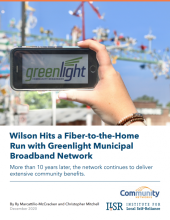
Built in 2008 with an eye toward the future and operated with local priorities in mind, Greenlight has a long track record of putting people first. In a new case study, the Institute for Local Self-Reliance explores the wide-ranging community benefits of Greenlight, the city-owned Fiber-to-the-Home network in Wilson, North Carolina.
Download Wilson Hits a Fiber-to-the-Home Run with Greenlight Municipal Broadband Network.
The case study details how it has been able to quickly adapt and expand service during the pandemic, as well as the host of advantages and overall value brought to the city over the last decade in education, equity, and economic development. For example:
Access for All
Economic Development
Education

In a new case study, the Institute for Local Self-Reliance explores the wide-ranging community benefits of Greenlight, the city-owned Fiber-to-the-Home network in Wilson, North Carolina. The case study details how it has been able to quickly adapt and expand service during the pandemic.
Built in 2008 with an eye toward the future and operated with local priorities in mind, Greenlight has a long track record of putting people first. A few examples are:
Access for All
Economic Development
Education
For the eighth episode of our special podcast series “Why NC Broadband Matters,” Christopher and his guests, Catharine Rice and Jack Cozort, continue their conversation on HB 129, North Carolina’s restrictive law that prevents local governments from investing in broadband infrastructure. The first half of their discussion focused on the years leading up to the passage of HB 129 in 2011. Today, Christopher, Catharine, and Jack talk about the bill itself, the influence of the telecom industry over the state legislature, and how HB 129 has impacted connectivity in North Carolina.
Catharine and Jack explain that local broadband authority became a partisan issue after the 2010 election, which flipped control of the North Carolina legislature to the Republicans. They share their experiences advocating against HB 129, explaining how legislators restricted public comments on the bill by limiting speaking time and rescheduling hearings and meetings. Jack tells Christopher that there were as many as 25 lobbyists representing telephone and cable companies at the state legislature pushing for HB 129. Catharine relates how corruption and a lack of transparency in government are the reasons why the telecom industry successfully got the bill passed.
Christopher and his guests also run through some of the provisions of HB 129, dissecting the telecom monopolies’ misleading arguments in favor of the bill.
This is the second half of a two part discussion. For part one, listen to episode 412 of the Community Broadband Bits podcast.
We produced this episode and the “Why NC Broadband Matters” series in partnership with NC Broadband Matters, a nonprofit organization advocating for better connectivity across North Carolina.
This show is 32 minutes long and can be played on this page or via Apple Podcasts or the tool of your choice using this feed, at the Community Broadband Bits page, or at the NC Broadband Matters page. We encourage you to check out other "Why NC Broadband Matters" content at the podcast feed so you don't miss future bonus content that may not appear in the Community Broadband Bits Podcast feed.
Transcript below.
We want your feedback and suggestions for the show-please e-mail us or leave a comment below.
Listen to other episodes here or view all episodes in our index. See other podcasts from the Institute for Local Self-Reliance here.
Thanks to Shane Ivers for the Music: What's The Angle? by Shane Ivers - https://www.silvermansound.com a Creative Commons Attribution (4.0) license.
We've written a lot about North Carolina's HB 129, the anti-competition law that prevents communities in the state from investing in broadband infrastructure. This week on the Community Broadband Bits podcast, Christopher dives deeper into the history of HB 129 with guests Catharine Rice, co-founder of NC Broadband Matters and project manager at the Coalition for Local Internet Choice, and Jack Cozort, a government relations consultant who has worked with the City of Wilson. In this first half of a two part conversation, Christopher and his guests discuss the years leading up to HB 129, which was passed in 2011, speaking frankly about the sway telecom lobbyists held over state legislators.
To start, Jack describes how Wilson decided to invest in its own broadband network Greenlight, after incumbent providers refused to partner with the city to upgrade the community. He goes on to explain how Wilson's decision led the regional broadband monopolies Time Warner Cable (now Charter Spectrum) and AT&T to advocate for legal restrictions on municipal broadband at the state legislature.
Catharine and Jack review some of the early bills — written by telecom companies and handed off to state legislators — that the monopoly providers introduced in an attempt to stop broadband competition. They share their involvement in those legislative fights and explain how difficult it was to counter the influence that the telecom industry had over politicians in both major parties. However, Catharine points out that there were also Democratic legislators during this time who defended local broadband authority and kept anti-competitive legislation from being passed.
In the November 2010 election, the North Carolina legislature shifted control to the Republican party. Christopher and his guests end the podcast by talking about how that set the stage for HB 129, which would be introduced the next year.
Today's episode is part one of two. Listen to the second half of this conversation on North Carolina's HB 129.
This is a special episode of the "Why NC Broadband Matters" podcast series, created in partnership with NC Broadband Matters, a nonprofit that's working to bring high-quality Internet access to all communities in the state. Previous epsiodes in the series touch on telehealth, the homework gap, and broadband mapping, among other topics relevant to connectivity in North Carolina.
This show is 56 minutes long and can be played on this page or via Apple Podcasts or the tool of your choice using this feed.
Transcript below.
We want your feedback and suggestions for the show-please e-mail us or leave a comment below.
Listen to other episodes here or view all episodes in our index. See other podcasts from the Institute for Local Self-Reliance here.
Thanks to Arne Huseby for the music. The song is Warm Duck Shuffle and is licensed under a Creative Commons Attribution (3.0) license.
"North Carolina State Capitol" by Jim Bowen via Flickr. Used under a Creative Commons Attribution (2.0) license.

As authors at MuniNetworks.org have the opportunity to add to our growing cache of holiday-themed, broadband-centric writings, we try to remember to share classics like this one from 2015. “Twas the Night Before Muni Fiber” was crafted by Tom Ernste and Hannah Trostle. Both have moved on to the next phases of their careers but their contributions to ILSR’s work, including this poem in the style of “A Visit from St. Nicholas” by Clement Clarke Moore will be appreciated for many years to come.
Enjoy, share, and thank you for your support!


Along with family, appreciating what we have, and sharing our benefits, the holidays have a strong sense of tradition. Several years ago, our team put together "Twas The Night Before Muni Fiber" and we've made it a tradition to share it each Holiday Season.
We look forward to more collaborations, challenges, and sharing in 2018. Enjoy and thank you for your support!

Beverly Hills may be known for mansions and upscale shopping, but within a few years, it will also be known for fast, affordable, reliable connectivity. The city is investing in a citywide Fiber-to-the-Premise (FTTP) network for all homes and businesses, including apartments and condos, inside the city.
"90210" Wants Something Better
The city (pop. 35,000) is a little less than six square miles and they receive electricity from Southern California Edison (SCE). AT&T and Spectrum (formerly Time Warner Cable) provide Internet access throughout the community but a 2014 survey as part of the city’s feasibility study indicated that 65 percent of respondents would “definitely or probably” switch to services from the city, if the services were offered. As part of the survey, 25 percent of respondents also want video and voice bundles; 86 percent feel using the Internet at home is important.
While incumbents offer fiber connectivity in commercial areas of Beverly Hills, local businesses report that rates are expensive and they must pay for the cost of construction, which is also a big expense. At a recent City Council meeting when the Council approved funding for the project, the Mayor and Members expressed the need to be an economically competitive city. With Santa Monica, Culver City and Burbank nearby (all communities with municipal networks), Beverly Hills wants to be able to attract businesses looking to relocate or hold on to the businesses that need affordable and reliable gigabit connections.
Nuts And Bolts To Networking

When a community is plagued with poor connectivity, it impacts residents, businesses, schools, and government. Several entities within a community sometimes band together to explore solutions. In Grand Island, New York, the Town Board and the School District are pooling resources in search of possibilities.
Chronically Slow
The town entered into a contract for Internet access with Time Warner Cable, which was purchased by Charter Communications; the company now serves the town under the name “Spectrum.” According to Town Supervisor Nathan McMurray, he’s measured speeds in Town Hall, which dip as slow as 5 to 10 Megabits per second (Mbps). The cable provider claims that its speeds are 50 Mbps. "I can't find anyone who has had 50 Mbps, the fastest I've seen is 25," said McMurray. "Every week I receive screenshots from people complaining."
Grand Island (population approximately 21,000) is in the Niagara River and considered part of Erie County. The county is at the western border of the state with Canada; Buffalo is the nearest American urban center.
A Middle Mile Partnership?
The town and the school district have commissioned a feasibility study to examine the idea of investing in a publicly owned fiber-optic line through the middle of the island. The city hopes the investment will encourage more providers to move into the area and build out last mile infrastructure to serve the community.
School district representatives mentioned that they are satisfied with the service the schools now receive from the Board of Cooperative Educational Services, but are in interested in the benefits of owning the infrastructure:
"By building their own infrastructure (the school district) will have at least as good as service as they do now, but they will own the lines," said McMurray of the potential for a partnership. "And by leveraging the power of the schools the municipal infrastructure will benefit as well. By involving the school this puts this into the realm of possibility."

As federal agencies examine the potential consequences if the AT&T - Time Warner merger is allowed to proceed, how we analyze antitrust also needs to be reevaluated.
A new report from the Roosevelt Institute takes a closer look at how antitrust enforcement philosophy has changed, how that change has enabled our current state telecommunications in which a few large anticompetitive players control the market. The authors offer recommendations and cautionary predictions that may arise if we continue without reassessing how we scrutinize these large scale mergers.
Authors Marshall Steinbaum and Andrew Hwang complement each other with economic and legal approaches. Steinbaum is Senior Economist and Fellow at the Roosevelt Institute and has also written for Democracy, Boston Review, The American Prospect, and The New Republic. He earned his Ph.D. from the University of Chicago Economics Department in 2014. Hwang is a legal fellow at the Roosevelt Institute and has also been an associate at Simpson Thacher & Bartlett LLP, working on transactions involving securities issuance, mergers and acquisitions, and corporate lending. He received his J.D. from the Duke University School of Law in 2014 and B.A. in economics and political science from the University of Chicago in 2011.
The report notes how scrutiny of mergers has come to depend on the perceived harm the results will have on consumers, but such a narrow focus results in harming competition.
Instead, regulators should adopt a more holistic view of market power, specifically incorporating analysis of upstream impact of anticompetitive behaviors, especially those enabled by mergers. This would entail closer scrutiny of vertical mergers, positive price discrimination, and non-price-based schemes to profit excessively by withholding access to consumers.
Several specific recommendations caught our attention as particularly relevant approaches, including:
Regulators should utilize Section 2 of the Sherman Act to a greater degree by taking enforcement actions against antitrust violators, up to and including undoing previous mergers that have proven anti-competitive after the fact.
This is episode 241 of the Community Broadband Bits podcast. John Bergmayer from Public Knowledge joins the show to talk about the "bundle" in the cable industry. Are cable bundles a bargain as advertised? What do customers want? Listen to this episode here.
John Bergmayer: You know the structure of the programing industry and the structure of the cable industry means effectively they're not being served. They’re getting ripped off I believe.
Lisa Gonzalez: This is episode 241 of the Community Broadband Bits podcast from the Institute for Local Self Reliance, I'm Lisa Gonzalez. Cable subscribers often complain about bundling. Being forced to choose from video packages that include channels they don't want in order to get access to the content they do want. Why are we stuck in this model? And what are the ramifications for service providers? Especially now that so much content is available via the Internet. What are some of the concerns smaller cable providers encounter when negotiating for content? This week, Christopher talks with John Bergmayer, Senior Counsel from Public Knowledge who explains why Comcast and Time Warner Cable and other cable companies are so in love with the bundle. They discuss why it's difficult to move past this model and whether or not bundles are a bargain, as they are described in advertising. Or something quite different. Now here's Christopher and John Bergmayer, Senior Counsel at Public Knowledge, discussing unbundling and the world of cable.
Christopher Mitchell: Welcome to another edition of the Community Broadband Bits podcast. I'm Chris Mitchell. Today I'm speaking with John Bergmayer, Senior Counsel for Public Knowledge, a non-profit organization in Washington, DC. Welcome to the show!
John Bergmayer: Yeah, thanks for having me Chris.
Christopher Mitchell: John, can you tell us a little bit about what Public Knowledge does for people that haven't been around to hear past interviews with Chris Lewis and Harold Feld and other great people that you have on staff?