Image

Fast, affordable Internet access for all.
Two years after launching a community-based model to help residents overcome the digital skills challenges that keep so many offline, the National Digital Inclusion Alliance (NDIA) announced in February 2022 that it has received a $10 million grant from Alphabet subsidiary Google to dramatically expand the impact of its Digital Navigator Corps model across the country. The money will allow NDIA to take the Corps nationwide to 18 new rural communities (including Tribal sites), helping thousands of people overcome adoption barriers with the help of local experts.
Filling a Need at the Onset of the Covid-19 Pandemic
In August of 2020, NDIA first announced the launch of its new venture - the Digital Navigator initiative - to directly reach the many households across the United States that have access to wireline infrastructure but lack the knowledge, skills, trust, or comfort to turn that possibility into an affordable connection. The goal was to help people “get connected with affordable home Internet [access], find affordable computing devices, and learn basic digital skills,” and was borne directly out of the onset of the Covid-19 pandemic the previous spring.
The Salt Lake Public Library and Rural LISC were pilot partners, but NDIA has since worked with more than 20 organizations and communities over the last two years in addition to releasing a cornucopia of resources for cities and anchor institutions that to adapt and use as they see fit, in places as wide ranging as Austin, Cleveland, Denver, Nashville, Philadelphia, Portland, Providence, and Seattle. All of this work has led to refinement of the Digital Navigator model while also helping thousands get and stay online.

The Schools, Health, & Libraries Bradband Coalition is hiring for a new position that will work with state and federal policymakers to advance its mission to “to close the digital divide by promoting high-quality broadband for anchor institutions and their communities.”
From the call for applicants, SHLB is looking for someone who “has a graduate degree in public policy or a law degree, 3-7 years of broadband or technology policy experience and strong writing skills. This person will work with federal and state policy-makers, including on Capitol Hill, regarding broadband policy issues and funding programs. Knowledge of broadband and technology policy issues preferred. Physical location in the Washington DC area is preferred but not required.”
Duties for the Policy Advocate/Director include:
- Working with the Executive Director to develop and implement policy positions to promote our mission.
- Leading calls with SHLB members to formulate advocacy strategies.
- Initiating meetings and developing relationships with policymakers.
- Organizing speakers for our events, including our Annual Conference in October.
- Analyzing and suggesting changes to federal and state legislation.
- Drafting and filing comments with the FCC, NTIA and other government agencies.
- Representing the SHLB Coalition in other coalitions and interacting with our allies on a regular basis.
- Speaking at broadband conferences around the U.S.
SHLB is seeking candidates for the position who have:
On this episode of the Community Broadband Bits podcast, Christopher Mitchell talks with John Windhausen, Executive Director of the Schools, Health, Libraries and Broadband Coalition (SHLB) and Alicja Johnson, SHLB Communication Manager. The nonprofit advocates for anchor institutions to be at the table when communities are considering building municipal fiber networks. This is because these institutions are not only the cornerstones of healthy communities, but also well positioned as gateways for bringing reliable broadband to every household.
Windhausen and Johnson cover the wide array of specific projects SHLB has going on, from work on the Emergency Connectivity Fund, to telehealth efforts, to larger picture efforts they participate in, specifically, the future of spectrum and its role in expanding wireless networks across the country.
This show is 41 minutes long and can be played on this page or via Apple Podcasts or the tool of your choice using this feed.
Transcript below.
We want your feedback and suggestions for the show-please e-mail us or leave a comment below.
Listen to other episodes here or view all episodes in our index. See other podcasts from the Institute for Local Self-Reliance here.
Thanks to Arne Huseby for the music. The song is Warm Duck Shuffle and is licensed under a Creative Commons Attribution (3.0) license.
On this episode of the Community Broadband Bits podcast, Christopher Mitchell is joined by broadband analyst and telehealth advocate, Craig Settles; Dianne Connery, Special Projects Librarian in Pottsboro, Texas; and Adam Echelman, Executive Director of Libraries Without Boarders, to talk about how libraries are the cornerstones of information access for communities across the country.
Libraries have been connecting communities to resources and services for decades, but with the digital age, libraries are answering the same call for action with Internet access and digital literacy. Connery shares her firsthand experience working in a library in Pottsboro, Texas where there are no doctors in town and telehealth access has become crucial, especially with the pandemic. The group also talks about the importance of libraries connecting those who would otherwise not have Internet access and how that is becoming an absolute necessity with the way education and healthcare are changing.
For another resource, check out Craig's new guide to help librarians uncover patrons’ healthcare needs, create health milestones for they community, and effectively market telehealth and broadband grant proposals: Shhhhhh! The Doctor is In [pdf].
This show is 35 minutes long and can be played on this page or via Apple Podcasts or the tool of your choice using this feed.
Transcript below.
We want your feedback and suggestions for the show-please e-mail us or leave a comment below.
Listen to other episodes here or view all episodes in our index. See other podcasts from the Institute for Local Self-Reliance here.
Thanks to Arne Huseby for the music. The song is Warm Duck Shuffle and is licensed under a Creative Commons Attribution (3.0) license.
Schools offer not only education, but nourishment, a place to form friendships and bonds, and a way to make sure youth are safe. When the pandemic hit, schools had to transition to distance learning and, as a result, many students disappeared because their family didn’t have access to or couldn’t afford a home Internet connection. It became immediately clear, all over the country, that a lack of broadband access and broadband affordability were no longer issues that could be ignored.
Many cities throughout the U.S. have been working over the last year to address this issue, but one city in particular - Columbus, Ohio - has been taking a holistic approach to broadband access.
The Franklin County Digital Equity Coalition was borne out of the emergency needs presented by the pandemic, but has shaped up to be a good model for how to address the broadband issues facing urban communities across the country.
After 11 months of meeting and planning, the coalition released a framework in March outlining its five pillars of focus: broadband affordability, device access, digital life skills and technical support, community response and collaboration, and advocacy for broadband funding and policy.
The coalition also developed two pilot programs to increase broadband access.
The first, which was a quickly deployed and desperately needed response to the lack of broadband access, was the Central Ohio Broadband Access Pilot Program. Launched in September 2020 in anticipation of the upcoming school year, it offered hotspot devices with unlimited data plans to central Ohio households with k-12 students. The program, while still growing, has been deployed with about 2,300 hotspots distributed so far with the help of PCs for People.
The second (the City of Columbus and Smart Columbus Pilot Projects) uses the city’s existing fiber backbone to bring affordable Internet service to the Near East and South Side neighborhoods in Columbus.
Both pilot programs are the result of nearly 30 organizations coming together to get affordable access to some of the city and county’s most vulnerable populations.
There’s Power in Numbers
In August we first covered the National Digital Inclusion Alliance’s new Digital Navigator’s program, which provides a best-practices model for organizations looking to use local resources to help neighbors learn the skills and overcome their reluctance to getting online. This week on the podcast Christopher welcomes Paolo Balboa, Program Manager at the National Digital Inclusion Alliance and Shauna Edson Digital Inclusion Coordinator, at the Salt Lake City Public Library to dive deeper into the program and talk about lessons learned so far.
The group dives right into what digital equity means both in policy and practice, and how we can be more thoughtful about both. Paolo shares the history behind the idea of the NDIA’s Digital Navigator Program and how it came to fruition, helpfully, right at the start of the pandemic.
Shauna talks about the challenges Digital Navigators confront head on in communities, from helping residents overcome lack of familiarity with new devices, to learning to navigate the web, to connecting with local resources. Both Shauna and Paolo stress that successful forward progress will come from the presence of ongoing programs staffed by fellow community members, and Shauna shares the progress made in Salt Lake City so far.
This show is 32 minutes long and can be played on this page or via Apple Podcasts or the tool of your choice using this feed.
Transcript below.
We want your feedback and suggestions for the show-please e-mail us or leave a comment below.
Listen to other episodes here or view all episodes in our index. See other podcasts from the Institute for Local Self-Reliance here.
Thanks to Arne Huseby for the music. The song is Warm Duck Shuffle and is licensed under a Creative Commons Attribution (3.0) license.

Podcasts can be a great way to glean important insights on all things broadband – from the policies and politics that shape the digital landscape to the pathways and platforms that connect us to or keep us from the Internet.
If you haven’t already tuned into our own weekly podcast, "Broadband Bits", consider this an invitation to do so. (Or the brand new Connect This show.) But, we also want to highlight two new limited podcast series that we think are worth checking out.
#SpreadtheTech
One is #SpreadtheTech created by the National Digital Inclusion Alliance (NDIA) and Digital Charlotte – a ten-episode series that “showcases interviews with digital inclusion stakeholders and practitioners from across the country highlighting their community-based efforts to address the digital divide.” This Verizon-sponsored podcast is hosted by NDIA Executive Director Angela Siefer, Digital Charlotte’s Executive Director Bruce Clark, and the Director of Operations for Digital Charlotte, Andrew Au.
In the first four episodes, #SpreadtheTech covers how digital inclusion advocates have pivoted their work to focus on the significance of Internet connectivity as we deal with the on-going Covid-19 pandemic.
The first episode looks at how the North Carolina Department of Information Technology is responding to connectivity challenges brought on by Covid-19. The featured guest of that episode is Amy Huffman, Digital Inclusion and Policy Manager for the Broadband Infrastructure Office within the North Carolina Office of Information and Technology Services.
Huffman reports on how the state created an interactive searchable map that allows North Carolina residents to enter their address to see if they have access to one of the discount or low-cost programs the state’s Internet Service Providers (ISPs) are offering. The map also shows the locations of community anchor institutions (libraries, schools, and community colleges) which have Wi-Fi hotspots in their parking lots that allow residents to access the Internet from their cars.
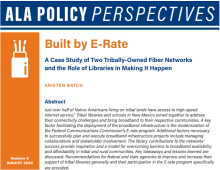
A new report out by the American Library Association shows how community anchor institutions — and libraries in particular — can serve as central players in expanding tribal connectivity efforts around the country. “Built by E-rate: A Case Study of Two Tribally-Owned Fiber Networks and the Role of Libraries in Making It Happen" [pdf] looks at the striking success of tribal efforts in New Mexico in putting together a coalition of actors to dramatically improve Internet access in the region.
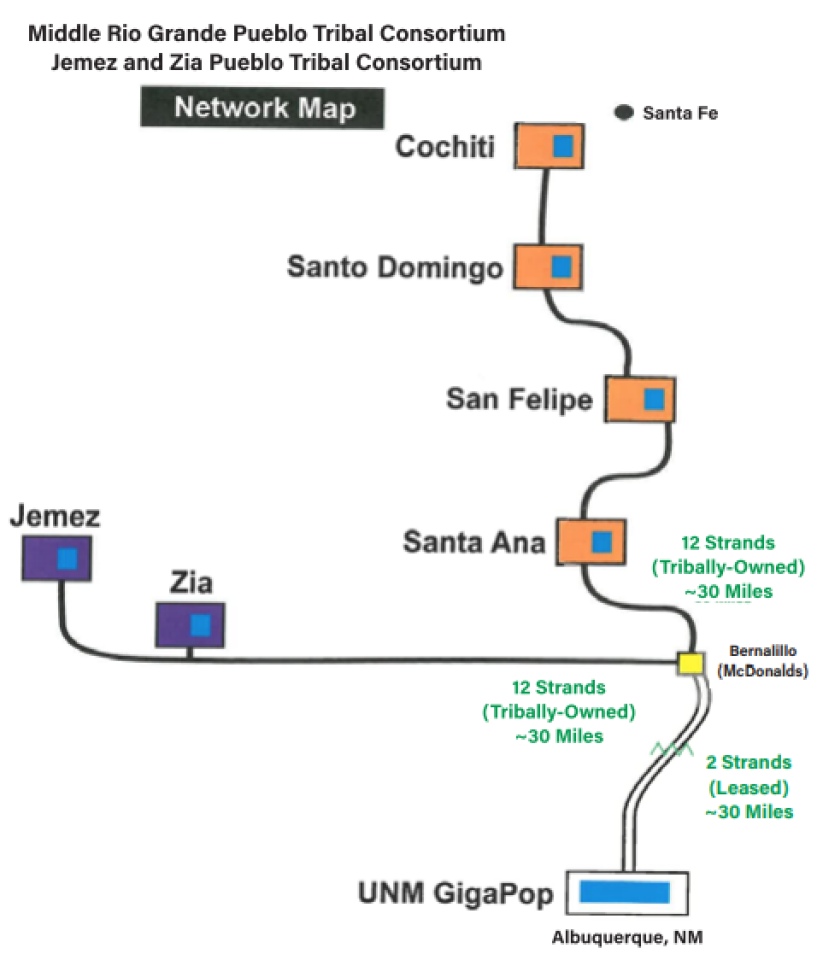
The report examines networks built by two consortiums situated in the middle of the state in the summer of 2018: the Middle Rio Grande Pueblo Tribal Consortium and The Jemez and Zia Pueblo Tribal Consortium. An endeavor initially spearheaded by the Santa Fe Indian School (which long ago recognized the need for virtual learning, the value of fast, affordable Internet and the ongoing cost of slow, poor, high monthly costs), “Built by E-Rate” details how they came into being and the obstacles they faced along the way, and offers policy recommendations moving forward.
Image
Faster Speeds, Lower Costs
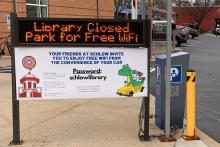
Visitors to libraries across the country are being greeted with signs declaring, “Library Closed,” in an attempt to contain the spread of the novel coronavirus. But increasingly, those words are followed by the ones seen outside Schlow Centre Region Library in State College, Pennsylvania: “Park for Free Wi-Fi.”
As the Covid-19 outbreak pushes almost all daily functions online, libraries, schools, and Internet service providers (ISPs) are finding themselves on the front lines of responding to their communities’ connectivity needs — especially those of students. Nationwide, these broadband first responders are working rapidly to open and deploy public Wi-Fi hotspots that families can access from the safety of their parked cars.
Even before the current crisis, the “homework gap” meant that 7 million school-age children did not have Internet access at home, hampering their ability to get an education. Now, the digital divide is being thrown into even starker relief, as students struggle to access online classes and school districts grapple with equity concerns.
Though it isn’t a permanent solution to the homework gap, these community institutions and providers hope that the emergency Wi-Fi access will give students on the wrong side of the divide a chance to learn while schools are shut down.
Students Trade Desks for Cars
Earlier this week, the American Library Association (ALA) recommended that libraries leave their Wi-Fi turned on and accessible while facilities are closed. In a press release, ALA stated:
In late October 2019, Christopher travelled to the D.C. area to attend a Broadband Communities Economic Development event and while he was there, he sat down with Executive Director Adrianne Furniss and Senior Fellow Jon Sallet from the Benton Institute for Broadband & Society. This week, we get to sit in on their conversations about the recent change at Benton from "foundation" to "institute" and about their recent report, Broadband for America's Future: A Vision for the 2020s.
First, Christopher speaks with Adrianne, who discusses the reasons why the organization has recently changed in order to stay current with their mission and with the times. She talks a little about the history of Benton and describes some of the reasons for developing the report.
Christopher spends most of the interview with Jon Sallet, who authored the report and who has a long career in antitrust and communications. After working in D.C. in telecommunications and Internet policy for several decades, he's seen the influence of the Internet grow. In this report, Jon analyzes stories and situations from around the U.S. and establishes a vision that will help us move forward to connect as many people as possible. He and Christopher discuss the four major factors that, if nurtured correctly, can help us integrate broadband into all sectors of society and maximize its usefulness. Christopher and Jon give special time to competition, an issue that arises repeatedly in the work at Benton and in our work at the Institute for Local Self-Reliance.
The interview will spark your interest in the report that provides more depth into the way broadband can be used as a versatile social tool. Broadband for America's Future: A Vision for the 2020s [PDF] is filled with examples in which local communities have been able to expand local connectivity to achieve goals that went beyond better Internet access.
This show is 41 minutes long and can be played on this page or via Apple Podcasts or the tool of your choice using this feed.
Transcript below.
We want your feedback and suggestions for the show-please e-mail us or leave a comment below.
Listen to other episodes here or view all episodes in our index. See other podcasts from the Institute for Local Self-Reliance here.
Thanks to Arne Huseby for the music. The song is Warm Duck Shuffle and is licensed under a Creative Commons Attribution (3.0) license.