Image


Fast, affordable Internet access for all.
A new report out by the American Library Association shows how community anchor institutions — and libraries in particular — can serve as central players in expanding tribal connectivity efforts around the country. “Built by E-rate: A Case Study of Two Tribally-Owned Fiber Networks and the Role of Libraries in Making It Happen" [pdf] looks at the striking success of tribal efforts in New Mexico in putting together a coalition of actors to dramatically improve Internet access in the region.
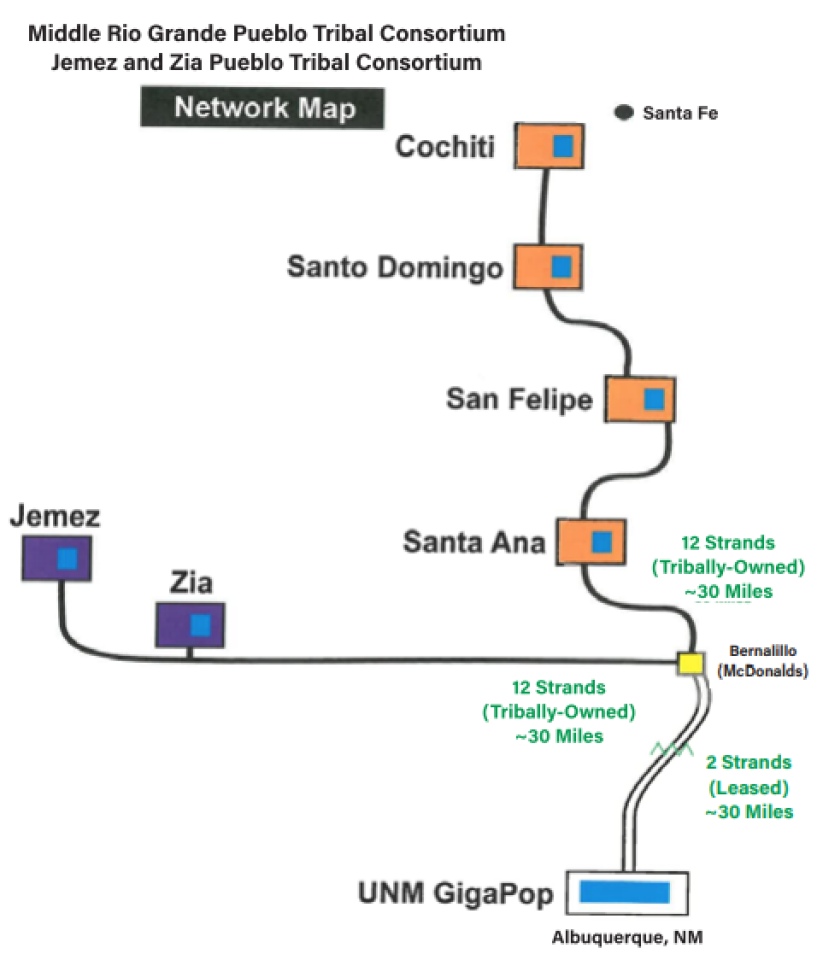
The report examines networks built by two consortiums situated in the middle of the state in the summer of 2018: the Middle Rio Grande Pueblo Tribal Consortium and The Jemez and Zia Pueblo Tribal Consortium. An endeavor initially spearheaded by the Santa Fe Indian School (which long ago recognized the need for virtual learning, the value of fast, affordable Internet and the ongoing cost of slow, poor, high monthly costs), “Built by E-Rate” details how they came into being and the obstacles they faced along the way, and offers policy recommendations moving forward.
Image
Faster Speeds, Lower Costs

The fifth anniversary of the announcement of the KentuckyWired project is approaching later this year. As voters start to assess their candidates’ job performance, the unfinished and over budget middle mile public-private partnership (P3) has become an albatross that incumbents aren’t able to easily cast off. When we last discussed the project in 2017, we shared our observations and misgivings. Not much has changed, except some of our concerns have played out and the project has become troubled by new problems.
In Case You’re Just Arriving to the Party…
The statewide, massive middle mile project officially began when Kentucky announced in late 2014 that they would build a fiber optic network in order to bring better connectivity to rural areas. They planned to find a private sector partner and sought bids. In the fall of 2015, Australian firm Macquarie won the contract for what soon became an even larger endeavor — a fiber optic network that would enter every county in the state at a minimum of one location. The network would consist of approximately 3,200 miles of fiber and connect about 1,000 public facilities. At the time the project was developed, the state estimated that deployment would cost approximately $300 million.
With early bipartisan support, the state allocated $30 million from their budget, which they expected to combine with $23.5 million in federal grants. When the Kentucky Economic Development Finance Authority issued $232 million in tax-exempt revenue bonds and $58 million in taxable revenue bonds to complete financing, Bond Buyer named the issue the “Deal of the Year” for 2015. Macquarie’s timeline estimated an optimistic one-year completion for the entire statewide project.
Last fall, the northern Minnesota community of Ely took up a feasibility study to determine the possibilities of better connectivity with publicly owned Internet infrastructure. They also wanted to explore local interest in investment. After conducting a survey and reviewing the situation, local officials are contemplating moving ahead with two pilot projects.
A Big Demand
Citizens’ group, Ely Area Broadband Coalition (Ely ABC) and the Ely Economic Development Authority (EEDA) collaborated to manage the feasibility study process. In 2016, the Blandin Foundation, the Iron Range Resources Rehabilitation Board (IRRRB), and St. Louis County awarded the city $25,000 which they’ve dedicated toward their efforts to improve local connectivity.
In order to gauge the community’s current feeling about the quality and cost of the services they purchase from area cable and DSL providers, the Ely ABC and the EEDA encouraged area residents and businesses to compete a survey last fall. They wanted evidence to share with potential funding sources that the community was not being served. Community leaders also expected the results to help them decide which direction to take moving forward.
At a recent EEDA meeting, members discussed the survey results and the potential pilot projects.
“We want to see how people are satisfied with what they have and what they feel the needs are,” said Harold Langowski, the city’s clerk-treasurer. “Right now we are assuming everybody wants faster broadband. and that they’re not satisfied with what we have. But we’re only hearing that from people on the committee.”

As schools across the country look at their budgets, Janesville, Wisconsin, has decided to cut their future expenses with a fiber optic investment. This spring, the district will use E-rate funding to help finance a fiber optic local area network (LAN) in order to cut telecommunications costs by $70,000 per year.
Connecting Facilities
The school district will install 12 lines, eliminating leased lines and the associated expense. E-rate funds will pay for $1.6 million of the estimated $2 million project; the school district’s contribution will be approximately $400,700 and an additional $225,000 for engineering and project fees. School district officials calculate their contribution will be paid for in nine years. Fiber optic networks have life expectancies upwards of 20 years and in Janesville, District CIO Robert Smiley estimates this project will last for 50 years.
At a recent Board meeting, Smiley told the members that the new network will be like transitioning “to our own private Interstate.” In addition to better prices, the new infrastructure will allow the district to ramp up speeds to ten times what they current share between facilities. The system Janesville School District uses now has been in place since the 1990s.
The federal E-rate program started during the Clinton administration as a way to help schools fund Internet access and has since been expanded to allow schools to use if for infrastructure. School districts obtain funding based on the number of students in a district that are eligible for the National School Lunch Program. Funding for E-rate comes from the School and Libraries Program from the Universal Services Fund.
“Hello, Savings!”
Like many other schools that have chosen to switch to a district owned fiber network, Janesville sees a big advantage for voice communications. Due to the age of their phone system, they’ve had failures in the past. Last winter during a day of inclement weather, a large volume of incoming calls from parents overloaded the system and other parents who had signed up for emergency alerts on their phones didn’t receive them. With a new fiber network, the school district will be able to switch to VoIP.

With the best intentions, Kentucky announced in late 2014 that it would build out a statewide open access fiber optic network to at least one location in each county to encourage high-quality connectivity in both urban and rural communities. Hopes were high as rural residents and businesses that depended on DSL and dial-up envisioned connectivity to finally bring them into the 21st century. After almost three years and multiple issues that have negatively impacted the project, legislators and everyday folks are starting to wonder what's in store for the KentuckyWired project.
Local Communities Are Best Suited To Deploy Community Networks
There is no one-size-fits-all method of deploying across a state filled with communities and landscapes as diverse as Kentucky. From the urban centers like Louisville and Lexington to the rocky, mountainous terrain in the southeastern Appalachian communities, demographics and geography vary widely. But most lack modern Internet access and local ISPs have found it hard to get affordable backhaul to connect to the rest of the Internet.
There are several municipal networks in Kentucky, some of which have operated for decades. In addition to Glasgow, Paducah, Bowling Green, Frankfort, and others, Owensboro is currently expanding a pilot project that proved popular. As our own Christopher Mitchell discussed at the Appalachia Connectivity Summit, several cooperatives have made major fiber-optic investments in the state.
When it comes to connecting residents and local businesses, we strongly believe local entities are the best choice. Local officials have a better sense of rights-of-way, the challenges of pole attachments, and the many other moving pieces that go into network investment. Projects with local support see fewer barriers - people are more willing to grant easements, for instance.

Chippewa Valley Electric Cooperative (CVEC) and local communications cooperative Citizens Connected are joining forces to improve Internet access in rural northern Wisconsin.
Collaborating For Connectivity
The two cooperatives recently announced that they will invest in fiber infrastructure to connect residents, businesses, and schools through a new entity called Ntera. Construction will start in Holcombe, population around 300, because it’s one of the communities with the worst Internet access within the CVEC service area. Construction in Holcombe should begin this fall.
Ntera will offer 1 Gigabit per second (1,000 Mbps) connectivity to premises in addition to voice and video. Rates have yet to be determined. CVEC’s service area includes approximately 7,500 premises within five counties. Citizens Connected has already invested in fiber infrastructure passing more than 3,200 premises.
Holcombe is a census-designated place in the town of Lake Holcombe, where the population is a little more than 1,000. Even though they’d like to, Lake Holcombe schoolteachers don’t offer devices to students because so many of them don’t have Internet access at home. Superintendent Jeff Matin says that more than half of the students don’t have Internet access because it isn’t available in their home or just too expensive.
The Lake Holcombe schools will use $80,000 in E-rate funding and state grants to connect to existing fiber in the community that will be incorporated into the larger network. Although the school district is obtaining funding to connect, the cooperatives are funding the network investment themselves. They have not yet released a final estimate for the cost of the project. School officials look forward to the educational opportunities the new fiber will bring:
Mastin is eager to have the improved broadband in the Holcombe area. Right now, there is Internet in the school building only.
“We’ll be able to have our community having easier access to the Internet,” Mastin said. “We could give (students) more devices to allow them to connect to it. It’s definitely needed for education in the 21st century.”

With a growing need for fast, affordable, reliable connectivity, an increasing number of schools are constructing fiber optic infrastructure to serve their facilities. In some cases, they partner with local government and a collaboration eventually leads to better options for an entire community. Schools in Orange County, Virginia, will be working with county government to build a $1.3 million network.
Quickly Growing Community
Orange County’s population of approximately 34,000 people is growing rapidly, having increased by 29 percent between 2000 and 2010. Nevertheless, it’s primarily rural with no large cities. Gordonsville (pop. 1,500) and Orange (pop. 4,800 and the county seat) are the only towns. Another community called Lake of the Woods is a census-designated place where about 7,200 people live. The rest of the county is filled with unincorporated communities. There are 343 square miles in Orange County of rolling hills with the Blue Ridge Mountains to the west.
Manufacturing and retail are large segments of the economy with 65 percent of all business having four or less employees as of 2013. Agriculture is also an important part of the community, including the growing local wine industry.
Working Together To Connect The County
The county and schools have teamed up to commence a multi-step project that begins by connecting the Orange County Public Schools’ facilities. A 33-mile wide area network (WAN) will connect all eight buildings. Federal E-rate funds will pay for approximately 80 percent of the deployment costs and Orange County and the school district will share the remaining costs from other funding. The partners plan to deploy extra capacity for future uses.
Once the first phase of the network is complete, the county hopes to use the excess capacity to improve public safety operations. Sheriff, Fire, and EMS services need better communications so the county intends to invest in additional towers, which will also create an opportunity for fixed wireless and cellular telephone providers.

Public Knowledge recently released a video on changes in the new administration’s FCC policies. One by one, progress made during the last eight years is being sliced up and doled out to the detriment of ISP subscribers.
Public Knowledge describes the video like this:
This video draws attention to the growing list of giveaways by Congress and Federal Communications Commission Chairman Pai to large cable and telecommunications companies that act as local broadband monopolies.
The video, which functions as a broad statement of themes, uses a series of pie slices to detail what consumers fear about the new administration’s telecommunications policy positions, in general language. The pieces of pie reflect multiple potential giveaways being heaped onto big cable and phone companies’ plates.
From selling private data without consent and eliminating some companies’ ability to offer affordable broadband, to forcing consumers to rent set-top boxes and embarking upon efforts to kill net neutrality, FCC Chairman Pai and many in Congress are promoting policies that give consumers the short end of the stick.
Check it out:

When a community is plagued with poor connectivity, it impacts residents, businesses, schools, and government. Several entities within a community sometimes band together to explore solutions. In Grand Island, New York, the Town Board and the School District are pooling resources in search of possibilities.
Chronically Slow
The town entered into a contract for Internet access with Time Warner Cable, which was purchased by Charter Communications; the company now serves the town under the name “Spectrum.” According to Town Supervisor Nathan McMurray, he’s measured speeds in Town Hall, which dip as slow as 5 to 10 Megabits per second (Mbps). The cable provider claims that its speeds are 50 Mbps. "I can't find anyone who has had 50 Mbps, the fastest I've seen is 25," said McMurray. "Every week I receive screenshots from people complaining."
Grand Island (population approximately 21,000) is in the Niagara River and considered part of Erie County. The county is at the western border of the state with Canada; Buffalo is the nearest American urban center.
A Middle Mile Partnership?
The town and the school district have commissioned a feasibility study to examine the idea of investing in a publicly owned fiber-optic line through the middle of the island. The city hopes the investment will encourage more providers to move into the area and build out last mile infrastructure to serve the community.
School district representatives mentioned that they are satisfied with the service the schools now receive from the Board of Cooperative Educational Services, but are in interested in the benefits of owning the infrastructure:
"By building their own infrastructure (the school district) will have at least as good as service as they do now, but they will own the lines," said McMurray of the potential for a partnership. "And by leveraging the power of the schools the municipal infrastructure will benefit as well. By involving the school this puts this into the realm of possibility."

The Missoula County Public Schools (MCPS) plans to save $150,000 per year by investing in its own fiber infrastructure. Over a 20-year period school officials expect to save approximately $3 million.
Fiber For Education And Savings
MCPS will be the first in the state to self-provision its wide area network (WAN), the connections between district facilities. Right now, the school pays approximately $287,000 per year to lease its WAN connections and for Internet access; about $200,000 of that figure is dedicated to leasing the WAN.
School officials were already leasing lit fiber service when they began investigating options to compare cost and service. They also looked at leasing dark fiber, which would mean they would need to maintain the equipment to light the fiber themselves, and investing in an Indefeasible Right of Use (IRU). The IRU would give the school district the ability to use a designated number of fiber strands to use as they wished for a fixed period of time.
As other school districts around the country are discovering, the best choice for them was to own the infrastructure and control it themselves:
"We're saving the district $3 million over the next 20 years in the general fund that will be able to be allocated to other things," Littman said of self-provisioned fiber. "It's more than $3 million, actually. The reason we say we'll only end up saving the general fund $3 million in the end is because we do have some annual maintenance costs to incur to protect the fiber."
Leasing lit fiber for the speeds MCPS needs would have cost $1.5 million to $3.1 million for only a five-year contract. A dark fiber 10-year contract would have cost about $3 million.
Right now, the school pays approximately $287,000 per year to lease its WAN connections and for Internet access; about $200,000 of that figure is dedicated to leasing the WAN. The school will still need to contract for Internet access from an Internet Service Provider (ISP).