Image


Fast, affordable Internet access for all.
It's a new year, which means there's plenty to talk about in the broadband space. Join us live on Friday, January 6th, at 2:00pm ET for the latest episode of the Connect This! Show. Co-hosts Christopher Mitchell (ILSR) and Travis Carter (USI Fiber) will be joined by regular guests Kim McKinley (UTOPIA Fiber) and Doug Dawson (CCG Consulting) to talk about the recent renomination of Gigi Sohn to the FCC, why location challenges won't matter for state BEAD allocations (and why that's a big deal), and what the planning funds will do for states preparing for infrastructure money. Later, Dane Jasper (Sonic) joins the show to talk about the recent announcement by AT&T and BlackRock private equity of a joint venture to help the monopoly provider enter markets outside of states where it has traditionally operated. Finally, Roger Timmerman (UTOPIA Fiber) joins live from the Consumer Electronics Show (CES) in Las Vegas to share the trends making household bandwidth demands continue to rise.
Email us at broadband@muninetworks.org with feedback and ideas for the show.
Subscribe to the show using this feed or find it on the Connect This! page, watch on YouTube Live, on Facebook live, or below.

Calloway County (pop. 39,000) in western Kentucky is known for the picturesque shorelines circling Kentucky Lake, the wildlife at Land Between The Lakes National Recreation Area, and as the home of Murray State University where Ja Morant dazzled basketball fans before becoming an NBA phenom.
Now there's a different team coming to town that will delight local residents: a new partnership between Calloway County and West Kentucky and Tennessee (WK&T) Telecommunications Cooperative will soon make this rural corner of the state known as a home for high-speed Internet connectivity, as the county and WK&T recently announced they were joining forces to expand the cooperative’s existing fiber network to reach every unserved and underserved location in the county.
Calloway County and WK&T are each committing a $6.2 million matching contribution for the first phase of the expansion project, which will see the co-op’s fiber-to-the-home network in the region extended 236 miles to serve an additional 4,274 homes and businesses.

During fire season in Northern California - when the sky often turns dusky with smoke in the middle of the day and the air quality can get so bad that officials declare it unhealthy to be outdoors - access to high-speed Internet connectivity is all-important.
For local governments, fast, reliable, and resilient Internet service is crucial for public safety communications. When flames engulf the region, relaying critical emergency information with speed is paramount. Seconds matter. It’s equally important for citizens to get timely information on the course of wildfires, receive alert notifications or evacuation orders, and be able to connect with friends and family.
Living in that reality is one of the driving reasons the Chico City Council recently voted to earmark $5 million of the city’s $22 million in federal American Rescue Plan funds to research and implement a plan to improve citywide Internet access.
City council members have already authorized spending $250,000 of the funds to develop a Broadband Master Plan in conjunction with EntryPoint Networks. The plan is projected to be completed by October, and once it is finished the City Council will decide where to go from there.
City officials are also in the process of surveying the city’s 115,000 residents to gauge community interest in building a municipally-owned open access fiber network. Responses to the survey so far have indicated residents are excited about the potential of a municipal broadband offering, the city’s Administrative Services Director, Scott Dowell, told ILSR in a recent interview. Dowell said he’s noticed three recurring themes in the survey responses to date: “They want it to be reliable, inexpensive, and fast.”
Although no plans have been finalized and the city is open to various approaches to improve Internet access, Dowell said the city’s lofty goal is to enable symmetrical gigabit Internet service to all premises in Chico for a monthly access fee of no more than $100.
Improving Emergency Communications in the Face of Forest Fires

On Episode 265 of the Techdirt podcast, Sonic CEO Dane Jasper joins host Mike Masnik to talk about how the broadband market in the United States is a failed competitive market, how the regulatory environment brought us from a place with thousands of Internet Service Providers (ISPs) to one where the vast majority of households have just one or two options at basic broadband speeds of 25/3 Megabits per second (Mbps), the arbitrariness of imposing usage caps and future of net neutrality, and the array of other interrelated issues that will dictate the way Internet access looks over the next decade.
Happy Holidays!
Just a quick note - this was an excellent, candid discussion about Internet access policy that featured Phil Dampier from Stop the Cap and Rachel Barnhart, a NY legislator from Monroe County.
The show is Connections with Evan Dawson. It is a 51-minute discussion and is far more reality-based than most that we come across.

The federal government is about to spend more than $120 million on subsidies that, rather than improving rural connectivity, will make tens of thousands of families worse off.
These funds are part of a 2018 federal program intended to expand rural broadband access called the Connect America Fund phase II (CAF II) reverse auction. The program, in which Internet access providers competed for subsidies, will distribute nearly $1.5 billion over the next 10 years to connect unserved rural residents. But in some communities, the auction may do more to widen the digital divide than diminish it.
While some winning bidders committed to building out high-speed fiber optic networks, satellite company Viasat will rake in more than $120 million in subsidies to continue providing inadequate geostationary satellite connectivity to rural households that are clamoring for something better. Not only does satellite Internet access offer slower speeds, greater latency, and less reliability for a higher cost compared to other technologies, but Viasat’s subsidies are making those areas ineligible for future broadband funds, deterring other providers from building truly high-quality networks. Instead of bridging the digital divide, the process will relegate certain communities to satellite Internet access while others receive ultra-fast fiber and do nothing more than deepen the fissure.
Mo’ Money . . .
The Connect America Fund (CAF) is a multi-phase subsidy program that supports improved connectivity in rural, high-cost areas as part of the Federal Communications Commission's (FCC’s) Universal Service Fund. The most recent phase of the program, the CAF phase II reverse auction, auctioned off regions to providers using a complicated formula that prioritized bids for low subsidy amounts and high-quality service.
Previous rounds of CAF mainly subsidized the large incumbents, such as AT&T and CenturyLink, but for the reverse auction, the FCC opened participation to other entities, including non-traditional providers like electric cooperatives. Eligible areas included rural locations where the incumbents had previously refused subsidies (and the accompanying commitment to expand Internet access).

By now, you’ve met the people of “Villageville,” the imaginary town in rural America that, like many similarly situated communities, are struggling to find better connectivity. This week, we continue our soap opera saga “From Crops to Co-ops: Small Towns Want Better Internet.”
In this episode, the kids of the community are working on another big homework assignment and gather together at the neighbor’s house to tap into his satellite Internet access. Watch to find out the results when Grumpy Gary tells the kids to “get off his lawn.”
In rural areas with low population density, large corporate Internet access providers don’t find the motivation they need to invest in fast, affordable, reliable connectivity. High numbers of residents and businesses depend on satellite Internet access as a last resort. Plans are expensive, unreliable, and typically include data caps. In episode 3, we include pop-up information about satellite Internet access and how communities who must use it settle for less than they deserve.
Don’t miss another opportunity to hear the Very Amateur Acting Troupe from the Community Broadband Networks Initiative and the Institute for Local Self-Reliance fill the roles of local people who are just trying to get online to get stuff done.
If you want to get caught up first, read up on the storyline from episode 1 here or watch it below. You can also check out the synopsis of episode 2 and watch it below to experience the whole story from the start. Share the series playlist, where we'll continue to add episodes as we release them.
Next week we attend a city council meeting in Villageville in which residents and community leaders decide what to do about poor Internet access in their community. Don't miss it!
You can get caught up on the saga here with episode 1:

Much like the the bone-chilling flicks celebrating eerie entertainment that dwells in the depths of our dark imaginations, monster cable and DSL Internet service providers strike terror in the hearts of subscribers…if they survive. Mesmerizing fees, hair-raising customer service, and shockingly slow connections can drive one to the brink of madness.
In celebration of Halloween 2016, our writers each selected a national ISP and reimagined it as a classic horror character. The results are horrifying! Read them here…if you dare!
AT&T’s Frankenmerger
by Kate
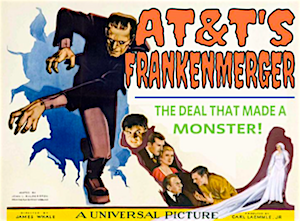
This shocking film tells the horrific tale of a mad scientist in his quest to create the world’s largest telecommunications monopoly monster. The scientist’s abomination runs amok, gobbling up company after company, to create a horrifying monster conglomerate. Watch the monster terrorize towns across America as it imposes data caps, denies people access to low-cost programs, and refuses to upgrade infrastructure. What nightmare lies ahead? Will the townsfolk and their elected officials unite to stop the monster, before it acquires Time Warner? Watch and find out!

The Mummy From Last CenturyLink
by Scott

A recent Wall Street Journal (WSJ) article (requires subscription) chronicles the increasingly problematic effect of data caps on the quality of residential subscribers' Internet access experience.
Also known as a bandwidth cap, a data cap is a monthly bandwidth usage limit Internet Service Providers (ISPs) sometimes impose on subscribers at their standard monthly rates. While some ISPs charge customers more for exceeding their monthly bandwidth caps, in other cases ISPs may even cut off a customer’s service completely.
The problem is also harming companies like Netflix and Sling TV who are losing customers who can’t justify paying for a high capacity video streaming service that’s only available until they hit their data caps partway through the month. In response, Netflix lowered the video quality for users on ISP networks that use data caps as a way to help them avoid the limitations. The plan worked, but in the process Netflix angered customers, who blamed both the ISPs and the streaming service for the lowered video quality.
It's Not All About The Money
The problem goes beyond the extra fees charged to customers who use a lot of data. The WSJ article cites two Internet users who’d like to join the growing number of “cord cutters” who are dropping television service for Internet-based video. As one man put it:
“I wouldn’t have regular TV if not for the data cap,” he says. “Comcast has got me by the throat.”
Another added:
“I was planning to cut the cord when my DirecTV contract is up,” he says. “This is essentially a ploy to keep people from cutting cable in my opinion.”
An increasing number of subscriber complaints and suspicions about the accuracy of measuring bandwidth usage heighten concerns.
Feds Take Notice

The East-Central Vermont Community Fiber-Optic Network (EC Fiber) recently announced plans to increase speeds across tiers with no increase in prices.
Changes will look like this:
All speeds from EC Fiber are symmetrical so both download and upload are equally fast.
Self-Funded at the Start
Twenty-four communities in Vermont make up the consortium which began in 2009. The towns joined forces to deploy a regional Fiber-to-the-Home (FTTH) network when large corporate incumbent providers chose to invest elsewhere. Slow DSL was the best option in the area and local residents, businesses, and local institutions needed better connectivity.
Individual investors funded the initial network buildout but last year a new Vermont law took affect that allows towns to create "communications union districts." EC Fiber now functions under such a governance structure and organization officials expect to more easily attract larger investors and borrow at lower interest rates. EC Fiber hopes to answer requests to expand beyond its 24 member towns.
Characteristic Altruism
Increasing speeds with little or no rate increases is typical of publicly owned network communities. Tullahoma's LightTUBe, Chattanooga's EPB Fiber, and Lafayette's LUS Fiber have done it, often with little or no fanfare.