
public interest

The Commons

Elinor Ostrom's Nobel Prize Award was a significant victory for those of us who have recognized not only a difference between the public good and private good, but really for those of us who have recognized the great variety of approaches on how to promote the public good.

First, the background - Elinor Ostrom has won a Nobel Prize in economics for her work demonstrating ways that public commons may be successfully managed to the benefit of all. "The Commons" is a term for a resource that is collectively owned by everyone.

Some had argued that the only way to prevent a few from despoiling the commons was by enforcing private property rights - but Ostrom's work demonstrated that different communities around the world have successfully maintained the commons without resorting to auctioning it off.

Perhaps most importantly from our perspective, she clarified in an NPR podcast that there is no single solution to managing the commons. In many cases, a government should avoid preemption when local people are able to work out the management on their own. In other areas, government may have a stronger role to play.

This is the same philosophy that we have embraced on the issue of broadband - we are not advocates solely for municipal ownership. We advocate accountability - the network must put community first and be responsive to those changing needs.

A Public Interest Internet Agenda

Publication Date: 
August 3, 2009
Author(s): 
Media and Democracy Coalition

The Media and Democracy Coalition put together an impressive report examining a number of policy options to put communities first in telecommunications infrastructure. The report discusses the fundamental importance of broadband - noting that it enables the right to communicate. Having establishing its importance, the report notes that good policy must be well informed and goes on to make multiple recommendations.

Policy should promote competition, innovation, localism, and opportunity. Locally-owned and -operated networks support these core goals of Federal broadband policy, and therefore should receive priority in terms of Federal support. Structural separation of ownership of broadband infrastructure from the delivery of service over that infrastructure will further promote these goals.

The report also touches on other key issues - including Universal Access, a non-discriminatory Internet (network neutrality), symmetrical connections, and privacy. But the most important focus from our perspective is that of localism:

For decades, American communities — both rural and urban — have been neglected and underserved by absentee-owned networks, whose business models clearly do not work in smaller or economically challenged communities. By contrast, in the communities in which they are based, locally-owned networks are more likely than absentee-owned networks to provide rapid response to emergencies, enhanced services, and value-added, social capital benefits such as job-training, youth-mentoring, and small business incubation. In addition, local networks are less likely to outsource jobs, thereby strengthening local and regional economies, while creating more opportunities for community-based innovation and problem-solving. Federal broadband policy that prioritizes support for local networks will produce more competitive markets, consumer choice, and opportunities for innovation.

Comcast, Caps, and the Public Interest

While I try to keep postings on this site to the subject of publicly owned networks, I think it important to discuss the ways in which some major carriers routinely flout the public interest. Thus, a little history on how Comcast has acted against the public interest.

Most of the readers of this blog are probably aware that Comcast has been dinged by the FCC following its practice of interfering with subscribers legal content (and undoubtedly illegal content as well) by blocking and disrupting the BitTorrent traffic. BitTorrent is frequently used to transfer large media files because it efficiently breaks large files into many little pieces, allowing the user to download from a variety of sources concurrently - the file is then reassembled.

When Comcast detected BitTorrent connections, it would effectively hang up on them, regardless of the congestion level on the network at the time. The FCC (the Bush Administration's FCC) said it couldn't do that and Comcast is currently in the courts trying to tell the FCC that it can't tell Comcast what it can't do on its network.

Prior to a journalistic investigation that proved Comcast was doing this, net geeks had repeated asked Comcast if it were blocking the BitTorrent protocol. Comcast never admitted to anything, often claiming it did not "block" anything... as time would go on, Comcast would refuse to admit it was blocking anything - as if permanently delaying traffic was anything other than a blockage. "I'm not blocking you, try back in 20 million years."

Around this time, Comcast quietly changed its policy regarding the maximum amount of bandwidth subscribers could consume in a month. At the time, I thought it was a result of the FCC cracking down on the arbitrary policies frequently used by cable companies, but it turns out we can thank the State of Florida for forcing Comcast to enact a transparent cap on monthly usage.

Prior to the official cap, there was an unofficial cap. Every month, some number of people would be notified they were kicked off Comcast's service for using too much bandwidth - but no one knew how much was too much and, perhaps more importantly, how to keep track of how much bandwidth they were using. Discussions on geek-hangout Slashdot suggested a monthly cap of between 100 Gigabytes and 300 Gigabytes depending on the neighborhood. There was no limit documented anywhere and Comcast representatives refused to acknowledge any hard cap.

In stepped Florida's Attorney General, who reached an agreement with Comcast to create a transparent cap and fined them for their actions.

It turns out that Comcast's "network management" strategy was to take the top 1000 subscribers who used the most bandwidth over a month and disconnect them. Harold Feld had the best reaction:

Comcast is almost certainly telling the truth when it says the highest 1000 users were atypically intense bandwidth consumers. duh. Of course the top 1000 out of 14.4 million will be at the high end of the curve.

No, the more interesting question is what the hell kind of a system is it where Comcast simply goes after the top 1000 users no matter how much they actually use, and why Comcast would adopt such a policy if it wants to reasonably manage network congestion? It seems rather . . . inefficient and arbitrary. Unless, of course, one is trying to save money running a crappy network and generally discourage high-bandwidth use.

Now Comcast has a transparent cap - 250 GB/month - that we still have no way of really knowing how close we come to it (nearly all of us don't come close). Was that so hard? Apparently. Meanwhile, they keep claiming that network neutrality requirements would leave them unable to exercise reasonable network management. How would they even know what reasonable network management is?

Though defining the public interest may be difficult, it is easy to show what is against the public interest: Comcast calls you and tells you that you have to use less bandwidth each month. You ask how much you can use and they say they cannot tell you but you need to use less.

Fortunately, we now know how much is too much. If only we could tell how much we were using...

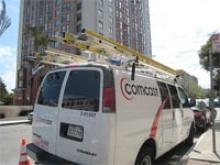
Photo used under Creative Commons license, courtesy of Titanas on flickr.

Broadband Truth-in-Labeling

Kudos to the New American Foundation's Open Technology Initiative (OTI). Earlier this week, I told Geoff Daily that we would all benefit from some form of a truth-in-labeling requirement for broadband. This should be a no-brainer that both the FCC and FTC embrace because it will educate subscribers and allow them to make better, more informed choices - which is a requirement for a functioning market.

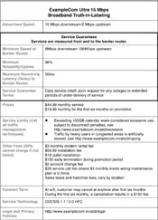
One day later it became apparent that I was too slow in my idea, because OTI already had a prototype. They even have a sample label and have come up with a great set of required disclosures.

To make sure the broadband service is clearly expressed, the Broadband Truth-in-Labeling disclosure should be standardized to comprise several typical elements as indicators of broadband service quality, such as minimum expected speed and latency to the ISP's border router (where the ISP connects to the rest of the Internet) and service uptime. These minimum assurances will be supported by the ISP as guarantees in the delivery of broadband services, backed by technical support and service charge refunds or credits. In addition to the description of minimums being guaranteed of the service, the disclosure should include all applicable fees, a common description of the technology used to provide the services, any service limits such as a bandwidth cap or the application of any traffic management techniques, the length of the contract terms, and a link to all additional terms and conditions. Requirements should be established for disclosing any highly objectionable or surprising terms such as arbitration restrictions or information or data selling. 

Verizon Actions Show Carriers Will Not Wire Rural America

In a recent post the NY Times Bits Blog, Saul Hansell reports "Verizon Boss Hangs Up on Landline Phone Business" - something we have long known. Nonetheless, this makes it even more official: private companies have no interest in bringing true broadband to everyone in the United States.

Verizon is happy to invest in next-generation networks in wealthy suburbs and large metro regions but people in rural areas - who have long dealt with decaying telephone infrastructure - will be lucky to get slow DSL speeds that leave them unable to participate in the digital age. These people will be spun off to other companies so Verizon can focus on the most profitable areas.

For instance, Verizon found it profitable to spin off its customers in Hawaii to another company that quickly ran into trouble before unloading most of its New England customer on FairPoint, moves that enhanced Verizon's bottom line while harming many communities (see the bottom of this post and other posts about FairPoint).

Isen has been writing about it recently - picking up on FairPoint immediately breaking its promises to expand broadband access in the newly acquired territories. No surprise there.

Isen also delved deeper into Verizon's actions, with "Verizon throws 18 states under the progress train." He is right to push this as a national story - the national media focused intently on the absence of major carriers in the broadband stimulus package but they seem utterly uninterested in major carriers running away from broadband investments in rural areas.

Though Frontier likes to position itself as a company focused on bringing broadband to rural areas, it offers slow DSL broadband and poor customer service to people who have no other choices - more of a parasite than angel. As long as we view broadband as a vehicle for moving profits from communities to absentee-owned corporations rather than the infrastructure it truly is, we will farther and farther behind our international peers in the modern economy.

Perhaps the most frustrating angle of these transactions are the many ways in which Verizon benefits from stranding thousands of communities. West Virginia is one of the states most impacted by the proposed Verizon-Frontier swap and has generated in-depth coverage of the story.

She [Elaine Harris of Communications Workers of America (telephone employees union)] believes the payoff for Verizon is it cannot only make money selling off its assets, but it can take advantage of a federal tax loophole that allows tax-free mergers between companies. The smaller companies are left saddled with debt and, as a result, can't make the necessary upgrades to existing infrastructure, turning off customers and ultimately leading to work force reductions as dissatisfied customers turn somewhere else.

Trying to figure out how to force absentee-owned, profit-maximizing corporations to bring true broadband to everyone ignores the reality of our market system: we are trying to force the square peg through the round hole. These companies may well invest in urban and suburban areas (though these areas continue to fall behind major cities elsewhere in the world) but they have no reason to invest in rural America. To get the job done, we need smart public investments to ensure everyone benefits from the communications revolution.

When we expanded telephone and electrical infrastructure to everyone, everyone in the United States benefited because networks always become more valuable as they increase in size. More people on the network means increased markets, increased productivity, and a higher quality of life.

Ensuring everyone has quality broadband is not charity for rural folks, it is in all of our self-interest. The narrow self-interests of Verizon, Frontier, and FairPoint (this is not a shot at them, companies are designed to have a narrow self-interest for legitimate reasons) do not line up with our larger national interest - something that too few people understand when dealing with broadband policy.

This is a video offering good coverage of the FairPoint problems:

Photo by Derek Jensen, used under creative commons license.

The Broadband Definition Matters

In all the wrangling over how we should define broadband, I wanted to step back and remember why the definition is important.

Information networks have become essential for business, education, and entertainment. The broadband definition originally meant something faster than the dial-up speeds that topped out at 56kbps. In the late 90's, any connection faster than dial-up pretty much supported all Internet activities.

Over the years, some connections got faster while the slower connections were expanded to more people across the United States. In 2009, people who remain stuck with dial-up would be happy to get the slow speeds that first became available when DSL and cable modems debuted. On the other hand, many no longer consider those connections (often in the neighborhood of 200kbps to 768kbps for download speeds and even slower for upload speeds) to be capable of supporting many modern applications.

When the broadband definition supported all the applications users wanted to run, it was useful for subscribers. However, as the broadband definition has lagged farther and farther behind modern applications, it has become only useful to large companies like Comcast, AT&T, Verizon, and Qwest because they could brag that they were delivering "broadband" to most of their customers.

The result is a country that can claim x% of the population has access to broadband without that number really telling us anything. We do not know how many home users have access to connections that will support working from home or two-way video chat. We do not know how many businesses can access the speeds they need to be competitive in a real-time world.

When the FCC revises the broadband definition, it must make it more stringent for the following reasons:

  1. Subscribers need accurate information to make informed decisions. If they subscribe to "broadband," they should immediately know if it will actually support modern applications. This means incorporating common usage scenarios: multiple devices concurrently using a connection for browsing, e-mail, games, video-chats, media downloads, and large file uploads (online backup is becoming more popular and easy and people increasingly want to work effectively from home).
  2. Large companies, particularly telephone carriers, claim that there is no need for government intervention in broadband because almost everyone has access under the existing definition. (Why build highways when we have all these great dirt roads?) In order to standardize data and make good public policy, we need a more useful definition of broadband.
  3. Upstream speeds are all but ignored in the current definition. The average person is intimidated by computers and technology -- when they are subscribing to a connection that may be advertised as ULTRA FAST 8Mbps, they may still be getting a pathetic 300kbps upload that makes two-way video untenable. They will undoubtedly think the computer or application is the culprit rather than understanding what they are truly paying for in their "broadband" connection.

Increasingly bandwidth-hungry applications and an unchanging broadband definition have rendered "broadband" a meaningless term. It is time we restored meaning to it. Those of us lucky enough to have a choice between Internet service providers should easily be able to understand the differences between advertised connections and what we really get - no more "up to" rates that we never experience. Companies must not be allowed to call their product "broadband" while hiding pathetically slow upload speeds in fine print. Any caps on monthly usage must be clearly defined.

This is why the broadband definition matters, and why it must be improved.

Image Credit: BlueMiniu - Fotolia.com

Ranking Broadband Stimulus Applications in Minnesota

Our focus on the broadband stimulus is almost entirely on last-mile infrastructure because it is the most challenging and expensive problem to solve before all Americans will have affordable access to the broadband networks they need in the modern era. As we are most familiar with Minnesota, we decided to take an in-depth look on who is proposing what projects in our state.

Total Infrastructure Grants Requested for Last Mile solely in MN: at least $240 million
Total Infrastructure Loans Requested for Last Mile solely in MN: at least $85 million

Groups seeking stimulus funds to deliver last-mile broadband access in Minnesota have asked for hundreds of millions of dollars. By my tally, some 17 applicants are seeking to serve Minnesota with last-mile access (I threw out applications pertaining to middle mile infrastructure, digital divide, and those last-mile projects that combine Wisconsin and North Dakota areas) have requested some $240 million in grants and $85 million in loans.

If one assumes that the total amount of money is divided evenly among the states, this is somewhere around 3x as much stimulus money that will be awarded to Minnesota applicants over the course of the multiple rounds of funding.

At some point, this list will have to be winnowed and prioritized, so let's delve into it. All applications still must survive the peer review process (ensuring they met NTIA/RUS requirements), the incumbent challenges (incumbents can veto applications by showing that targeted areas already have broadband advertised to them), and the prioritization of surviving projects by each state (no one seems sure of how this will happen in Minnesota, our Governor is too busy not running for President in 2012).

There are two applications that should be jettisoned immediately, Arvig Telephone Company and Mid-State Telephone Company, both of which are owned by TDS Telecom. [Update: I have now heard conflicting reports on whether Arvig is, in fact, a subsidiary of TDS]

When NTIA formulated the stimulus rules, it ignored Congressional intent by allowing any private company to apply despite the requirement that the company act in the public interest.

Though NTIA ignored the intent of Congress, states like Minnesota should absolutely use that criteria in deciding how to rank projects. You may recall that TDS Telecom filed a frivolous lawsuit against the city of Monticello, which was tossed out of court at the earliest opportunity, but TDS continued obstructing the community's plans until the company ran out of appeals (our coverage here. TDS Telecom abused the court system by using it to delay a network approved by 74% of voters for more than a year in an attempt to prevent competition in the community. Few companies have abused the public trust more egregiously; they should be prohibited from receiving public money.

Further, government grants should certainly not be given to such a profitable company in order to expand their slow DSL services rather than offering the higher speeds that are needed by communities in 2010 and beyond.

Minnesota should prioritize publicly owned networks when it comes to public dollars. Unlike networks run by absentee network owners, these networks are directly accountable to the citizens of the community. Thus, projects like Lake County, Cook County, and City of Windom should all be front-runners. These grants are expensive in the short term, but they are investing in a technology that will last decades, rather than already-obsolete DSL. Rural Minnesotans need broadband, but extending speeds that already lag behind needs is not a wise use of public money.

Other smart projects that will deserve a hard look are the cooperatives that have applied - they have been borrowing from the federal government for years to extend state-of-the-art fiber networks to rural communities. Unlike companies like TDS and Qwest, they find it economical to bring fast and affordable access to their subscribers because they put community needs before profits. This is a model that needs to be expanded in rural areas.

Finally, we also support the applications of Donny Smith in several areas - his Jaguar Communications company runs an open network, allowing competitors to serve the community (again, something that other private companies avoid in order to maximize profits). He is working in several Minnesota regions to build fiber-to-the-home networks.

Basic Information about some MN Broadband Grant Applications available here - apparently, this does not include all applications aimed at Minnesota, but just applicants based in Minnesota.

Photo by Jackanapes, used under creative commons license.

Re-Defining Broadband

The FCC recently asked for comments about how broadband should be defined. There was a marked difference between those who put community needs first and those who put profits first. Companies like AT&T and Comcast were quick to argue that the FCC should not change the definition of broadband for reasons ranging from too much paperwork to the suggestion that rural people have no need for VoIP. The honest approach would have been for these companies to say they do not want a higher definition because it will change their business plans, likely requiring them to invest in better networks for communities, and that will hurt their short term profits.

On the other side were groups that argued for a more robust definition of broadband - something considerably less ambitious than our international peers but an improvement over the current FCC definition.
NATOA's comments [pdf] focused on issues like the need for measurements based on actual speeds rather than advertised and symmetrical connections (or at least "robust upstream speeds to facilitate interactivity" - which we think captures the importance of symmetric connections without getting lost in debates about absolutely symmetric connections).

The key metric for broadband should be the applications and needs that drive consumer requirements and choices. In this way, broadband should be understood as a connection that is sufficient in speed and capacity such that it does not limit a user’s required application.

Their magic broadband number is a reasonable and doable 10Mbps symmetric connection for residential and small businesses as well as a 1Gbps level for enterprise users. Importantly, they note that a single broadband connection supports far more than a single computer or use - these connections are shared, often among many wired and wireless devices.

Compare these comments to those of the NCTA [pdf] (lobbying organization for cable companies) that argue broadband is nothing more than an "always on" connection regardless of the speeds or user experience. This is how they justify maintaining the international laughingstock definition of 768kbps/200kbps.

It is this basic “always on” functionality that is most relevant for definitional purposes, more so than the presence or absence of the various detailed characteristics (e.g., latency, jitter, symmetry, mobility) mentioned in the Commission in the Notice.

If it is the "always on" functionality that is so important, why shouldn't the commission totally ignore speeds and consider people with 56kbps modems on dedicated phone lines to have broadband?

Eldo Telecom speculated on why the incumbents prefer the current, or other tepid definitions and what that says about them:

By advising the FCC to define broadband on such obsolete and arguably bogus terms, the providers are essentially telling the feds they aren't serious about the issue. It's a frivolous, throwaway position that summed up says "forget about any national broadband plan and leave us the hell alone."

It appears that these private service providers hold their product in low esteem and see little potential for it in the way that consumer and community-oriented groups see it is a transformational technology.

Reading the Free Press comments came as a welcome relief following the NCTA. They base their comments on existing legal definitions of broadband - one of which comes from the '96 Telecom Act:

The term ‘advanced telecommunications capability’ is defined, without regard to any transmission media or technology, as high-speed, switched, broadband telecommunications capability that enables users to originate and receive high-quality voice, data, graphics, and video telecommunications using any technology

Much of the comments are, as they should be, inside baseball but make for interesting reading. These comments are the epitome of what the U.S. needs in order to remain competitive in the coming decades. They conclude that the minimum broadband speed should be 5Mbps symmetrical to each user during peak times (using the the somewhat standard approach of 95% availability of that speed during the measured period).

Connected Nation Captures Minnesota

Minnesota is now in poor company, along with several other states that have chosen to use telecom industry-backed Connected Nation (if unfamiliar with CN, read this report) to supply data from Minnesota to the federal government as part of the national broadband map that is being constructed.

Just how this came about explains why a group like Connected Nation thrives in the current telecommunications arena.

Mike O'Connor, the urban users' representative on the Minnesota Governor's Broadband Task Force, explains that the Minnesota Department of Commerce and Department of Employment and Economic Development (DEED) chose Connected Nation absent any public discussion or even consultation of the broadband task force.

Mike is not one to mince words about the deal (which got him picked up by MinnPost):

I'm pretty cranky about this process.  Nice n'cozy.  Nice n'closed.  Nice bypass of the Task Force.  No public input at all as far as I can see.  Looks like there was lots of opportunity for providers to provide input about their confidentiality needs, not too much input about what consumers need.  Look forward to more sub-par optimistic maps, and impossible to use/verify data, peepul.

He references the ample opportunity for providers to express their preferences, this comes from the letter from the two commissioners to the governor:

The other primary reason that we are recommending Connected Nation is that in conversations with and letters from the broadband provider community (including the Minnesota Telecom Association, the Minnesota Cable COmmunications Association, Qwest and Comcast), they have noted their satisfaction with the work Connected Nation as done, the professionalism displayed. Most important, the providers have confidence in Connected Nation's ability to protect their sensitive, nonpublic infrastructure information.

The letter goes on to discuss the other possible mapping entity - the University of Minnesota:

First, the University indicates that it has entered into confidentiality agreements on other projects. However, in speaking with the provider community, it is unclear whether they would be able to reach agreement with the University on nondisclosure agreements (NDAs) in order to turn their infrastructure data over to the University.

So let's clarify all this.

  1. Broadband providers across the United States, mostly large private companies like Comcast and Verizon, have failed to invest in the broadband infrastructure we need.
  2. In order to discover the magnitude of the problem, we are developing a massive map to show where these companies fail to offer services needed by communities.
  3. To gather this data, many states are using Connected Nation, a group created and heavily influenced by these same companies.
  4. We are to believe that Connected Nation does a good job because the providers like working with Connected Nation (a group supposedly tasked with demonstrating their shortcomings).
  5. We cannot use anyone but Connected Nation because the providers do not want to give this data to anyone but Connected Nation (because it is a secret if you are getting the rates they advertise).

Awesome. Perhaps we could next ask the Minnesota Vikings to create a nonprofit to study whether a new football stadium is a good idea or not.

This is not a broadband policy, it is a giveaway to telephone and cable companies. We know that these companies cannot and will not offer the necessary services to low-density and low-income areas because it is not profitable and these companies exist to increase profits. For how long will we hold communities hostage to whether a company can make a big enough profit for that community to get 21st century infrastructure?

Update: I should have noted that Kentucky, the birthplace of Connected Nation, has decided not to use them to gather and submit this data. It seems that aside from shoddy work, some the cable companies are frustrated that CN may be too biased toward the telcos.

Update 2: It is disappointing to see that only is Minnesota's Department of Commerce committing us to more bad data, it is serving as a reference for CN in other states like Florida.

In the section of the bid asking for references, Connected Nation included recommendations for Connect Minnesota, from Diane Wells of the Minn. Department of Commerce

Photo by Jackanapes, used under creative commons license.

FairPoint unfairly competing with UMaine?

FairPoint's lobbyists in Maine have gone on the offensive, arguing that another group attempting to get stimulus funds is competing unfairly. FairPoint, you may remember, has already accomplished the improbable: it took over the dilapidated networks in New England from Verizon and made them worse. The charge of unfair competition, even if it were true, would be silly because FairPoint has proven it cannot provide these important services.

Karl Bode put Fairpoint in its place:

Even if the company was competing directly with UMS, at least Maine residents could be certain the University will even exist a year from now. But as it stands, Fairpoint isn't competing with the University of Maine. They're competing with a public private partnership of which the University is only a member. Applications for Federal funds are open to public entities and private companies. Given recent history, giving taxpayer dollars to somebody other than the regional dysfunctional incumbent might not be the worst idea in the world.

Bangor Daily News argues that rural Maine cannot afford to fight over who will expand broadband access. Unfortunately, Bangor Daily News' why-can't-we-all-just-get-along approach ignores the very real damage Fairpoint has already done to the state. Their suggestion that these competing networks just "be merged" seems like a call for open access but ignores the need for Fairpoint to maximize profits (right after it gets out of bankruptcy) rather than invest in communities.

The larger point is ominous: the idea that large institutions should suffer with whatever crummy service Fairpoint provides (at the high prices they will provide it) in order that Fairpoint can expand its poor DSL service to rural areas, misses the important point that Fairpoint cannot and will not offer the services that Maine needs. As Mayor Joey Durel of Lafayette suggested, maybe Maine should just send its jobs down to Lafayette, where they are building the necessary infrastructure for the future.

Watching the steady stream of news covering FairPoint's failures is pathetic - the Vermont Telecommunications Authority tracks telecom news in Vermont and much of it centers on FairPoints inadequacies. Putting public money into FairPoint would be a disaster - the exact sort of disaster Congress wanted to avoid when conceiving of the program. Unfortunately, NTIA ignored Congress public-interest requirement and may well waste funds on FairPoint.

Syndicate content