Image


Fast, affordable Internet access for all.
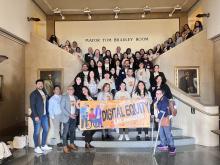
As California aims to boost broadband competition and Los Angeles County pursues what could be the biggest municipal broadband network ever built, local activists say they’ve made some meaningful recent inroads on both improving broadband mapping, and regulatory reform that should aid the equitable deployment of modern, affordable access.
Recently, inroads have been made on fixing long-broken California cable franchise law. In the early aughts, cablecos (and telcos pushing into the TV business) successfully lobbied for state-level “cable franchise reform” laws they promised would dramatically lower prices. In reality, such bills were often little more than legislative wishlists crafted by telecom giants.
Often these state-level replacements for local franchise agreements eroded legal regulatory authority, eliminated long standing requirements for uniform broadband and TV deployment, and in some states–like Wisconsin–even acted to strip away local consumer protections and eminent domain rights. Warnings by academics on this front were widely ignored.
Seventeen years after its passage, California activists say that California’s 2006 Digital Infrastructure and Video Competition Act (DIVCA) was no exception.
This week on the podcast, Christopher is joined by Rudolf van der Berg, Partner at Stratix Consulting, a Dutch consulting firm that does work in telecommunications and has been deeply involved in the historic level of new infrastructure deployment projects in northern Europe. Rudolf breaks down what's going on today in Europe's broadband landscape, including efforts to reach the unserved, new entrants, and the actions of private equity.
Rudolf challenges the notion that overregulation stifles innovation and competition, and dispels the rhetoric (pushed by monopoly ISPs in the United States) that the European networks struggled with the onset of the pandemic because of the regulatory landscape and comparative lack of investment as compared to their ISPs' American counterparts. Christopher and Rudolf close out the show by digging into the struggle between tech companies and ISPs between which should pay for infrastructure upgrades.
This show is 41 minutes long and can be played on this page or via Apple Podcasts or the tool of your choice using this feed.
Transcript below.
We want your feedback and suggestions for the show-please e-mail us or leave a comment below.
Listen to other episodes here or view all episodes in our index. See other podcasts from the Institute for Local Self-Reliance here.
Thanks to Arne Huseby for the music. The song is Warm Duck Shuffle and is licensed under a Creative Commons Attribution (3.0) license.

Two recent victories in digital equity work out of California give cause for celebration this week. AB 2748 Telecommunications: Digital Equity in Video Franchising Act and AB 2751 Affordable Internet and Net Equality Act both passed the Communications and Conveyance Committees this week; the former by a margin of 10-3 and the latter 7-3.
Sponsored by Assemblyman Chris Holden, AB 2748 would have a range of impacts if passed, including giving the state CPUC and local governments more power in negoitating with providers to ensure that there is no discimination based on neighborhood household income that leads to inequitable access to service. It also revises franchise fee agreements at the local level. Read the full bill analysis for more.
"Although DIVCA originally intended to address inequitable broadband access, it remains pronounced across California cities," says Shayna Englin, Director of the California Community Foundation Digital Equity Initiative. "AB 2748 modernizes DIVCA by establishing equal access requirements as policy, and makes them enforceable through a reasonable application process for franchise renewals. We are pleased to co-sponsor Assemblymember Holden's bill, as the legislation will bring us one step closer to ensuring every Californian has access to fast, reliable, and affordable Internet [access]."
AB 2751 would create a Net Equality Program which would require that most state agencies only do business with Internet Service Providers (ISPs) that have a low-income plan offering of $40/month for 25/3 Megabits per second (Mbps). Read the full bill analysis for more.
Public testimony for AB 2751 highlighted the significant disparity in service speeds and prices that disadvantage low-income Californians by the state's two monopoly providers: Charter Spectrum and AT&T:
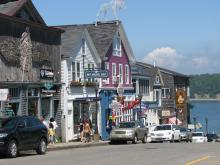
Bar Harbor, Maine (pop. 5,500) has been trying to get a municipal fiber network off (and into) the ground for more than half a decade. If local officials throw weight behind the most recent move, we may see momentum continue to build for faster, more reliable, affordable, and universally available Internet access for government use, commercial development, and maybe, down the road, residents as well.
We last checked in with the town in 2016, when its franchise agreement with Charter had expired and negotiations for a new agreement had stalled. At the time, Bar Harbor was considering a $100,000 engineering study to flesh out the possibility of a municipal Fiber-to-the-Home (FTTH) network or a $50,000 study to do so for a government-only network, but at the last minute the town’s Warrant Committee and Council decided not to move ahead on either at the last minute. Since then, the situation has remained more or less in stasis.
But with recent changes, Charter has signaled that it will begin to charge Bar Harbor $45,000 a year for access via – a ten-fold increase over the $4,500/year the town currently pays. With the company refusing to negotiate, on December 15 the Town Council, at the recommendation of the Communication and Technologies Committee (CTC), voted unanimously to place a $750,000 proposal to build their own institutional network onto the 2022 budget draft review. The general public will have the chance to vote on the measure in June.
Image
Locally Owned Infrastructure at a Fraction of the Price

At a May 6 City Commission meeting in Decatur, Georgia, city leaders approved a project budget of $2.35 million to build a municipal I-Net and award the construction contract to Georgia-based Network Cabling Infrastructures, Inc. The decision came amid demands from cable giant Comcast that the community of about 24,000 immediately begin paying exorbitant fees for infrastructure the city has used under a past local franchise agreement. The case of sour grapes was resolved, but it once again reveals how the large corporate monopolies don't hesitate to flex their muscles when things don't go their way.
Conflict Over I-Net
The infrastructure at the center of the dispute dates back to the late 1990s to a franchise agreement Decatur made with MediaOne, which Comcast has since acquired. As part of the deal, MediaOne agreed to connect city facilities with a fiber network, and the city permitted the cable company to recover some construction costs through a 25 cent charge on subscribers’ monthly bills, up to a total cap of $200,000. MediaOne finished building the I-Net in 2000. Since then, Decatur has used the infrastructure without paying fees to MediaOne or Comcast for critical city operations.
Last year after working with a consultant, Decatur decided to replace the aging I-Net with a new, city owned fiber network and began to search for a contractor to build it. Comcast was one of several companies that responded to a Request for Qualifications (RFQ) issued by Decatur in October, but it did not meet the requirements established by the city.
 Less than one month after Decatur notified Comcast that it was not selected, the company told former City Manager Peggy Merriss that it planned to retire the I-Net right away, unless the city paid for its use. A few months later, Comcast reiterated its intentions to current City Manager Arnold, explaining that the company had acquired a state franchise to replace the local franchise agreement that ended in 2009. According to Arnold, Comcast decided to charge the city approximately $370,000 annually for use of the current I-Net until the new one is built.

Ever since the FCC reversed network neutrality protections, an increasing number of local communities have started to wonder about the advantages of publicly owned Internet infrastructure, including conduit. At the Institute for Local Self-Reliance, we’ve received an uptick in requests for information from elected officials, community business leaders, and local citizens.
When folks are similarly curious about public-private partnerships, they wonder about whether or not a municipality or other form of local government can require a private sector partner ISP to adhere by the tenets of network neutrality. An agreement between public and private sector partners to bring better connectivity to a city or region is a contract between the involved parties; the FCC’s decision won't interfere.
Looking At Lincoln
Lincoln, Nebraska, has fine-tuned the art of working with private sector partners interested in using their publicly owned conduit for privately owned fiber. The city invested in an extensive conduit system back in 2012 to create an environment that would welcome private sector providers. Nelnet’s ALLO Communications uses the conduit to offer Fiber-to-the-Home (FTTH) in Lincoln.
The city uses a Broadband Franchise agreement to allow ISPs non-exclusive use of their publicly owned conduit. In Section 4: Service Characteristics, Lincoln requires any private sector ISP that wishes to use their conduit to adhere by network neutrality rules, which they clearly spell out. You’ll notice that the city also imposes a “no data caps” rule:
Section 4: Service Characteristics.
A. The System shall, at a minimum, provide the following capabilities and characteristics:
1.Net Neutrality: In the provision of Broadband Service, Franchisee shall comply with the Open Internet regulations.
2.No Blocking: Franchisee shall not block lawful content, applications, services, or non-harmful devices; and
3.No Throttling: Franchisee shall not impair or degrade lawful Internet traffic on the basis of Internet content, application, or service, or the use of non-harmful devices; and

Things have been looking up for the Utah Telecommunications Open Infrastructure Agency’s fiber optic network (UTOPIA) in recent years and in December network officials reported they’ve reached a significant financial milestone. For the first time since the open access network began operations in 2003, revenue will cover bond payments and will provide a 2 percent dividend to most of the member communities.
Despite The Limitations
In keeping with state restrictions, UTOPIA can only provide wholesale services via their fiber infrastructure. Ten ISPs offer residential services on the network, which establishes ample competition and all its benefits for subscribers, including lower prices, better customer service, and the ability to switch providers. Businesses can choose from 25 ISPs.
The wholesale-only model, however, significantly reduces the revenue communities can expect from their investment, which was the case with UTOPIA. The eleven member cities bonded approximately $185 million, but revenue limits due to the restriction, some early management decisions, and general apprehension from member communities, created political controversy. At one point, member communities considered selling out to Australian investment firm Macquarie.
Fortitude Paying Off
In 2011, eight of the member communities created the Utopia Infrastructure Agency (UIA) in order to spur more network expansion. UIA collaborates with UTOPIA as a separate entity; its purpose is to deploy the network in more locations and connect more premises and has issued the dividend to its member communities.
This is the transcript for Episode 281 of the Community Broadband Bits podcast. Will Rinehart of the American Action Forum in Washington D.C. discusses telecommunications and economics with our host Christopher Mitchell. Listen to this episode here.
Will Rinehart: And I do think that obviously good policy is very very important and that's where you and I agree a lot. You know there's obviously some good policies that can be enacted. There's probably better conversations that could be had in this space and that's also something else that I really do really want to see. You're
Lisa Gonzalez: listening to episode 281 of the Community Broadband Bits podcast from the Institute for Local Self-Reliance. I'm Lisa Gonzales as a research organization. We here at the institute make it a habit to hear all sides of the debate along the way we make connections with people who offer perspectives on policy that differ from ours. We consider these conversations critical as we analyze factors that help us create policy recommendations and resources for local communities. This week Christopher talks with Will Rinehart from the American Action Forum. They got together at the recent broadband community's economic development conference in Atlanta. In this conversation you'll hear the two discuss a variety of topics they talk about the area of telecommunications and economics and the forum's approach. You'll also hear that these different perspectives aren't as black and white as they first appear. Now here's Christopher with Will Rinehart from the American Action Forum.
Christopher Mitchell: Welcome to another edition of the community broadband bits podcasts. I'm Chris Mitchell with the Institute for Local Self-Reliance. Coming to you from Atlanta sitting practically on a runway at the Atlanta airport with Will Rinehart the Director of Technology and Innovation Policy with the American Action Forum. Welcome to the show. Thanks Chris. Thanks for having me. We're at the broadband community's event here. We just had our second panel which is called a blue ribbon panel and general session kind of thing. And you and I are typically brought on as people who have very opposing points of view.
Christopher went to Atlanta for the Broadband Communities Economic Development Conference in early November, and while he was there, he touched base with this week’s guest Will Rinehart. Will is the Director of Technology and Innovation Policy at the American Action Forum, a DC nonprofit organization that’s been around since 2009.
Will and Christopher don’t always see eye to eye on issues that affect telecommunications and broadband policy, but both agree that it’s important to have spirited debate to share perspectives. Only by examining issues from different sides can we craft policy that creates lasting benefits.
In this interview, Will describes his organization and his work there. Chris and Will look at compelling issues such as ISP competition, government regulations, and how the FCC’s 2015 upgraded definition of broadband has reverberated in the market. The two get into franchising and ubiquitous broadband, local authority, and connectivity in rural America. It’s a spirited discussion chock-full of issues.
You can tweet to Will, he’s @WillRinehart on Twitter.
This show is 30 minutes long and can be played on this page or via Apple Podcasts or the tool of your choice using this feed.
Transcript below.
We want your feedback and suggestions for the show-please e-mail us or leave a comment below.
Listen to other episodes here or view all episodes in our index. See other podcasts from the Institute for Local Self-Reliance here.
Thanks to Arne Huseby for the music. The song is Warm Duck Shuffle and is licensed under a Creative Commons Attribution (3.0) license.
The Utah Telecommunications Open Infrastructure Agency’s (UTOPIA) regional fiber network serves communities in the north central region of the state. Without the publicly owned network, it’s doubtful the eleven communities served would have access to high-quality Internet access. It’s almost certain they wouldn’t be able to choose between so many providers who operate on UTOPIA's open access infrastructure. Now, the city of Bountiful, Utah, wants the network to extend its reach to their community.
Reaching Out To Other Communities
Recently, the city council voted to give UTOPIA a franchise agreement so the network but the city will not contribute financially to the deployment. According to the Standard Examiner, officials from the networks anticipate the first customers will be business subscribers who would help pay for the expansion.
Bountiful isn’t alone - other communities have granted franchise agreements to UTOPIA.
“This is just kind of a natural progression out of the Salt Lake Valley,” said [Roger] Timmerman, executive director of UTOPIA… The deal “brings more options to Bountiful,”
Bountiful City Councilman Richard Higginson described UTOPIA as a “proven player” in an email to the Standard Examiner. Other communities with franchise agreements include Salt Lake City, Draper, South Jordan and Pleasant Grove. Higginson wrote:
“If UTOPIA and its member cities find that providing services to customers in neighboring cities benefits their operation, then it could be a win-win for both UTOPIA and non-UTOPIA cities alike."
The franchise agreements will allow UTOPIA to deploy in cities' rights-of-way in order to connect customers to the network.
Broadband Benefits In UTOPIA Towns
Last fall we spoke with Mayor Karen Cronin from Perry City, which already connects to the UTOPIA network. She described how competition from the open access network has improved local services, the economy, and the general quality of life. Roger Timmerman participated in the interview as well. Listen to the podcast here.