Image


Fast, affordable Internet access for all.
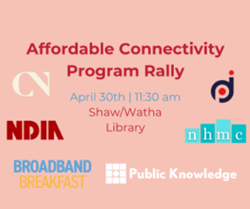
Next week an array of public interest groups, federal lawmakers, FCC officials, and digital equity advocates will converge on the Shaw/Watha T. Daniel Library in the nation’s capital for an Affordable Connectivity Program Rally.
Organized by Public Knowledge, Civic Nation, National Hispanic Media Coalition, National Digital Inclusion Alliance (NDIA), Digital Progress Institute, and Broadband Breakfast, the event will be held on April 30 beginning at 11:30 AM ET and will highlight the importance of the ACP and what happens if Congress allows the popular subsidy program to expire.
They will be joined by U.S. Rep. Yvette Clarke, U.S. Sen. Peter Welch, FCC Commissioner Anna Gomez, and FCC Commissioner Geoffrey Starks as the rally aims to bolster the chances of a discharge petition making its way to a House floor vote to extend the ACP in the face of reluctant GOP leadership.
The rally will be livestreamed by Broadband Breakfast here.

*In partnership with Broadband Breakfast, we occasionally republish each other's content. The following story by Broadband Breakfast Reporter Jericho Casper was originally published here.
In a setback to efforts aimed at enhancing broadband access across Wisconsin, the state Senate dealt a blow to three key bills aimed at improving various aspects of broadband provision Monday.
The first bill in question, AB 1180, aimed to give local governments more autonomy by allowing them to apply for broadband grants directly, rather than requiring them to partner with a telecommunications utility or a for-profit organization, as is required under current (state) law.
The bill also proposed expanding the permissible uses of grants beyond infrastructure construction and would have eliminated a requirement for a city, village, or town to prepare a feasibility report before constructing or operating facilities for public telecommunications, cable TV or broadband services.
Presently, Wisconsin law necessitates a public hearing before a local government can pass an ordinance or resolution to provision such facilities. Additionally, at least 30 days before this hearing, these entities must furnish a comprehensive report to the public, detailing the facility's costs, revenues, and a cost-benefit analysis spanning three years. AB 1180 would have waived the need for this report preparation.
Manding Internet Service Providers Deliver Advertised Speeds

The Rural Digital Opportunity Fund (RDOF) was supposed to drive affordable fiber into vast swaths of long-underserved parts of rural America. And while the FCC administered program accomplished some of that goal, a multitude of problems have plagued the program since its inception, putting both current and future broadband funding opportunities at risk.
The $20.4 billion RDOF program was created in 2019 by the Trump FCC as a way to shore up affordable broadband access in traditionally unserved rural U.S. markets.
The money was to be doled out via reverse auction in several phases, with winners chosen based on having the maximum impact for minimum projected cost.
During phase one of the program, the FCC stated that 180 bidders won $9.2 billion over 10 years to provide broadband to 5.2 million locations across 49 states and the Commonwealth of the Northern Mariana Islands.
But, according to ILSR data, roughly 34 percent of census blocks that won RDOF funding–more than $3 billion in awards – are now in default. All told, 287,322 census blocks were defaulted on by more than 121 providers as of December 2023.
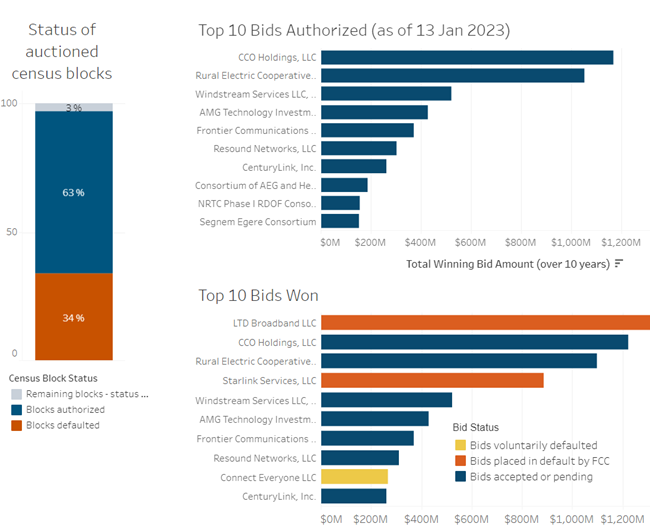
The defaults are only one part of a larger problem: namely that many communities bogged down in RDOF program dysfunction may risk losing out on the historic amount of federal funding to build modern broadband networks (BEAD) made possible by the 2021 bipartisan infrastructure law.
One Big Giant Mess
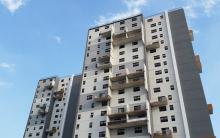
Massachusetts and New York officials hope to entice affordable housing property owners with new grant programs that would pay the retrofitting costs to expand high-speed Internet connectivity into decades-old affordable housing developments.
The programs aim to focus on the multitude of multi-dwelling units (MDUs) in those states, particularly housing developments built before the advent of the Internet.
With property owners and Internet service providers (ISPs) often reluctant to pay the costs of getting these buildings up to broadband speed, Massachusetts and New York have launched initiatives – using a portion of their federal broadband funds – to chip away at the digital divide in housing developments where a significant number of tenants live in buildings not wired to support reliable broadband or where the service is not affordable, thanks to agreements with monopoly providers.
New York Bytes Into Broadband Affordability
In December, New York Governor Kathy Hochul’s office announced the state’s ConnectALL Office (CAO) was setting aside $100 million New York State received from the federal Capital Projects Fund (courtesy of the American Rescue Plan Act) to bring broadband connectivity to 100,000 affordable housing units across the Empire State.
In announcing New York's Affordable Housing Connectivity Program, Hochul said:
“With work, school, and essential government services going digital, affordable homes need affordable, reliable broadband, and this funding will help bolster our efforts to build housing equipped with the basic tools that New Yorkers need to succeed.”
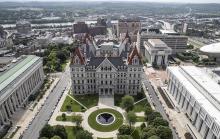
Language added to a New York State budget bill is threatening to undermine a municipal broadband grant program established by Gov. Kathy Hochul’s office earlier this year.
Known as the Municipal Infrastructure Program, it was designed to provide grant funding for municipalities in the state eager to build publicly-owned, locally controlled broadband infrastructure as a way to ensure ubiquitous, affordable access to high-quality Internet after decades of frustration with expensive, spotty and uneven service from the regional monopolies.
Currently, New York state lawmakers are in the midst of budget proposal season in which the Governor’s office and both legislative chambers (the state Senate and Assembly) have until April 1 to reconcile and complete a final budget for the upcoming fiscal year.
Buried near the bottom of the Assembly budget proposal (A8805B) is a Trojan horse legislative sources say is being pushed by lobbyists representing Charter Spectrum, the regional cable monopoly and 2nd largest cable company in the U.S. that was nearly kicked out of New York by state officials in 2018 for atrocious service.
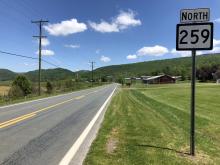
The rocky rural hills of West Virginia are a formidable foe when it comes to building high-speed Internet infrastructure that offers affordable high-quality service.
Nobody knows that better than Hardy Telecommunications (OneNet), a small community-owned cooperative that delivers affordable fiber to frustrated locals deemed too costly and cumbersome to be served by the incumbent telecom giants.
The cooperative serves parts of four counties (Hardy, Pendelton, Grant, and Hampshire). It connected its first fiber customer in 2013, after receiving $31.6 million in federal BTOP funding. Since then, the cooperative tells ILSR they’ve spent $20 million of their own funds to bring fiber to rural corners of the aptly-named Mountain State.
Derek Barr, Assistant General Manager at Hardy Telecommunications, says the cooperative currently delivers broadband service to 5,050 rural subscribers – 4,736 of which are on fiber lines that simply wouldn’t exist without federal funding programs. Hardy Telecommunications also provides 68 customers with fixed wireless access (FWA) broadband service.
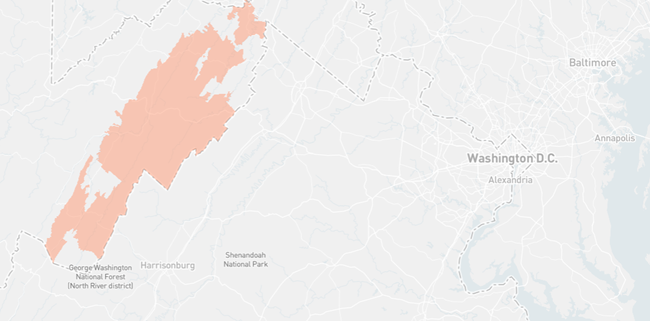
“Our focus is fiber, and we're trying to build out fiber as much as we can,” Barr tells ILSR. “But it's very tough in our serving region. It's all mountains and a lot of trees, and a big chunk of our area is either state park or national forest land. It's also very hard to do fixed wireless because even if it might work in the winter, it's not going to work in the summer” when tree leaves block line of sight, he noted.
So the cooperative slowly and consistently expands fiber as it can, often in partnership with Pendleton County. As a result, locals have the option of a variety of double and triple play phone, cable, and fiber options, starting with a symmetrical 100 Mbps (megabit per second) downstream, 50 Mbps upstream fiber and phone bundle for $79 a month.

On the most recent episode of the Connect This! Show, co-hosts Christopher Mitchell (ILSR) and Travis Carter (USI Fiber) were joined by regular guests Doug Dawson (CCG Consulting) and Kim McKinley (UTOPIA Fiber) tackle the hard questions in digital equity work now that the ACP is going away. Among the discussion: FCC Chair Jessica Rosenworcel's recent appearance at the national Net Inclusion conference, and what we can learn from her remarks about how to move ahead productively while avoiding easy mistakes and making sure we stay committed to the course.
Email us at broadband@communitynets.org with feedback and ideas for the show.
Subscribe to the show using this feed or find it on the Connect This! page, and watch on LinkedIn, on YouTube Live, on Facebook live, or below.
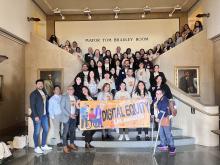
In the wake of the new rules issued by the Federal Communications Commission (FCC) to prevent digital discrimination, digital equity advocates from California to Cleveland are leveraging the new federal rules to spur local action.
In Los Angeles, city leaders have passed an ordinance to combat what advocates say are discriminatory investment and business practices that leave historically marginalized communities without access to affordable high-quality Internet. Similar efforts to mobilize communities and local officials are underway in Oakland and Cleveland.
In November 2023, the FCC codified rules to prevent digital discrimination, outlining a complaint process whereby members of the public can offer evidence of digital discrimination being committed by Internet service providers (ISPs). Though the FCC order does not outline local policy solutions, nor does it empower localities to carry out enforcement of the federal rules, it has the potential to open up conversations between local advocates and elected officials about new ordinances, stronger enforcement of existing ones, or public investment to facilitate competition and the building of better broadband networks.
Los Angeles First City in Nation To Officially Define Digital Discrimination At Local Level
The local organizing work behind the proposed ordinance in LA dates back to 2022 when digital equity advocates began to document inequitable broadband access across the county.
In this latest episode of the podcast, Christopher is joined once again by Sean Gonsalves to delve into the expanding landscape of municipal broadband networks in the U.S. They emphasize the noteworthy surge in municipal networks, citing the establishment of 47 new networks since 2021, which has brought the total to over 400!
This discussion explores the various models and approaches taken by these networks while touching on the challenges faced by these municipal networks, such as opposition from large ISPs and the importance of community support and engagement.
Additionally, Chris and Sean emphasize the significance of data from schools and organizations in comprehending the current state of broadband access and advancing digital equity.
This show is 38 minutes long and can be played on this page or via Apple Podcasts or the tool of your choice using this feed.
Transcript below.
We want your feedback and suggestions for the show-please e-mail us or leave a comment below.
Listen to other episodes or view all episodes in our index. See other podcasts from the Institute for Local Self-Reliance.
Thanks to Arne Huseby for the music. The song is Warm Duck Shuffle and is licensed under a Creative Commons Attribution (3.0) license.
The fading sound of holiday bells and soft stillness that comes with plunging temps can only mean one thing; it's January again, which means it's time to break out the crystal ball and have a conversation about the year to come. Joining Christopher in the recording booth are a slew of CBN staffers new and veteran to join in the collective task of putting words to feelings both foreboding and optimistic about the year to come.
Will we see the first BEAD-connected home this year? Will the Affordabel Connectivity Program get re-funded? How will the maps look in 11 more months, with slews of challenge data? How many new municipal ftth networks will we see founded in 2024? State preemption laws rolled back, or re-introduced? Tune in for answers to all these and more.
This show is 48 minutes long and can be played on this page or via Apple Podcasts or the tool of your choice using this feed.
Transcript below.
We want your feedback and suggestions for the show-please e-mail us or leave a comment below.
Listen to other episodes or view all episodes in our index. See other podcasts from the Institute for Local Self-Reliance.
Thanks to Arne Huseby for the music. The song is Warm Duck Shuffle and is licensed under a Creative Commons Attribution (3.0) license.