Image


Fast, affordable Internet access for all.

Since it was first introduced in Congress in March, the Community Broadband Act of 2021 has gained widespread support from over 45 organizations representing local governments, public utilities, racial equity groups, private industry, and citizen advocates.
The legislation -- introduced by U.S. Representatives Anna Eshoo, Jared Golden, and U.S. Senator Cory Booker -- would authorize local communities to build and maintain their own Internet infrastructure by prohibiting laws in 17 states that ban or limit the ability of state, regional, and local governments to build broadband networks and provide Internet services.
The Act also overturns state laws that restrict electric cooperatives' ability to provide Internet services, as well as laws that restrain public agencies from entering into public-private partnerships.
States have started to remove some long-standing barriers to public broadband on their own. In the last year, state lawmakers in both Arkansas and Washington removed significant barriers to municipal broadband networks, as high-quality Internet with upload speeds sufficient for remote work, distance learning, telehealth, and other online civic and cultural engagement has become essential.
Community broadband networks offer a path to connect the unconnected to next-generation networks. State barriers have contributed to the lack of competition in the broadband market and most communities will not soon gain access without public investments or, at the very least, the plausible threat of community broadband.
The Many Benefits of Publicly-Owned Networks
This week on the podcast Christopher talks with Steve Lange, IT Manager for the city of Wadsworth (pop. 26,000) in eastern Ohio, which built its hybrid fiber-coax municipal network CityLink back in 1997.
The two talk about the history of the network, its push to bring more competition to the town, and its operational structure — the network, unlike in many places, is separate from the city’s municipal electric department. Christopher and Steve also talk about the phenomenal momentum the network has built over the last few years, almost tripling it subscriber base to 5,400 this year, with Steve attributing this to their focus on thoughtful planning and customer service.
This show is 35 minutes long and can be played on this page or via Apple Podcasts or the tool of your choice using this feed.
Transcript below.
We want your feedback and suggestions for the show-please e-mail us or leave a comment below.
Listen to other episodes here or view all episodes in our index. See other podcasts from the Institute for Local Self-Reliance here.
Thanks to Arne Huseby for the music. The song is Warm Duck Shuffle and is licensed under a Creative Commons Attribution (3.0) license.

ETI Software Solutions sponsored an event to help untangle the set of considerations facing communities discussing what route they want to take to improve Internet access for families and businesses in the community.
Heather Gold (HBG Strategies) presided over the panel which included ILSR's Christopher Mitchell as well as Ben Fineman, President of the Michigan Broadband Cooperative, Steve Lang, IT Manager for the city of Wadsworth, Ohio and its CityLink Fiber, and Will Aycock, General Manager of the Greenlight Network in Wilson, North Carolina. They cover a lot of ground, from the different models worth considering, to the phases of planning, to financing, construction, and customer service.
Watch the video at ETI's YouTube channel, or below.

While large Internet service providers routinely face some of the lowest customer satisfaction rates in the country, municipal broadband networks, like FairlawnGig in Fairlawn, Ohio, have set themselves apart by offering superior customer service to residents and businesses.
Case in point: recent subscriber surveys from FairlawnGig revealed that 94% of residential respondents were satisfied with their service from the community-owned network. Businesses in Fairlawn also appreciate the municipal fiber provider. A similar survey given to businesses showed that about 700 jobs — at least — can be directly ascribed to the FairlawnGig network.
“Our customer service revolves around our building a strong and diverse network to our residents and businesses,” Fairlawn Deputy Director of Public Service Ernie Staten said in a press release. “We have the extremely high customer satisfaction scores to prove it.”
Numbers Don’t Lie
FairlawnGig conducted its survey of residential subscribers at the end of April and found an astonishingly high rate of satisfaction among those surveyed. Overall, 94% of respondents said they were satisfied with the service and 77% reported that they were “very satisfied,” which is impressive even with an accuracy range of plus or minus four percentage points. Another three quarters of survey takers said that FairlawnGig’s customer service is “excellent.”
In addition, about half of respondents said that FairlawnGig was “extremely important” in their choice to live or stay in the community. And the survey found that activities like working from home and streaming movies and other entertainment increased after residents started subscribing to FairlawnGig’s Internet access.
NextLight, the municipal Fiber-to-the-Home (FTTH) network in Longmont, Colorado, has been serving residents and businesses in the community since 2014 and offers reliable gigabit connectivity at affordable rates. This week, Director of NextLight, Valerie Dodd, is on the show to discuss the past, present, and future of NextLight with Christopher.
NextLight has implemented some special marketing and customer service techniques, which has helped achieve the high take rate that continues to grow. As the network expands to all areas of the city, Longmont has used some creative approaches and contended with a few challenges to connect residents and businesses. Valerie and Christopher talk about some of these decisions and how those choices have panned out.
They also discuss the community's commitment to digital inclusion and how it's paying off in an increasingly diverse and growing city. Valerie describes how her experience with a private sector provider has contributed to NextLight's focus on subscribers and breaks down some of the key differences between a traditional municipal utility, such as an electric service, and broadband service from the city.
We want your feedback and suggestions for the show-please e-mail us or leave a comment below.
This show is 29 minutes long and can be played on this page or via Apple Podcasts or the tool of your choice using this feed.
Transcript below.
We want your feedback and suggestions for the show-please e-mail us or leave a comment below.
Listen to other episodes here or view all episodes in our index. See other podcasts from the Institute for Local Self-Reliance here.
Thanks to Arne Huseby for the music. The song is Warm Duck Shuffle and is licensed under a Creative Commons Attribution (3.0) license.

We last wrote about MB Link, the municipal fiber network in Mont Belvieu, Texas, in October 2018. Since then, the city near Houston has connected about half of its 7,500 residents to the network and is talking about expanding into the surrounding county, reported the Dallas Morning News.
The in-depth article from late last month discussed many aspects of the groundbreaking network, including why the city decided to take charge, the legal and logistical challenges it faced, and how local service is benefiting the community.
MB Link Emerges
As in other communities, poor service quality from existing providers drove Mont Belvieu to deploy a city owned broadband network, the article explained:
For years, residents of this fast-growing town on the outer ring of Houston complained to local leaders about slow and spotty Internet. They put satellite dishes on their rooftops. They endured intermittent service and frequent outages.
. . .
So Mont Belvieu took matters into its own hands: It decided to build and operate its own high-speed Internet service.
Now, MB Link offers residents across the city speeds of up to 1 Gigabit per second for only $75 a month. Approximately half of all Mont Belvieu households get Internet access from the municipal network, which has recently begun providing service to businesses as well.
Community Networks Create Competition
Mont Belvieu isn’t the only city that has built a broadband network to create options for residents and businesses, the article noted:
Christopher Mitchell, director of the Institute for Local Self-Reliance’s community broadband network initiative, said cities began building broadband networks in the 1990s when they had no Internet. Now, he said, they’re motivated because they feel stuck with Internet that’s inferior or overpriced.
. . .

Over the past several months, we’ve recounted trials and tribulations as we tried to obtain a telephone power cord from CenturyLink. The saga has taken us through the horrors of Halloween to an odd fall Groundhog Day, and now we’re happy to report that our hero recently celebrated an early Christmas. The phone power cord has finally arrived.
In order to memorialize the event, we recorded John opening the package from CenturyLink. Against all odds, it WAS the correct cord.
All He Wanted Was A Phone Cord
 As a recap, the CenturyLink Saga actually began on August 22, 2018, when our Co-Director and head of the Energy Democracy Initiative, John Farrell, contacted our Internet access and VoIP provider to request a phone cord. If you read the first story in the series, you’ll remember that a phone he ordered for a new hire came with no power cord in the box. Seems like a simple request, but is there such as thing as a "simple request" when dealing with a massive, inefficient bureaucracy such as CenturyLink?
What He Got Was A Trip on A Hamster Wheel
From that moment on, John was mindlessly shuffled from sales associate to “help” desk, and eventually routed back the first person he reached out to for help. When he expressed his frustration on Twitter, CenturyLink was all over the problem, tweeting that they could help him if he would just direct message him. He obliged, only to be sent through the same maze once more after being ignored after some weeks. The final response, after CenturyLink had wasted John’s time was, “We don’t provide power cords for the phone. I apologize.”
He Had to Let the World Know
Halloween is less than a week away, but our horrifying tale of customer service terror is quickly turning into science fiction in which we are caught in an never-ending loop bending time and space. Time for a quick update.
As a refresher, our Halloween story relayed the difficulties ILSR has had in recent months with CenturyLink, which provides Internet access and VoIP service to our Minneapolis office. When we received a new phone for a new employee, there was no AC power cord in the box. After running on a human hamster wheel for months, one of our Co-directors, John Farrell, who had been shuffled from department to department at the ISP in search of a cord had been told that he could continue to try to get one from the company or just buy one on Amazon.
It didn’t take long for CenturyLink to reach out to us, once we shared our story via Twitter, telling us that they were “saddened” by our negative experience with the phone power cable and letting us know that, if we would reach out to them, they’d be happy to help.
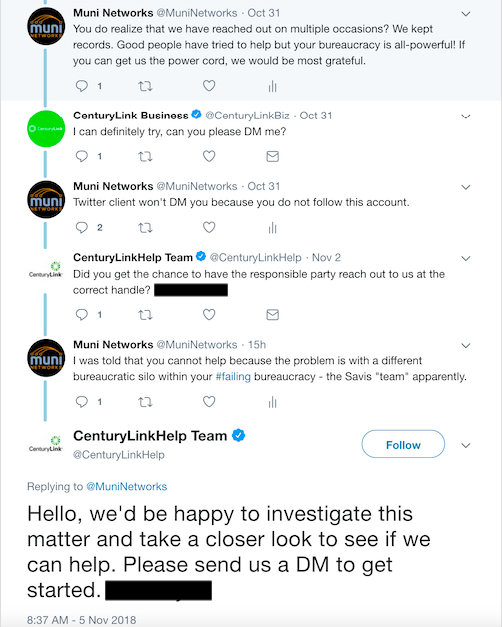
Anxious to get the conversation out of the public sphere, CenturyLink employees managing the Twitter account requested we direct message them, which we did.
It didn't take long for the nightmare to start all over again as we were looped into an endless version of "Groundhog Day," repeating ourselves and once again being passed from one customer service representative to the next. We've blocked out their names, because we realize that it isn't their fault that the behemoth that they work for is too massive to work efficiently. Over the course of several days, we interacted with several different people, each not completely aware of what the other had been up to in order to tend to our issue.
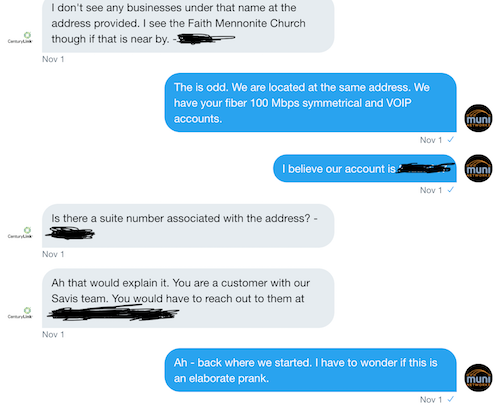
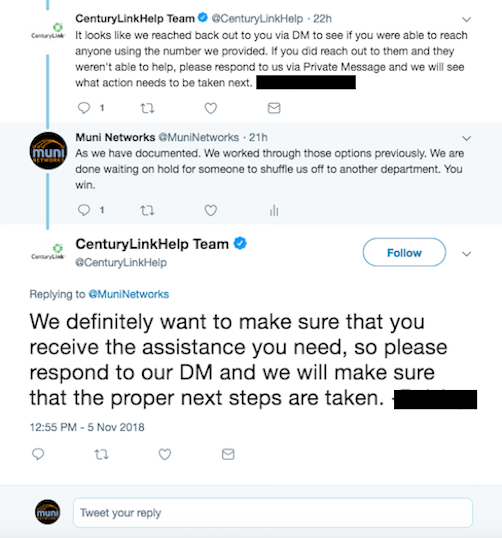
After sharing the DMs displaying the endless cycle with our Twitter followers, CenturyLink once again asked us put a lid on the conversation. We yielded, but they would not accept our surrender.

Ghastly ghouls, horrific monsters, and vile flesh-eating creatures roam the earth this night of Halloween, but none evince the evil that has of late entered the halls of ILSR. One of our own has faced the torture of an entity bent on pushing him over the precipice of human endurance, twisting his psyche with the torment of nonsense, and claiming his head for their own.
On past Halloweens we’ve written fun, spooky content about scary telecom monsters and frightening tricks; this year we relay the haunting, dramatic tale of John Farrell and The Legend of CenturyLink Hell.

The Hamster Wheel of Phone Cord Purgatory
Unlike Icabod Crane of gothic New England lore, John's head has stayed firmly attached at the neck, but recent encounters with the office Internet service provider have lead him to that dark place where so many others have accidentally strayed - into the no man's land of customer service decapitation.
It all began with a new phone for the office. John, newly appointed Co-Director of the Institute for Local Self-Reliance and the head of the Democratic Energy Initiative, had ordered phones from ILSR’s Internet access provider in the past. CenturyLink, which provides VoIP, had provided the physical phones before with no issue, but this time there was no power adapter included in the package. Thinking the oversight would be easily remedied was John's first mistake ... and the first step on his journey into hell.
John reached out to the sales associate who he had worked with when ILSR switched from Comcast to CenturyLink’s fiber service. He explained that the new phone ILSR received didn’t include a power adapter and asked them to order one. To John's surprise and dismay, the sales associate told John that they couldn’t order a solo adapter and referred John to the Mac Desk at CenturyLink. He reached out to the sales people at the Mac Desk, but the answer he received was cold comfort that stirred an uneasy feeling in his bowels.

People in Wyoming, Minnesota, gathered together on September 12th to bend the ear of officials from the state’s Public Utilities Commission (PUC). Ann Treacy from the Blandin Foundation attended the meeting and recorded most of the conversation from the 100 or so frustrated and fed-up folks. The meeting was one of five organized by the PUC after a record number of complaints by incumbent telephone and Internet access provider Frontier.
A Shared Reality
It’s safe to say that “frustration” was the star of the night, as everyone who spoke mentioned how it had consumed their experience with Internet access from Frontier. People who spoke at the meeting included those who worked from home, business owners, parents with families whose kids needed Internet access for homework, and retired folks who just wanted to enjoy a quiet evening streaming a movie.
Most of the people who spoke at the meeting said that they needed to run mobile hotspots or had given up on Frontier’s DSL service and now rely solely on hot spots to avoid the frustration of dealing with terrible service. Several people at the meeting don’t have the option of mobile hotspots because there’s no cell coverage where they live.
In addition to horribly unreliable connectivity, where the only consistency is dropped service, people expressed anger about overpaying for Internet access that was down far too often — even for weeks at a time. When they were able to get online, many people who spoke at the meeting reports horrifically slow speeds and feel they are being “ripped off” because they never reach the “up to” speed that they pay for each month. Once woman has documented her line’s performance and the fastest download speed she has reached is .96 Megabits per second (Mbps); the slowest is .05 Mbps. This same person has had limited success in cajoling Frontier to temporarily lower her bill since 2012.