Image


Fast, affordable Internet access for all.

This article was originally published on GovTech.com. Read the original here. This version contains additional details.
The southwest corner of New Hampshire will be blanketed with Fiber-to-the-Home (FTTH) networks over the next two years, as over 20 communities are drawing up plans to enter into public-private partnerships to boost high-speed Internet access in the Granite State.
Fitzwilliam, Marlborough, Gilsum, and Troy voted in March to issue bonds through the New Hampshire Municipal Bond Bank to construct fiber networks; while Greenfield, Jaffrey, Marlow, Roxbury, Keene, Peterborough, and Temple, delayed by the pandemic, have been voting in support of FTTH agreements throughout April, May and June.
According to New Hampshire’s Southwest Region Planning Commission (SWRPC), six more cities, Charlestown, Goshen, Langdon, Salisbury, Sullivan, and Unity, have also issued warrant articles indicating their interest in partnering with a private Internet Service Provider (ISP) to expand Internet access. Most of the cities are considering partnerships with Consolidated Communications to improve insufficient connectivity.
This is the transcript for Episode 251 of the Community Broadband Bits podcast. Carole Monroe and Irv Thomae discuss connectivity in East Central Vermont and the future of the ECFiber Network. Listen to this episode here.
Carole Monroe: What we see, in this area, is that most of the customers coming to ECFiber are customers that are coming from FairPoint.
Lisa Gonzalez: This is episode 251 of the Community Broadband Bits Podcast, from the Institute for Local Self-Reliance. I'm Lisa Gonzalez. ECFiber is a consortium of 24 member towns in East Central Vermont that banded together in 2008, on a mission to bring high quality connectivity to their small, rural towns. The project began with funds from many local investors. Since then, the network has expanded, and a new structure will allow ECFiber to continue to grow. In this interview, we learn about ECFiber's past, present, and future plans. Christopher's guests, Carole Monroe and Irv Thomae, describe what it was like getting the community network going. Now, here's Christopher with Carole Monroe and Irv Thomae, talking about ECFiber in Vermont.
Christopher Mitchell: Welcome to another edition of the Community Broadband Bits Podcast. I'm Chris Mitchell, and I'm enthusiastic today, to be talking with Carole Monroe, once more. Carole is now the CEO of ValleyNet. Welcome back to the show.
Carole Monroe: Thank you. Glad to be here.
Christopher Mitchell: And we also have Irv Thomae on, who is the district chairman of the governing board for the East Central Vermont Fiber Network-
Irv Thomae: Telecommunications district.
Christopher Mitchell: Right. We're going to explain for a second, how that used to be ECFiber, and now has a different name because it has a new, exciting approach. So welcome to the show, Irv.
Irv Thomae: Thank you.
Christopher Mitchell: Maybe that's actually just a really good place to start, quickly. Irv, can you just remind me how ECFiber is now structured?
We’ve been covering the East-Central Vermont Community Fiber-Optic Network (ECFiber) since 2009; it has come a long way from inception. ECFiber is a group of rural Vermont towns that are working together to deploy a regional network to offer high-quality Internet access to communities typically stuck with slow, unreliable connections such as DSL and dial-up. In this episode, Christopher talks with Carole Monroe, CEO of ValleyNet, and Irv Thomae, District Chairmen of ECFiber’s Governing Board. The not-for-profit ValleyNet operates the ECFiber network.
The organization has faced ups and downs and always seemed to overcome challenges. It began with funding from individual local investors who recognized the need to bring Fiber-to-the-Home (FTTH) to the region. Now, the organization is characterized as a “communications union district,” which creates greater funding flexibility and stability.
In this interview, Carole and Irv talk about the new designation and the plans for bringing the network to the communities that are clamoring for better Internet access. They also get into recent developments surrounding overbuilding by DSL provider FairPoint, a project funded by CAF II subsidies. We hear how ECFiber is bringing better connectivity to local schools and helping save public dollars at the same time and we find out more about the ways Vermonters in the eastern rural communities are using their publicly owned network.
This show is 29 minutes long and can be played on this page or via Apple Podcasts or the tool of your choice using this feed.
Transcript below.
We want your feedback and suggestions for the show-please e-mail us or leave a comment below.
Listen to other episodes here or view all episodes in our index. See other podcasts from the Institute for Local Self-Reliance here.
Thanks to Arne Huseby for the music. The song is Warm Duck Shuffle and is licensed under a Creative Commons Attribution (3.0) license.

We haven’t reported on East Central Fiber (ECFiber) in almost a year and, boy, are things hopping in Vermont. The community network has obtained funding to expand in east-central Vermont and have a plan to bring high-quality connectivity to more towns during the next two years. In the mean time, FairPoint Communications is using federal funding to overbuild inferior DSL in many of the areas already served by ECFiber. No, this is not an April Fool's Joke.
First, The Good News: ECFiber Is Growing
We recently touched base with Carole Monroe, Stan Williams, and Irv Thomae from ECFiber in Vermont to get caught up on what's happening with the publicly owned network comprised of 24 member towns.
The last time we shared an update, they had just announced plans to expand the Fiber-to-the-Home (FTTH) network. The organization of 24 member towns received an infusion of $9 million in revenue bonds, which allowed ECFiber to pay down existing debt and add more fiber miles to the network.
Prior to obtaining the new funding source, ECFiber had always used the crowd funding approach, which limited growth to small and steady deployments. In 2015, the state legislature enacted a state law that created “communications union districts.” A Union District can consist of municipalities that join forces to invest in Internet infrastructure; the new model made it easier for ECFiber to obtain funding for larger deployments.
This February, ECFiber announced that the network would now bring service to parts of Royalton, Strafford, Pittsfield, and Randolph, with more growth on the way:
Many communities feel like they are an island without proper connectivity but Islesboro, Maine, is literally an island... without proper connectivity. This week, we talk with Page Clason, Manager of the Broadband Internet Working Group for the island that is moving toward a fiber solution to expand high quality Internet access.
We discuss the differences between a mainland community and island life, the dynamic between full time residents and people who live on the island part of the time, and what Islesboro is doing to ensure everyone has high quality Internet access. We also touch on the discussions around how to pay for the fiber. We recently wrote about the vote to move forward with an engineering study and contractor search.
This show is 20 minutes long and can be played on this page or via Apple Podcasts or the tool of your choice using this feed.
Transcript below.
We want your feedback and suggestions for the show-please e-mail us or leave a comment below.
Listen to other episodes here or view all episodes in our index. See other podcasts from the Institute for Local Self-Reliance here.
Thanks to bkfm-b-side for the music, licensed using Creative Commons. The song is "Raise Your Hands."
Islesboro residents voted on May 30th to move forward with their municipal network plan. According to the Islesboro Press Herald, approximately 75 percent of voters attending the annual town meeting approved a motion to spend $206,830 on an engineering study and contractor search. Approximately 200 residents attended.
As we reported in March, the community has been working since 2012 on a plan for a fiber network to improve connectivity for businesses and the almost 600 residents on the island. The infrastructure will belong to the Town of Isleboro; GWI will offer services via the network. The entire project estimate is $2.5 - $3 million to be funded with a municipal bond.
Many of the island's residents now obtain Internet access via DSL from Fairpoint, which has been described as spotty and unreliable, for $20 - $70 per month. GWI already operates on the island, offering wireless service.
This is the first in a several step approval process:
Town officials plan to hold a second public vote in the fall on 20-year municipal bond for up to $3 million that would fund the network’s construction, [Selectman Arch Gillies] said.
Completion is scheduled for the end of 2016.
“We’re a community intent on keeping up with the world, and maybe getting ahead of the world,” [Gilles] said.
In late April, LD 1185 and several other broadband bills came before the Maine House Energy, Utilities, and Technology Committee. We have seen a flurry of activity in Maine this year as local communities deploy networks, develop plans, or begin feasibility studies. Likewise, the state legislature has been active as House and Senate members try to defibrillate the barely beating heart of the state listed as 49th for broadband availability.
The national providers in Maine - Time Warner Cable and FairPoint have little interest or capacity to invest in high quality services in Maine. Time Warner Cable is more focused on major metros and being acquired. FairPoint is laying off workers and also, positioning itself to be acquired. Fortunately, these big companies aren't the only option for improving Internet connectivity in Maine.
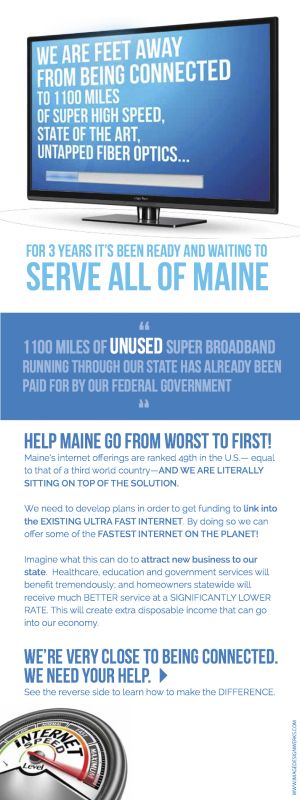
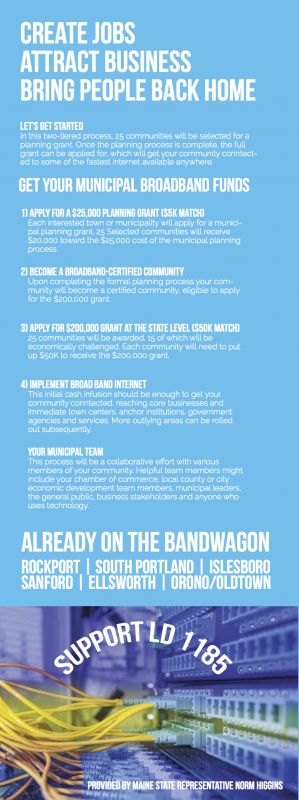
LD 1185, presented by Representative Norm Higgins, seeks to establish $6 million this year in funds for local communities that wish to deploy municipal networks. Maine already has the middle mile Three Ring Binder in place; the focus of this proposal is to help communities get the infrastructure they need to connect to it. In an effort to get the word out about the bill and grow support, Higgins and his team created this graphic explaining the proposal (a 2-page printable edition of the graphic is available for download from the link below):
Islesboro, the Maine island community of 566, will decide in May whether or not they want to bond to build a municipal fiber network, reports The Working Waterfront. The network will be owned by the town who plans to partner with GWI to operate and manage it.
Currently, about 2/3 of residents on the island use DSL from Fairpoint. While a few locations can reach 15 Mbps download, most residents pay from $20 - $70 for around 3 Mbps download. Upload speeds are much less. GWI also offers point-to-point wireless from the mainland and one side of the island has cellphone.
The firm estimated costs to cover the island to be between $2.5 and $3 million, which would include construction and leasing of poles from Central Maine Power (CMP). Community leaders will ask voters to approve a municipal bond to fund the project:
The $3 million bond would raise property taxes on a house assessed at $300,000 by about $13.77 per month ($164.25 per year). As a per-month cost, with both the pay-back on the bond and the standard service fee for Internet, the resident of a house valued at $300,000 would pay $48.77, according to [Arch] Gillies, [chairman of the Board of Selectmen]. (This appears to be for the lowest level of service.)
After reviewing the recommendations, community leaders decided it was in the community's best interest to deploy a network that would be owned by the public. They then engaged in a Request for Information process and received responses from three vendors. Eventually, they chose to work with GWI, in part because it is a local company. Fairpont and Time Warner Cable also responded, but their proposals did not stipulate that the infrastructure would belong to the town. There were other inferiorities in their proposals.
Last week, the Vermont Department of Public Service began a series of public hearings on the public comment draft of its State Telecommunications Plan. The plan is intended to asses the current state of the telecom landscape in Vermont, map out goals and benchmarks for the next 10 years, and provide recommendations for how to achieve them. The plan sets a target of 100 megabit per second symmetrical connections for every home and business in the state by 2024.
Oddly enough, achieving that even today would put them behind many metropolitan areas across the United States. The technology needed to deliver 100 Mbps connections is essentially the same that would be used to deliver 1 Gbps, begging the question why such a limited goal?
The 100/100 mbps symmetrical target is for 10 years into the future, but in the nearer term the plan calls for universal 4/1 Mbps coverage, raised to 10/1 Mbps coverage by 2020. While it may at first glance seem reasonable to set gradually rising targets, these long and short term goals actually have the potential to conflict with each other.
As pointed out by Vermont Public Radio, the 100/100 Mbps standard would likely require universal FTTH, or at least fiber to the node combined with other technological advances and investments. Meeting this goal would require a huge investment in next generation fiber optic infrastructure, yet the Telecommunications Plan calls for funding priorities to be focused on achieving universal 4/1 mbps coverage for the next 6 years. This lower standard will likely be met with a combination of last generation technologies like copper wire DSL and wireless that are incapable of meeting the 100/100 standard.
Continuing to build out older systems while deferring investments in fiber, which is adaptable to meet just about any future need, seems illogical. It’s a bit like saying you’re going to put all your expendable income for the next six years into repairing your VCR and buying tapes, while promising you’ll buy a DVD player immediately after.

“We will plant the first seed in fertile economic soil,” he said.