Image


Fast, affordable Internet access for all.
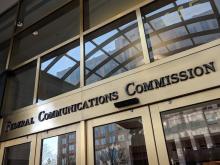
The Federal Communication Commission (FCC) recently published rules for its broadband nutrition label provides a partial victory for Internet subscribers and a potential marketing advantage for fiber providers – but may pose a challenge for wireless Internet service providers.
Though the new rules were finalized in October, Internet Service Providers (ISPs) have until April 10, 2024 to publish their broadband labels, though providers with 100,000 or fewer subscriber lines have until October 10, 2024.
Just like the label on the back of packaged food in grocery stores helps shoppers understand the nutritional value of the food they are buying, the broadband label requires ISPs to disclose their broadband pricing and service information (at the point of sale) to help potential subscribers make informed decisions about the service they are signing up to get.
Transparency on Display
Though the label is just another red-tape requirement for some providers, others see it as an opportunity to show off the quality of their services.
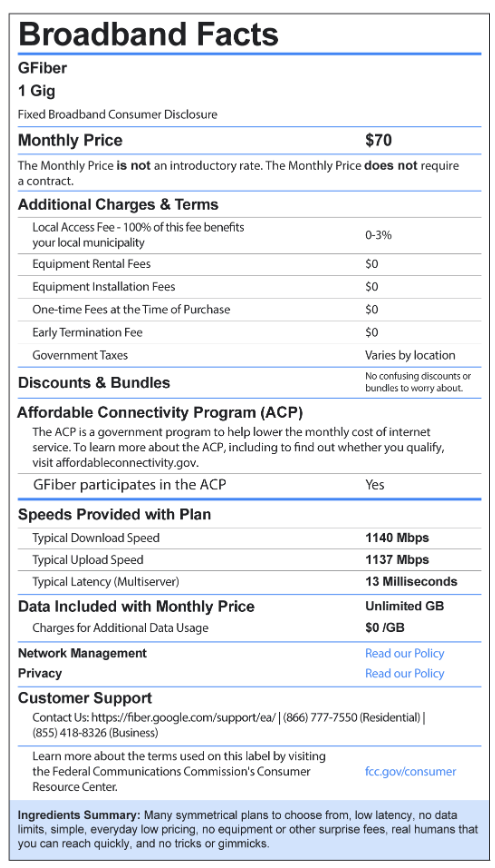
Google Fiber, for example, published via social media and its blog a preliminary version of its own broadband consumer label, just days after the final rule was published, and six months before its deadline.
This year's Mountain Connect conference begins Monday, May 23rd and runs through Wednesday, May 25 in Keystone, Colorado. The conference's self-stated goal is to "move our western US communities forward by providing relevant and targeted content to help them make the most effective decisions as they build new or expand existing telecommunications infrastructure that enable the long-term vision of a community."
It will feature panels on navigating state and federal funding, telehealth, disaster resilience, digital inclusion, tribal connectivity, construction challenges, and communications and technology standards.
We'll also get to hear an array of conversations with local leaders, talking about everything from revitalizing downtowns with new municipal broadband infrastructure, to partnerships, to open access, to marketing, to managing subscriber expectations. See the full agenda here.
Anchoring the panels will be communities like Boulder, Colorado, Loveland, Colorado, and Detroit, Michigan, with familiar faces and industry veterans helping to break things down in clear ways, including Peggy Schaffer (ConnectME), Joshua Edmonds (Director of Digital Inclusion, Detroit), Brian Snider (Lit Communities), Bruce Patterson (EntryPoint Networks), and Gary Bolton (Fiber Broadband Association).
ILSR's DeAnne Cuellar will be participating on a digital inclusion panel moderated by NDIA's Paolo Balboa with Colorado Department of Labor's Katherine Keegan. Likewise, Christopher Mitchell will moderate a panel with Peggy Schaffer, Eric Forsch (Idaho Commerce) and Veneeth Iyengar (ConnectLA) to talk about how states will use the BEAD money. See the full slate of speakers here.
We don’t often get to spend a whole episode diving into the earliest work that communities do to set the foundation for progress in expanding high-quality broadband access down the road, but that’s what we’re talking about today.
This week on the podcast Christopher is joined by Pierrette Renée Dagg, Director of Marketing and Communications for the MERIT Network, and John Egelhaaf, Executive Director of the Southwest Michigan Planning Commission.
The two share the history of efforts in Berrien County, Michigan, and how a group of residents and local officials began pursuing better Internet connectivity a few years ago. Pierrette and John share the work that’s gone into the formation of a broadband task force, the identification of avenues and goals, and collaboration with hundreds of community partners along the way.
The story they tell is one of the power of partnerships and outreach groups (like anchor institutions andlibraries, senior centers, HOAs, fraternal orgs, and PTA groups) in contributing to a growing momentum.
This show is 36 minutes long and can be played on this page or via Apple Podcasts or the tool of your choice using this feed.
Transcript below.
We want your feedback and suggestions for the show-please e-mail us or leave a comment below.
Listen to other episodes here or view all episodes in our index. See other podcasts from the Institute for Local Self-Reliance here.
Thanks to Arne Huseby for the music. The song is Warm Duck Shuffle and is licensed under a Creative Commons Attribution (3.0) license.
This week on Connect This! Christopher and Travis Carter (CEO, USI Fiber) are joined by Kim McKinley (Deputy Director and Chief Marketing Officer, UTOPIA Fiber) and Kyle Hollifield (VP of Business Development, Magellan Advisors), both veterans with years of experience.
Marketing means more that a logo with a snappy slogan, and it can be hard to quantify the value in taking precious dollars and applying them to tasks other than fiber in the ground and the supporting electronics. The group emphasizes how important it is to get right from the start, and the impact it can have on take rates, positive word-of-mouth, and a sense of goodwill. They discuss why marketing should be both a budget priority and a central part of any business plan, and what it means for everyone from installation subcontractors to CEO to play a role. Travis, Kyle, and Kim share some of their favorite marketing success stories.
Subscribe to the show using this feed.
Email us broadband@muninetworks.org with feedback and ideas for the show
For timely updates, follow Christopher Mitchell or MuniNetworks on Twitter and sign up to get the Community Broadband weekly update.

Marketing plays a pivotal role in the success of community broadband at every stage of the game: from helping build political will during the initial stages of a project, to driving strong early take rates, to maintaining momentum down the road. Thoughtful and cohesive marketing, outreach, and community education efforts go hand in hand, and help broadband initiatives and networks weather the inevitable challenges that go with major infrastructure projects.
On Episode 6 of Connect This!, Christopher and Travis Carter (CEO, US Internet) will be joined by Kim McKinley (Deputy Director and Chief Marketing Officer, UTOPIA Fiber) and Kyle Hollifield (VP of Business Development, Magellan Advisors), both veterans with years of experience. The group will talk about all that marketing entails, including what we can learn from those that do it right and what gets left on the table when it's not part of the discussion.
Join us Monday, February 8th, at 3:30pm CST on YouTube Live with this link, or watch below.

Over 140 municipalities in Colorado have opted out of a state law (SB-152) that prevents local governments from investing in broadband infrastructure. With overwhelming support from voters on Election Day last month, Denver, Berthoud, and Englewood became the most recent Colorado communities to bail on SB-152 in the 15 years since Qwest (now CenturyLink) and Comcast successfully lobbied for passage of the anti-local authority bill designed to protect their profits.
While Denver, Berthoud, and Englewood residents ponder next steps, a number of other Colorado communities have already built, or are in the process of building, municipally-owned broadband networks, the most successful example being the NextLight Fiber-To-The-Home (FTTH) network in Longmont.
NextLight, which began building its award-winning FTTH network in 2014, now offers Longmont’s 90,000 residents access to gigabit (1,000 Mbps) service and has surpassed a 50% take rate.
Three other communities in the Front Range region of Colorado are now on the front lines of building municipal broadband networks.
Loveland
Loveland, a city of 76,700 situated in a 25.5 square mile valley at the entrance to Big Thompson Canyon, opted out of SB-152 with 82% voter approval in 2015, a year after Longmont began building its fiber network 17 miles south of the “gateway to the Rockies.”
Over the past five years, the Loveland Water and Power Department has been planning, and now building, its own Pulse fiber network.
To finance the project, city officials opted to issue $95.5 million in bonds. The bonds are backed by Loveland’s electric utility, which serves 37,500 residential and commercial accounts.

ETI Software Solutions sponsored an event to help untangle the set of considerations facing communities discussing what route they want to take to improve Internet access for families and businesses in the community.
Heather Gold (HBG Strategies) presided over the panel which included ILSR's Christopher Mitchell as well as Ben Fineman, President of the Michigan Broadband Cooperative, Steve Lang, IT Manager for the city of Wadsworth, Ohio and its CityLink Fiber, and Will Aycock, General Manager of the Greenlight Network in Wilson, North Carolina. They cover a lot of ground, from the different models worth considering, to the phases of planning, to financing, construction, and customer service.
Watch the video at ETI's YouTube channel, or below.

Building a successful community broadband network, we’ve often pointed out, relies on successful organizing and marketing campaigns as much as it does on putting fiber in the ground. Those networks that do it well succeed, and those that fail to take it into consideration can languish or stall out.
Successful marketing and organizing can build political will for a project, turn enthusiastic adopters into neighborhood champions who help increase take rates, help counter disinformation campaigns and predatory pricing by incumbent Internet Service Providers (ISPs), and show the ways that community owned networks have gone above and beyond over the years to invest not just in the most profitable neighborhoods around but ensure that those along every street and across every block have affordable, reliable, fast Internet access.
The New Hampshire Electric Cooperative recently saw firsthand how a smart, engaged, energetic subset of its membership can make Internet access a priority. Fairlawn, Ohio’s municipal network has also been highlighting the value it’s bringing to users in the midst of the ongoing pandemic.
And with votes regarding municipal broadband networks coming up in Kaysville, Utah, Denver, Berthoud, and Engelwood, Colorado, Chicago, Illinois, and Lucas, Texas, taking this into consideration is as important as it’s every been.
See some clever and colorful below examples below, and read our past coverage to see how different community networks have taken on the task of branding, marketing, and organizing for success.
Some images courtesy of Internet Freedom for McHenry County

Planning, designing, building, and maintaining a community broadband network involves a host of complicated technical, financial, and operational tasks, but being successful also requires having a game plan for marketing.
FairlawnGig, Ohio’s municipal network for the town of 7,500 just north of Akron, is succeeding at the latter during the ongoing public health crisis. It has added a section to its website called Pandemic Positives, highlighting the stories of residents who have, like so many of the rest of us, been forced to move the bulk of our lives online. "In the year of social distancing," FairlawnGig introduces the stories, "work-from-home, and remote learning, we’re thrilled to bring you and your household the robust Internet service you need. FairlawnGig provides the bandwidth that to support all your needs, even the unanticipated ones, like a pandemic. As necessity is the mother of invention, we’re looking at 2020 as a chance to take lemons and make lemonade."
The network shares a collection of testimonials from users:
FairlawnGig has been a life saver during the pandemic. Both my husband and I are still working from home and each of us have at least three devices running at once. I’m a teacher at Forest Hill CLC and I can run 2-3 class meetings at the same time with my students while my husband is able to complete his meetings and work with no lag at all from the WiFi. We’re very happy to have this FairlawnGig!
This week on the Community Broadband Bits podcast we flip the microphones around. Christopher gets interviewed by Isfandiyar Shaheen, also known as Asfi, an experienced thinker on all Internet-related issues around the world and longtime friend of the Community Broadband Networks initiative.
Asfi and Christopher have a wide-ranging discussion, including how Christopher first got involved with Internet policy work and the changes he’s seen over the last decade in fiberization and rural broadband development. Christopher shares what three actions he’d take as (an unhappily and reluctantly appointed) FCC chair, from putting together real processes for publicizing actionable data about broadband access, speed, and price around the country, to supporting experiments in different network structures, to encouraging policies that foster the creation of many overlapping networks.
Asfi also asks Christopher about the Christopher Mitchell smell test in affordable connectivity initiatives and what he’ll do once everyone in the United States has more than one option for fast, affordable, reliable Internet.
Asfi has been on the podcast before—he and Christopher talked on Episode 351 about the spillover effect of fiber networks in areas like public works and agriculture. They talked about how high-bandwidth connections can reduce municipal labor overhead, allow companies to do predictive maintenance on expensive machines, and give farmers way more information about how their crops are doing in the field.
We want your feedback and suggestions for the show; please e-mail us or leave a comment below.
This show is 54 minutes long and can be played on this page or via Apple Podcasts or the tool of your choice using this feed.
Transcript below.
We want your feedback and suggestions for the show-please e-mail us or leave a comment below.
Listen to other episodes here or view all episodes in our index. See other podcasts from the Institute for Local Self-Reliance here.
Thanks to Arne Huseby for the music. The song is Warm Duck Shuffle and is licensed under a Creative Commons Attribution (3.0) license.