Image


Fast, affordable Internet access for all.

In November, a majority of voters in China (not the country, but a small town in Maine) cast their ballots in opposition to a $6.4 million proposal for a municipal broadband network that, if built, would have provided high-speed Internet access to every household and business in this central Maine town of 4,300.
In recent weeks, China residents learned that Consolidated Communications would not be coming to the rescue. As reported by The Town Line, two representatives from Consolidated Communications attended China’s Broadband Committee (CBC) meeting in late January and the company reps “did not encourage (China) to expect an offer from the company to expand [I]nternet service to town residents.”
The CBC estimates that Consolidated currently serves about 20 percent of the town, while Spectrum serves about 70 percent of China’s households. But for the remaining 10 percent of China households without access to high-speed Internet service, the CBC meeting was a disappointing dose of post-election news.
Consolidated representatives Simon Thorne and Sarah Davis told the CBC that China is nowhere close to the top of their expansion plans, as the company bases its decisions on a combination of four primary factors: projected cost to build, number of potential customers, expected take rates, and whether a competitor also serves that market.
China’s population density is too low to offer enough profit to attract investors.
And just to be clear, when CBC member Tod Detre suggested the company is focused on “more profitable areas,” Davis replied, “You nailed it.”
‘Spirited Discussion’ About November Election
That, of course, led to a “spirited discussion” about last November’s election results. Ronald Breton, chairman of the select board and a guest at the CBC meeting, was emphatic in saying that town officials were still interested in facilitating town-wide connectivity, noting how even after the November ballot question failed the town select board unanimously voted that the CBC remain intact.

Insidious misinformation, false promises, and a fear of government-operated anything can be major barriers to getting a municipal broadband network off (or in) the ground. There is no clear playbook for how to disable these land mines, no clear path to success because every community is different: the people, the geography, and the incumbent Internet Service Providers (ISPs). But this past November, two communities in Maine facing similar access issues and similar political environments had two very different outcomes when municipal broadband was up for vote.
Just over 90 miles apart, Leeds (pop. 2,300) and Hampden, Maine (pop. 7,200), have had motivated people in the community and in leadership advocating for better Internet access for years. In November 2021, the work of both these community initiatives was tested as voters were asked to decide whether or not to move forward with their respective municipal broadband plans.
One ended in victory and the other in defeat shrouded in a haze created by big cable and telephone monopolies among a fog of misinformation.
In Leeds, residents voted at a special town meeting to move forward with a $2.2 million bond to help build a municipally-owned fiber optic network to underserved areas with the help of Axiom, a small, local Internet Service Providers (ISP). In nearby Hampden residents voted against a $4.5 million revenue bond to build a community network and are stuck waiting for TDS and Charter-Spectrum to bridge the gap in access. How did these two communities have such divergent outcomes?
Campaigning for Broadband
Peggy Schaffer, Director of the ConnectMaine Authority, has been watching the battle for better broadband play out in Leeds and Hampden, and while she admits there are a lot of factors in making something like a municipal broadband service stick, conversations and education are fundamental.
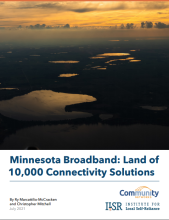
In a new report, the Institute for Local Self-Reliance showcases the diverse range of approaches communities and local Internet Service Providers (ISPs) have taken to expand affordable, high-quality Internet access in Minnesota. It includes a series of case studies that detail how communities are meeting the connectivity challenges of a broken marketplace shaped by large monopoly service providers.
Download Minnesota Broadband: Land of 10,000 Connectivity Solutions [pdf] here.
The profiled projects include municipal networks, public-private partnerships, cooperatives, and private investment. They run from the most rural areas of the state to Minneapolis. Some examples include:
Ry Marcattilio-McCracken, co-author of the report and Senior Researcher with ILSR’s Community Broadband Networks initiative, said of the report’s findings:

Our new report, Minnesota Broadband: Land of 10,000 Connectivity Solutions [pdf], showcases the diverse range of approaches communities and local Internet Service Providers (ISPs) have taken to expand affordable, high-quality Internet access in Minnesota. It includes a series of case studies that detail how communities are meeting the connectivity challenges of a broken marketplace shaped by large monopoly service providers.
The profiled projects include municipal networks, public-private partnerships, cooperatives, and private investment. They run from the most rural areas of the state to Minneapolis. Some examples include:
Ry Marcattilio-McCracken, co-author of the report and Senior Researcher with ILSR’s Community Broadband Networks initiative, said of the report’s findings:
Minnesota communities and local ISPs have found creative and sustainable ways to build future-proof networks across the state, despite a broken marketplace and state barriers that favor slow-moving, out-of-state monopoly providers clinging to outdated technology. Lawmakers must stand up for the cities and towns that sent them to the legislature, and remove the obstacles that prevent a more competitive market and local broadband solutions.
In this episode of the podcast Christopher talks with Jeff O'Neill, City Administrator of Monticello, MN, about FiberNet, which is owned by the city but today operates in a public-private partnership with local telecommunications provider Arvig.
Christopher and Jeff delve into the history and development of the network over the last fifteen years. They discuss how business leaders began calling for the city to look for a solution to poor Internet speeds all the way back in 2005, why the city ultimately decided to build its own network, and how FiberNet persevered in the face of an early lawsuit so that incumbent provider TDS could slow competition as it began its own fiber buildout. Jeff and Chris then talk about the network subsequently weathering a vicious price war with Charter Spectrum which contributed to the fracturing of its relationship with early partner Hiawatha Broadband, but which also brought significant savings and better customer service from incumbent providers to everyone in town.
They end by discussing the multitude of community benefits realized today by having three competing providers in Monticello — two offering Fiber-to-the-Home (FTTH) in the city of 14,000 — and what it means for community savings and economic development for the city moving forward. Jeff ends by sharing some of the work he’s most proud of being involved in and what he sees as important for FiberNet in the years ahead.
We want your feedback and suggestions for the show; please e-mail us or leave a comment below.
This show is 35 minutes long and can be played on this page or via Apple Podcasts or the tool of your choice using this feed.
Transcript below.
We want your feedback and suggestions for the show-please e-mail us or leave a comment below.
Listen to other episodes here or view all episodes in our index. See other podcasts from the Institute for Local Self-Reliance here.
Thanks to Arne Huseby for the music. The song is Warm Duck Shuffle and is licensed under a Creative Commons Attribution (3.0) license.

With their back against the wall, Comcast is pulling out it’s well manicured, sharp claws in Fort Collins, Colorado. Voters will be asked to approve measure 2B on November 7th, which would allow the city to take steps toward establishing their own municipal telecommunications utility. In order to preserve the lack of competition, incumbent Internet access providers are on track to spending more during this election than has been spent on any other issue in Fort Collins’ history.
Behind The Name Of "Citizen"
As we’ve come to see time and again, when a local community like Fort Collins takes steps to invest in the infrastructure they need for economic development, incumbents move in to prevent municipal efforts. Comcast and CenturyLink aren’t offering the types of connectivity that Fort Collins wants to progress, so the city has decided to ask the voters whether or not they feel a publicly owned broadband utility will meet their needs.
 In keeping with the usual modus operandi, out of the woodwork emerge lobbying groups that not-so-artfully mask incumbents like Comcast and CenturyLink. These groups are able to contribute large sums of money to whatever organization has been established, often in the form of a “citizens group,” to bombard local media with misinformation about municipal networks to try to convince voters to vote against the initiative. In Fort Collins, the “citizens group” happens to call itself Priorities of Fort Collins (PFC).
A closer look at who is funding PFC’s website and professional videos takes one to the recently filed campaign report. The City Clerk’s Office has a copy of this document on file and shows that PFC has only three contributors, none of whom are individual “citizens” but are associated with big telecom:

Earlier this spring, Sun Prairie Utilities (SPU) and TDS Telecommunications Corp. signed a letter of intent to transfer ownership of the community’s Fiber-to-the-Home (FTTH) network to TDS. After weighing the pros and cons, the City Council approved the deal by a 4 - 2 vote at an April 11th meeting.
Conversation and Reservations
TDS will pay $2.88 million for the fiber-optic network. The asset has been valued at $2.7 - $2.8 million and the city owes $2.85 million on the network.
The company has agreed to expand the network over the next 30 months and will use customer demand to determine where to deploy new investment. If they don’t begin expansion within 30 months, TDS will pay a $25 per unit penalty to the city.
At least one Alderman felt the penalty was too lenient. “I want this contract to have real consequences if the buildout doesn’t happen like they say it will,” said Mike Jacobs at the April 11th meeting. Jacobs expressed his desire to allow SPU to continue efforts to develop the network, arguing that high-speed Internet access is an essential service like police, fire, and other services the city typically provides. He argued such an asset should not be sold to a company that needs to make profits.
Alder Maureen Crombie also wanted to hold off on approving the transaction. She stated that the Council should wait three weeks to hear residents concerns but other council members disagreed.
Incumbent Charter Communications also opposed the sale, stating that they face unfair competition now because the city will be helping TDS market the FTTH service. Alders responded to Charter’s government affairs manager by reminding him that Sun Prairie had approached the company asking for upgrades but were ignored. They also said that, had Charter offered to purchase the system, Sun Prairie officials would have considered their offer.
Important Details
In Wisconsin, Sun Prairie Utilities (SPU) and TDS Telecommunications Corp. have signed a letter of intent (LOI) for the sale of the city’s municipal network to the Chicago-based telecommunications company. The parties plan on having a final deal hashed out and concluded by the end of March.
TDS Plans For Growth
According to Sun Prairie Mayor Paul Esser, approximately 700 homes are connected to the SPU network, leaving 12,000 households left to be hooked up. TDS has expressed a desire to accelerate the Fiber-to-the-Home (FTTH) expansion, in keeping with its recent growth strategy.
“We plan to expand the network to launch 1 Gigabit broadband speeds, as well as phone service, and our industry leading IPTV solution, TDS TV, to residents,” [Drew Petersen, vice president of external affairs and communications at TDS] said. “For businesses, we would look at providing dedicated fiber connections and our hosted VoIP phone solution, TDS managed IP Hosted.”
TDS has also recently acquired Interlinx Communications and its subsidiary Tonaquint Networks in southern Utah.
Sun Prairie Residents, Businesses Not Happy With Incumbents
About a year ago, we learned that an FTTH pilot project had experienced incredibly high demand: 54 percent of households in the pilot area requested the service. It was a good problem to have, but perhaps the community's leaders got cold feet. The demand for high-quality Internet access is strong in Sun Prairie where residents are fed up with poor service from Charter and Frontier. Enter TDS.
What The Future Holds
Will TDS be able to do a better job? Will TDS maintain the assets or sell out to some other behemoth like Comcast? Time will tell. Whether or not TDS will encourage the current providers to improve services or just offer another poor option to the people of Sun Prairie remains to be seen.

Update: Read an updated version of this report, published in July 2021, here, titled Minnesota Broadband: Land of 10,000 Connectivity Solutions [pdf]. It revisits all of the below communities to see how they fared over the intervening years, while adding new counties, communities, and, for the first time, two local Internet Service Providers.
In our latest report, All Hands On Deck: Minnesota Local Government Models for Expanding Fiber Internet Access, we analyze how local governments in 12 Minnesota communities are expanding 21st century Internet access to their citizens.
In 2010, the Minnesota legislature set a goal for 2015 - universal access to high speed broadband throughout the state. Even though we have the technology to make that vision a reality, large swaths of the state will not meet that goal. Nevertheless, local folks who have chosen to take control of their connectivity are finding a way to exceed expectations, surpassing the choices in many metropolitan regions.
Some of the communities we cover include:
We delved into networks in Anoka, Carver, Cook, Lake, and Scott Counties. The report also shares developments in the municipalities of Chaska, Buffalo, and Monticello. We tell the story of RS Fiber, located in Sibley and part of Renville County. These communities provide examples of municipal networks, a variety of public private partnerships, and "dig once" policies.