Image


Fast, affordable Internet access for all.

Hampton Roads, a metropolitan region bordering the Chesapeake Bay in southeastern Virginia, is known for its 17th century historical sites, shipyards crowded with naval aircraft carriers, and mile-long bridge tunnels. Home to 1.7 million Virginians, Hampton Roads is now looking to broaden avenues for economic development by leveraging existing transatlantic subsea broadband cables to transform the region into a technology-forward digital port. That’s why regional officials recently issued a Request for Proposal (RFP) seeking one or more private partner(s) to construct a regionally-owned 100-mile, open access fiber ring.
Private partners interested in responding to the RFP [pdf] must do so by August 24, 2021. Potential partners can decide to offer some or all of the project functions, choosing to: design, build, finance, operate, and/or maintain the regional fiber ring. (See instructions on how to respond to the RFP, as well as details on the selection process, under Section IV on Page 7.)
Five of the nine cities that make up the region colloquially referred to as “the 757” - Chesapeake, Norfolk, Portsmouth, Suffolk, and Virginia Beach - banded together to improve local fiber connectivity in 2018, forming the Southside Network Authority (the Authority).
According to the Authority's RFP, the project was undertaken to resolve the broadband issues faced by the cities, including:
a need for more and more affordable internal connectivity for governmental operations
equity and affordability concerns in general as compared to similar metropolitan areas
a perceived lack of responsiveness by incumbent providers to the needs of the business community and economic development prospects
a relative lack of broadband infrastructure by comparison to comparable metropolitan areas
and concerns about the security and scalability of existing, privately-owned regional networks
Regional Impacts
For timely updates, follow Christopher Mitchell or MuniNetworks on Twitter and sign up to get the Community Broadband weekly update.
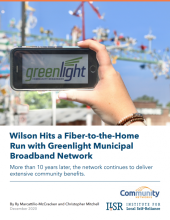
Built in 2008 with an eye toward the future and operated with local priorities in mind, Greenlight has a long track record of putting people first. In a new case study, the Institute for Local Self-Reliance explores the wide-ranging community benefits of Greenlight, the city-owned Fiber-to-the-Home network in Wilson, North Carolina.
Download Wilson Hits a Fiber-to-the-Home Run with Greenlight Municipal Broadband Network.
The case study details how it has been able to quickly adapt and expand service during the pandemic, as well as the host of advantages and overall value brought to the city over the last decade in education, equity, and economic development. For example:
Access for All
Economic Development
Education

As people living in areas plagued by hurricanes deal with increasingly difficult storms this time of year, policy advocates consider the impact of broadband on public safety. In this article shared with us by NC Broadband Matters, author Fiona Morgan reports on connectivity as critical for first responders. She delves into the ways FirstNet and other tools are affecting the conversation and she talks to people who work in emergency situations and understand communication needs during natural disasters.
Fiona's article originally ran on February 21st, 2019, on NC Hearts Gigabit's Our Stories.
Surviving the Storm: Why Broadband Matters for Public Safety
by Fiona Morgan
The water rose faster and higher than anyone had anticipated. Hal Lowder, Jr., recalled watching Hurricane Florence’s impact arrive in Whiteville, where he is the city’s emergency services director. “It was all swamp on Madison Street,” he said. In low-lying areas that might flood two feet in a big storm, water was more than 12 feet high. Even downtown, on Main Street, some areas had eight feet of water. “It was over my head. It was just bizarre.”
The coastal plain of North Carolina was hit hard by the hurricane. The 911 call center was down, and the police and firefighter radio system was inoperable. But there was no loss of life in Whiteville, thanks to the dedication of emergency responders and to the communications systems they had in place.
One of the reforms that came out of the 9-11 Commission was an effort by the federal government to bridge gaps in emergency responder communications. FirstNet is a nationwide public safety broadband network, a service of the federal government provided under exclusive contract with AT&T. Whiteville, seat of Columbus County, was the first city in North Carolina to sign up for FirstNet.
 While it’s not yet available everywhere, FirstNet has become part of the critical information infrastructure of emergency communications. And there’s reason to hope that as it’s built out, it will lead to greater connectivity in parts of the state that currently lack even reliable cellular service.

Last fall, the City Council in Aurora, Illinois, approved a grant to OnLight Aurora to help fund the publicly owned network expansion to more commercial facilities along South River Street. This year, community leaders plan to move north and bring fiber optic infrastructure to RiverEdge Park along the Fox River as they turn the location into a “smart park.”
RiverEdge Park hosts festivals and other events, including summer concerts at it’s pavilion. Public officials want to take advantage of the community’s publicly owned broadband infrastructure for better security and to control parking. The city’s CIO Michael Pegues says that with better parking monitor and control, the city will be able to provide quicker emergency response and more efficient energy use. OnLight Aurora at RiverEdge Park may also generate revenue with kiosks for advertising.
Pegues and other city officials want to continue to grow Aurora’s increasing reputation as a tech-savvy community and to possibly expand the network to serve the nearby communities of Naperville and North Aurora.
“Smart” Attraction
Community leaders, including Pegues and Mayor Richard Irvin, want to cultivate Aurora’s growing reputation as a “smart city.” They’ve already leveraged OnLight Aurora to attract high-tech jobs, such as luring wireless communications company Scientel Solutions from Lombard. Scientel leadership described OnLight Aurora as “a big attraction.” The company will build its new headquarters near CyrusOne, a data center that connects to the fiber network.
The addition of a “smart park” is another creative way to use the publicly owned infrastructure in ways that serve lifestyles of people in the community. Aurora hopes to soon be named a “smart city” by the D.C. Smart Cities Coalition. The Coalition's video describes what characteristics "smart cities" share:

Ammon, Idaho, has received a lot of attention in the past couple of years for their innovative approach to improving local connectivity with a publicly owned fiber optic network. Back in 2015, the city received an award from the National Institute of Justice Ultra-High Speed Apps: Using Current Technology to Improve Criminal Justice Operations Challenge for their “School Emergency Screencast Application”. We covered the award and the application in detail but wanted to share the story once again.
Improving the ability to monitor what’s happening in our kids’ schools is only one factor that can contribute toward making them safer, but every step helps. Ammon’s application uses gunshot detection hardware and a school’s existing camera system. It reports gunshot fire and provides live video and geospatial information to dispatch and first responders.
Hopefully, Ammon first responders will never have to use the application in anything other than a test, but the technology can be shared with other communities and can potentially save lives and reduce injuries by quickly ending any incident. Without their top-notch fiber optic network, Ammon would not have this incredible public safety tool.
Check out this video on Ammon’s School Emergency Screencast Application:
Learn more about Ammon's fiber optic network and their strategy to improve connectivity throughout the community:

Most people associate Pasadena with the annual Tournament of Roses parade and the Rose Bowl football game, but under the flowery surface, fiber is connecting Pasadena’s municipal facilities, businesses, and electric utility substations. Pasadena developed its fiber optic network to improve electric utility efficiency but also with an eye toward the future. When they invested in the infrastructure, community leaders anticipated that economic development would thrive in communities with ample high-quality connectivity.
Lori Sandoval, Telecom and Regulatory Administrator for Pasadena's Department of Information Technology was involved in the development of Pasadena's fiber network from the beginning and she shared the story with us. She also provided some lessons learned so other communities can get the most out of Pasadena's experience.
A Community Of Culture
The community of approximately 140,000 people was one of the first incorporated in what is now Los Angeles County and considered a cultural hub. IN addition to Caltech, Pasadena City College and the ArtCenter College of Design, the Pasadena Playhouse and several museums are there. JPL and Kaiser Permanente are two of its largest employers. Its school system, Pasadena Unified School District, extends beyond the reach of the city. Pasadena has been celebrated for its architecture, especially it 1930s bungalows and many historical estates.
How It All Started
In the mid-1990s, the community included construction of a fiber optic network in its strategic plan. Pasadena Water and Power had been using old copper lines for communications between substations and needed to replace them with something more reliable that also provided more bandwidth. During this same period, the City Manager’s Office was investigating ways to create new revenue and local businesses were finding that they could not obtain the Internet services they needed from incumbent ISPs.

With a growing need for fast, affordable, reliable connectivity, an increasing number of schools are constructing fiber optic infrastructure to serve their facilities. In some cases, they partner with local government and a collaboration eventually leads to better options for an entire community. Schools in Orange County, Virginia, will be working with county government to build a $1.3 million network.
Quickly Growing Community
Orange County’s population of approximately 34,000 people is growing rapidly, having increased by 29 percent between 2000 and 2010. Nevertheless, it’s primarily rural with no large cities. Gordonsville (pop. 1,500) and Orange (pop. 4,800 and the county seat) are the only towns. Another community called Lake of the Woods is a census-designated place where about 7,200 people live. The rest of the county is filled with unincorporated communities. There are 343 square miles in Orange County of rolling hills with the Blue Ridge Mountains to the west.
Manufacturing and retail are large segments of the economy with 65 percent of all business having four or less employees as of 2013. Agriculture is also an important part of the community, including the growing local wine industry.
Working Together To Connect The County
The county and schools have teamed up to commence a multi-step project that begins by connecting the Orange County Public Schools’ facilities. A 33-mile wide area network (WAN) will connect all eight buildings. Federal E-rate funds will pay for approximately 80 percent of the deployment costs and Orange County and the school district will share the remaining costs from other funding. The partners plan to deploy extra capacity for future uses.
Once the first phase of the network is complete, the county hopes to use the excess capacity to improve public safety operations. Sheriff, Fire, and EMS services need better communications so the county intends to invest in additional towers, which will also create an opportunity for fixed wireless and cellular telephone providers.

When Greeneville Light & Power System (GLPS) started bringing better connectivity to the local school system, it improved educational opportunities for kids in the Tennessee community. Now, the municipal utility plans to use the same approach to save lives by connecting emergency responders across the county.
Sparsely Populated
Rural Greene County, Tennessee, can’t attract national providers to invest in high-quality connectivity because it doesn’t have the population density ISPs look for to justify investment. According to GLPS General Manager Bill Carroll, the utility serves an average of 17 or 18 customers per mile. Greene County is approximately 650 square miles. Without a reason to bring better infrastructure to serve residential customers, national ISPs aren’t there to provide services to the police or sheriff facilities either.
GLPS will bring connectivity to Greene County 911, the Greenville Police Department, and the Greene County Sheriff’s Department. Each entity will pay for the construction of the fiber network to their facilities and pay a monthly fee to GLPS. The rate for their connectivity is based on a “per-mile” calculation, which allows GLPS to cover their costs; GLPS charges the school system the same way. Greeneville City Schools are saving approximately $50,000 per year, a significant savings in a town of 15,000 people.
GLPS will not act as an Internet Service Provider, but will allow public safety departments to cut down on expenses by eliminating leased lines. More importantly, the new network will be creating reliable connections. Greenville Police Department Captain Mike Crum said, “This partnership will truly save lives. That is a very difficult aspect to quantify when conducting a cost analysis.”
What The Future Holds
GLPS has no plans to expand their approach to serve residents and businesses throughout the county, but they haven’t ruled it out:
Carroll and his staff are assessing to determine if a project of that magnitude could be feasible and said they will bring that information to the Power Board as it becomes available.
Supervisory control and data acquisition (SCADA) systems allow utility systems to gather and analyze real time data. The computer system reduces outages, keeps the utilities running efficiently, and allows staff to know where problems arise. Municipal utilities that use SCADA systems are increasingly taking the next step - using the fiber-optic infrastructure that supports SCADA to bring better connectivity to town. Clarksville took that route and is now considering ways to become one of the best connected communities in Arkansas.
"I Don't Think We're In Kansas Anymore"
As the seat of Johnson County, Clarksville is located in the northwest area of the state along I-40 and is home to just under 10,000 people living at the foothills of the Ozarks near the Arkansas River. The area is known for its scenery and its tasty peaches and every summer, the county holds a popular Peach Festival. The nearest urban areas are Little Rock, about 90 minutes to the east, and Fort Smith about an hour west.
Large employers in the community include University of the Ozarks, Tyson Foods, Haines, and Baldor, a motor and control manufacturing processor. There’s also a Walmart Distribution Center in Clarksville.
When he began as General Manager of Clarksville Light and Water (CLW) in 2013, John Lester realized that one of the challenges the municipal electric utility faced was that it did not have a SCADA system for managing the electric, water, or wastewater system communications. Even though the Clarksville utility system was well cared for and managed, a SCADA system could push it to the next level in efficiency and services.
Lester had been instrumental in optimizing the use of the fiber-optic network in Chanute, Kansas, which had been developed for the municipal utilities. He understood the critical nature of fiber connectivity to utility efficiency, public savings, and economic development. Over time, the Chanute network had attracted new jobs, opened up educational opportunities for K-12 and college students, and created substantial savings.

Local officials in Columbia County, Georgia, wanted better public safety communications, synchronized traffic signals, and better connectivity for government facilities. They decided the best strategy was a publicly owned network and their decision is creating opportunities they hadn't anticipated.
When he considers how the county expanded its fiber network to improve economic development, education, and public savings, Columbia County Broadband Utility (C3BU) Broadband Manager Lewis Foster still sounds a little surprised. After all, Columbia County planned on using the network for a limited purpose, but then they realized the diversity of the asset. "It was almost an afterthought," he says.
Poor Options Created A Positive Path
Before the idea of a publicly owned network saw the light of day in Columbia County, local leaders contacted the incumbent providers to set up a dark fiber lease. To their dismay, incumbents AT&T, Comcast, and WOW, would not lease the county dark fiber.
County officials approached incumbents in 2007 and 2008 hoping to secure a dark fiber lease. The large providers, however, said they either didn’t have any dark fiber to lease, they could offer lit services, or they would build a dark fiber network for the county to use. Incumbents demanded a model where the county would pay the construction costs but the infrastructure would be owned and operated by the incumbents – who would then charge the County for access to the network the county had paid for. Foster recalls that incumbents we’re most interested in charging premium rates for lit services. Columbia County officials wanted a better option and found a more fiscally responsible approach in simply owning the network.