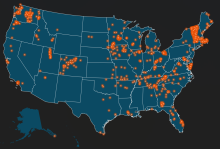

The National Broadband Plan recommended that Congress clarify that State, regional, and local governments should not be restricted from building their own broadband networks. When providers cannot meet the needs of local communities, the Plan provides that State, regional, and local entities should be able to respond accordingly, as they were able to do when municipal governments distributed electricity to thousands of rural communities during the 20th Century.
Seattle Will Take Year to Study Community Fiber Network
After Seattle's new Mayor campaigned on a community fiber network and consulted with both Lafayette and Tacoma on how to build it, it will now spend a year considering its options.
In discussing the current options for broadband in the city, Governing Magazine notes lack of demand for Comcast's "up to" 50/10 EXTREME package:
The demand for this "Extreme" tier speed, however, is "extremely low," says spokesman Steve Kipp. Later this summer, the ISP plans to offer 105 Mbps download and 12 Mbps upload speeds.
I suspect people mostly aren't interested in the extreme price for supposed extreme speeds. A number of communities that have built their own networks offer faster (and symmetrical) connections for considerably less. However, even there most people opt for lower tiers rather than the fastest speeds.
What the article utterly misses is that faster speeds are only one piece of the reason communities build these networks. Yes, next-generation networks offer faster speeds now and have much more capacity for future expansion than cable networks (and DSL is so far behind as to not be comparable).
But public ownership is about more than faster speeds. It spurs competition and lowers prices for everyone. It offers accountability, ensuring the network meets the needs of the community now and in the future. It allows public agencies to get faster connections at lower prices (though Seattle already has this through its previous investments in fiber-optics). As Seattle owns City Light, it would have greater abilities to invest in smart-grid and metering applications to make the city more energy efficient. When the community owns the network, it can ensure everyone has access to fast connections (particularly children in low-income neighborhoods where absentee companies may be reluctant to invest).
But to get back to the argument about network speeds, there is an argument for FTTH and faster speeds even if people do not demand them right now. Until people have access to robust connections, applications will not be created to take advantage of them. When people have access to faster connections that are affordable and symmetric, they are more able to work from home -- but this transition takes time and will not precede the availability of sufficiently robust connections that allow an employee to be as connected to office resources at home as in a cube.
Photo used under creative commons license from flickr.

Comments
Your key point -- municipal
Your key point -- municipal ownership is not about speed -- is important and correct. Yet, the urgency for speed real. Networks take time to build and have an investment duration. For fiber, that duration usually considered to be 20 to 25 years. So what is the likely "speed" expectation in the near to longer term? Historical capacity over the past 30 years suggests that "speed x distance" increases by a factor of 10 every four years.(1) The FCC claims that average speed today is roughly 4Mbps and that would suggest a purchased capacity of around 9Mbps. That in turn would suggest 1Gbps by 2020 and 10Gbps by 2030 for high-end users and perhaps well over 100Mbps for average to low-end users by 2020. We should cross that base need for 100Mbps by 2015 (higher-end). It usually takes private companies about 3 years to marshal a new fiber build. Communities take longer. We need to seriously consider getting beyond legacy, copper-based technologies in the fairly near term if we wish to stay with the world.
1.“Capacity Demand and Technology Challenges for Lightwave Systems in the Next Two Decades”, Emmanuel B. Desurvire, Journal of Lightwave Technology, Vol 24, No 12, December 2006]
Classic mis-direction
This commonly repeated trope that "...no one is buying our 100 megabit Internet access" is used constantly as "proof" that antiquated copper-based broadband networks are perfectly okay. It really obscures two issues. One of them Eric identifies above, and that is that the average bandwidth used by businesses and residents is doubling every two years. And we have fifteen years of hard, quantitative data to back that up...it's not just some imaginary number. The incumbents constantly define demand as whatever the average is today, rather than looking, say, five years out. It's a trick, and a lot of policymakers fall for it.
The second issue is that very few people, in fact, do need 100 megabit INTERNET access. It is another trick to conflate the size/capacity of the pipe with Internet access. Broadband is NOT the Internet. Broadband is a medium (e.g. fiber) capable of delivering many kinds of services, including access to the Internet. The average household today is doing fine with something like 3-5 meg access to the Internet. So the incumbents take a true statement and twist it to "prove" that 100 meg pipes are un-necessary. Few people want or need a 100 meg fiber connection to surf the Internet. They may want it because they are a radiologist and want to read MRIs from home on weekends. They may want to run a business and need to do HD videoconferencing. They may want to subscribe to a data backup service that can restore a hard drive in less than three weeks (true story). They may want it to access telehealth and telemedicine resources.
Community broadband projects are looking far beyond the tired old triple play of voice, video, and Internet access. Community broadband project see broadband as the road, not as the truck carrying Internet access. The broadband road will enable new jobs and business opportunities. Affordable, high performance broadband is an issue of economic and community survival.
Post new comment